
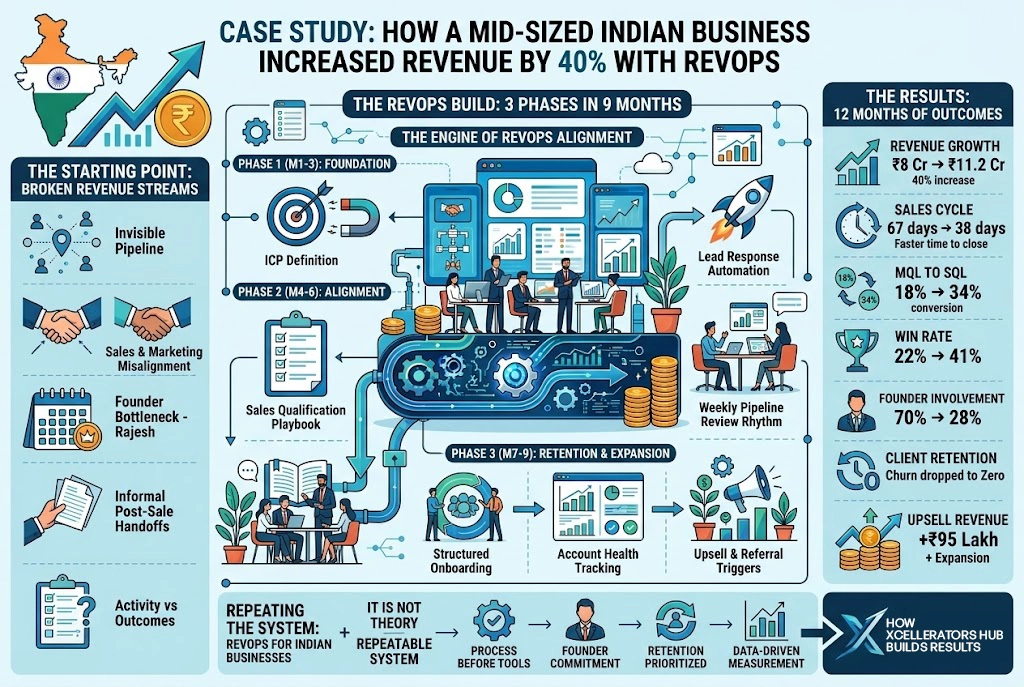
A RevOps Case Study India's Founders and Operators Need to Read
RevOps case study India content is rare. Most case studies come from US SaaS companies with large teams and big budgets. However, the revenue operations model works just as powerfully — often more so — for Indian mid-sized businesses with lean teams and tight margins.
This blog covers two things. First, a real Indian company that achieved significant revenue growth through sales and CRM alignment. Second, a detailed composite case study of a mid-sized Indian manufacturing business — called Aarna Components — that grew revenue by 40% in 12 months of implementing RevOps.
Together, they show that this is not theory. It is a repeatable, practical system — and Indian businesses are already using it.
Real-World Reference: Brigade Plus and the Power of Sales Alignment in India
Before diving into the detailed walkthrough, it helps to ground this revenue growth case study Indian business owners can relate to in something real.
Brigade Plus is the interior solutions division of Brigade Group — one of India's most established property developers. They operate as one of the largest full-service interior stores in the Indian real estate market. Their challenge was a familiar one. Sales data sat in separate systems. Decision-making relied on gut feel. Teams had no shared view of the customer journey.
Therefore, Brigade Plus implemented Zoho CRM to align their sales operations. They built over 40 interactive dashboards that gave leadership real-time pipeline visibility. As a result, they reshaped their sales strategies around live data. Over two years, they achieved 4x ROI.
Ponappa PM, Head of Brigade Plus, confirmed that Zoho CRM helped them "achieve 4x ROI in just two years" by enabling a 360-degree view of customers and operations.
This is what RevOps case study India examples consistently show. However, most mid-sized Indian businesses do not know how to get there. That is what the Aarna Components walkthrough below shows in detail.
The Starting Point: What Was Broken at Aarna Components
Aarna Components is a Delhi-NCR based B2B manufacturer supplying industrial parts across three states. Their team had 45 employees, a six-person sales team, and annual revenue of approximately ₹8 crore before the RevOps work began.
On the surface, the business looked solid. However, growth had stalled for two years. A full revenue audit revealed exactly why.
The pipeline was invisible. The sales team tracked leads across WhatsApp, personal email, and a CRM holding less than 30% of real opportunities. Therefore, nobody — including founder Rajesh — knew what was actually in the pipeline at any time.
Marketing and sales were misaligned. The marketing team generated leads from trade shows and referrals. However, they had no shared lead definition with sales. As a result, sales rejected a large portion of marketing leads — and marketing had no idea why.
The founder closed everything. Rajesh personally handled 70% of all deals. Any deal above ₹5 lakh required him directly. Therefore, deal velocity was capped by one person's calendar.
Post-sale was entirely informal. Once a client signed, the relationship moved to operations through a verbal briefing. No documentation. No onboarding process. No check-in rhythm. As a result, three top-ten clients had quietly reduced order volumes — and the team only noticed when invoices came in lower.
Metrics tracked activity, not outcomes. Weekly reviews tracked calls made and quotes sent. However, nobody measured conversion rates, sales cycle length, or win/loss ratios. Therefore, the team had no way to know whether things were improving.
The RevOps Diagnosis: Four Specific Revenue Leaks in This RevOps Case Study India
The audit revealed four leaks. Each had a direct, measurable revenue cost.
Leak 1 — Low MQL to SQL Conversion Rate
Of every 100 leads, only 18 became Sales Qualified Leads. Marketing and sales had never defined a shared Ideal Customer Profile. As a result, marketing generated leads from anyone who showed interest — regardless of fit. Therefore, the sales team wasted time on prospects that were never going to buy.
Leak 2 — Long and Inconsistent Sales Cycle
The average deal took 67 days to close. However, some deals closed in 20 days while others dragged past 120. When the team mapped fast deals against slow ones, the pattern was clear. Fast deals had early budget confirmation, a clear decision-maker, and structured follow-up. Slow deals had none of these. However, the sales team had no formal way to separate them upfront. Therefore, they spent equal time on both types.
Leak 3 — Significant Post-Sale Revenue Loss
Three key accounts had reduced order volumes by a combined ₹60 lakh in the previous year. The team discovered this only when invoices came in lower. The root cause was simple — clients were delivered to, but never actively managed. As a result, when clients found alternatives, they moved away quietly rather than raising the problem.
Leak 4 — Founder Bottleneck Capping Deal Velocity
With Rajesh involved in 70% of deals, the pipeline moved at the pace of his calendar. In a typical month, he could support six to eight deals actively. The other 15 to 20 deals sat waiting. Some went cold. Others were won by competitors who responded faster. In contrast to what Rajesh believed, this was a system problem — not a people problem.
The RevOps Build: Three Phases Over Nine Months
Phase 1 — Months 1 to 3: Foundation
ICP definition and lead qualification. Marketing and sales sat together for the first time and built a shared Ideal Customer Profile. It defined company size, industry, geography, order volume range, and decision-maker type. From that point, only ICP-matching leads entered the pipeline. Lead volume dropped 30%. However, lead quality improved significantly as a result.
CRM rebuild. The CRM got restructured around five clear pipeline stages — each with defined entry criteria, exit criteria, and an owner. Every salesperson received training on what to log and when. As a result, CRM adoption jumped from 30% to 85% within six weeks.
Lead response automation. Every new enquiry triggered an automatic acknowledgement within 10 minutes. It also created a task for the responsible salesperson to call within two hours. Before this change, average lead response time was 28 hours. After, it dropped below 2 hours.
Phase 2 — Months 4 to 6: Alignment
Sales qualification playbook. The team built a five-question framework for every first call. Budget confirmed. Timeline established. Decision-maker identified. Competing options understood. Specific pain point clarified. Deals failing three or more criteria moved to a lower-priority track.
As a result, the sales team stopped spending equal time on every lead. They focused energy only on qualified opportunities. Therefore, the average sales cycle dropped from 67 days to 41 days within three months of rollout.
Sales enablement library. The team wrote down Rajesh's approach to objections, pricing, and closing. This became a playbook every salesperson could follow. In contrast to before, the team could now handle deals that previously required his direct input. His involvement dropped from 70% to 35% by the end of Phase 2.
Weekly pipeline review rhythm. The team introduced a 30-minute weekly review focused entirely on deal movement. Every deal got checked against its current stage, close date, and next required action. Deals stuck at the same stage for more than two weeks got flagged straight away. As a result, the team stopped losing deals to inaction.
Phase 3 — Months 7 to 9: Retention and Expansion
Structured onboarding process. Every new client entered a defined onboarding journey. The sales handoff included a written brief — what was promised, what the client's goals were, and what risks existed. Operations received this brief before first delivery. Therefore, client expectations were set correctly from day one.
Account health tracking. Each account received a quarterly check-in. Order volume trends got tracked monthly. Any account showing a decline triggered an immediate call from the account owner. Because of this, two of the three at-risk accounts recovered their full order volumes within six months. The third churned — however, the team caught it early enough to replace that revenue before it hit the annual target.
Upsell and referral triggers. At the 90-day mark for every client, the account owner received a prompt to check upsell readiness. At 180 days, a referral conversation trigger fired. These were not automated messages. Instead, they were triggered tasks for timely human conversations at the right moment.
As a result, upsell revenue from existing clients grew by ₹95 lakh in the second half of the year. Three new clients also came through structured referral conversations — something that had previously happened only by accident.
The Results: 12 Months of This RevOps Case Study India
The numbers told a clear story at year end.
Revenue growth: Annual revenue grew from ₹8 crore to ₹11.2 crore — a 40% increase year on year.
Sales cycle: Average deal length dropped from 67 days to 38 days by month 12.
Lead conversion: MQL to SQL conversion improved from 18% to 34%.
Win rate: Overall win rate on qualified deals improved from 22% to 41%.
Founder involvement: Rajesh's direct involvement dropped from 70% to 28%.
Client retention: Churn dropped from three lost accounts to zero in the second half of the year.
Upsell revenue: Existing client expansion added ₹95 lakh in new revenue.
However, the most important outcome was not in the numbers. Aarna Components was no longer a founder-dependent business. The sales team could generate, qualify, and close deals without Rajesh in the room. The pipeline was visible. Decisions were data-driven. For the first time, Rajesh could focus on strategy — rather than being the fallback on every deal.
What Made This RevOps Case Study India Work
Not every RevOps implementation produces these results. The ones that do tend to share clear traits.
The audit came first. The team spent four weeks mapping where revenue was leaking — and why. Therefore, every solution fixed a real, documented problem rather than a guessed one.
The founder stepped back on purpose. Rajesh chose to trust the system. He followed the pipeline review rhythm. He resisted jumping into deals. As a result, the system had space to prove itself without being bypassed.
Process came before tools. The CRM rebuild happened only after pipeline stages and qualification criteria were clearly defined. In contrast to what most businesses do, the tool reflected the process — not the other way around.
Retention got equal priority to acquisition. Churn and upsell metrics got tracked from month one. Because of this, existing client revenue became a strong growth driver alongside new business.
Measurement ran from day one. Every change had a metric attached — lead response time, conversion rate by stage, sales cycle length, win rate. Reviews happened weekly. Therefore, problems surfaced fast and fixes happened before they became expensive.
Common Mistakes That Would Have Derailed This RevOps Case Study India
Mistake 1 — Starting with the Tool Instead of the Process
Buying a new CRM on day one would have created a digital version of the same broken process. The audit and process design had to come first. Otherwise, the tool just automates the chaos — faster and more expensively.
Mistake 2 — Trying to Fix Everything at Once
The phased approach was critical here. Phase 1 fixed the foundation. Phase 2 built alignment. Phase 3 extended into retention. Trying all three at once would have overwhelmed the team. As a result, nothing would have been implemented well.
Mistake 3 — Ignoring the Post-Sale Revenue
The ₹60 lakh in lost account value was the most immediate recovery opportunity in the business. However, it was completely invisible before the audit. Therefore, ignoring retention while focusing only on acquisition would have left significant revenue untouched.
Mistake 4 — Not Getting Founder Buy-In
RevOps only works when the founder commits to the system. If Rajesh had continued jumping into every deal, the sales team would never have built the confidence to close independently. Therefore, founder commitment is non-negotiable — not optional.
How Xcellerators Hub Builds Results Like This RevOps Case Study India
At Xcellerators Hub, this kind of revenue growth is not accidental. Their RevOps case study India results come from a structured diagnostic, a phased build, and a consistent measurement rhythm — applied to each business's specific context.
Their work with Indian SMEs follows the same pattern that produced results for Aarna Components. Start with the audit. Fix the foundation. Build alignment. Then extend into retention and expansion.
For Indian mid-sized businesses that have hit a growth ceiling despite a capable team and real market demand — this approach consistently reveals that the ceiling is a system problem. Not a people problem. Not a market problem. A system problem.
"The System Was Already There. It Just Needed to Be Built."
Key Takeaways
- Start with a full revenue audit to find the real leaks
- Define ICP and qualification criteria before scaling leads
- Build systems before adding headcount
- Give retention equal priority to acquisition
- Founder must commit to stepping back from daily execution
Want Results Like This For Your Business?
Our RXF System delivers measurable revenue growth for Indian mid-sized businesses through practical RevOps implementation.
Book a Coffee Call