
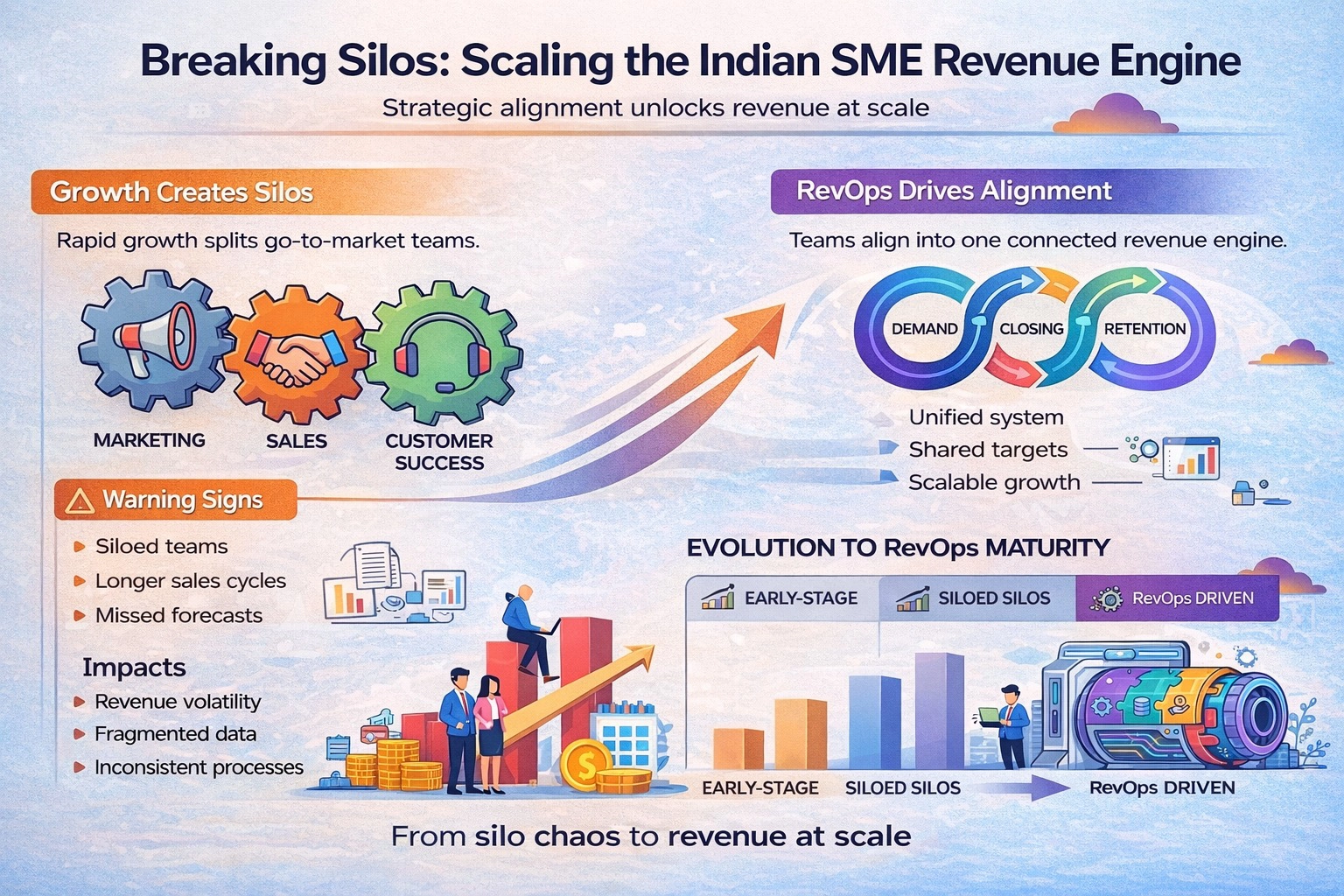
Breaking silos in Indian SMEs is no longer a theoretical organisational challenge or a cultural talking point. Instead, it has become a direct constraint on revenue predictability, customer experience, and scalable growth. As Indian SMEs move from founder-led execution to growth-stage operations, misalignment across revenue teams quietly erodes efficiency, visibility, and control.
In the earliest phase of an SME’s journey, silos rarely exist. Founders remain deeply involved across sales, marketing, and customer delivery. As a result, feedback loops are short and direct. Decisions are contextual rather than procedural. Sales conversations influence marketing messaging in real time, while customer feedback reaches leadership without delay or distortion. At this stage, coordination is informal, yet highly effective.
However, this equilibrium does not survive scale.
As teams grow, functions begin to specialise. Marketing shifts its focus toward demand generation, channel performance, and pipeline volume. Meanwhile, sales introduces structured pipelines, quotas, and forecasting discipline. Customer success then emerges as a dedicated function, responsible for onboarding, renewals, retention, and ongoing value delivery. Individually, each function optimises for its own objectives, tools, and metrics. Over time, what once operated as a single revenue engine starts to fragment into disconnected parts.
As a result, revenue becomes harder to forecast. Customer experiences lose consistency. Leadership spends more time resolving internal friction and less time shaping long-term strategy.
Importantly, this breakdown does not happen because teams lose intent, discipline, or competence. Instead, it occurs because organisational complexity increases faster than structural design evolves. This is why breaking silos in Indian SMEs requires more than better communication or stronger execution. It requires a structural solution that aligns how revenue is generated across the organisation.
The Scale Inflection Point Where Informal Alignment Breaks
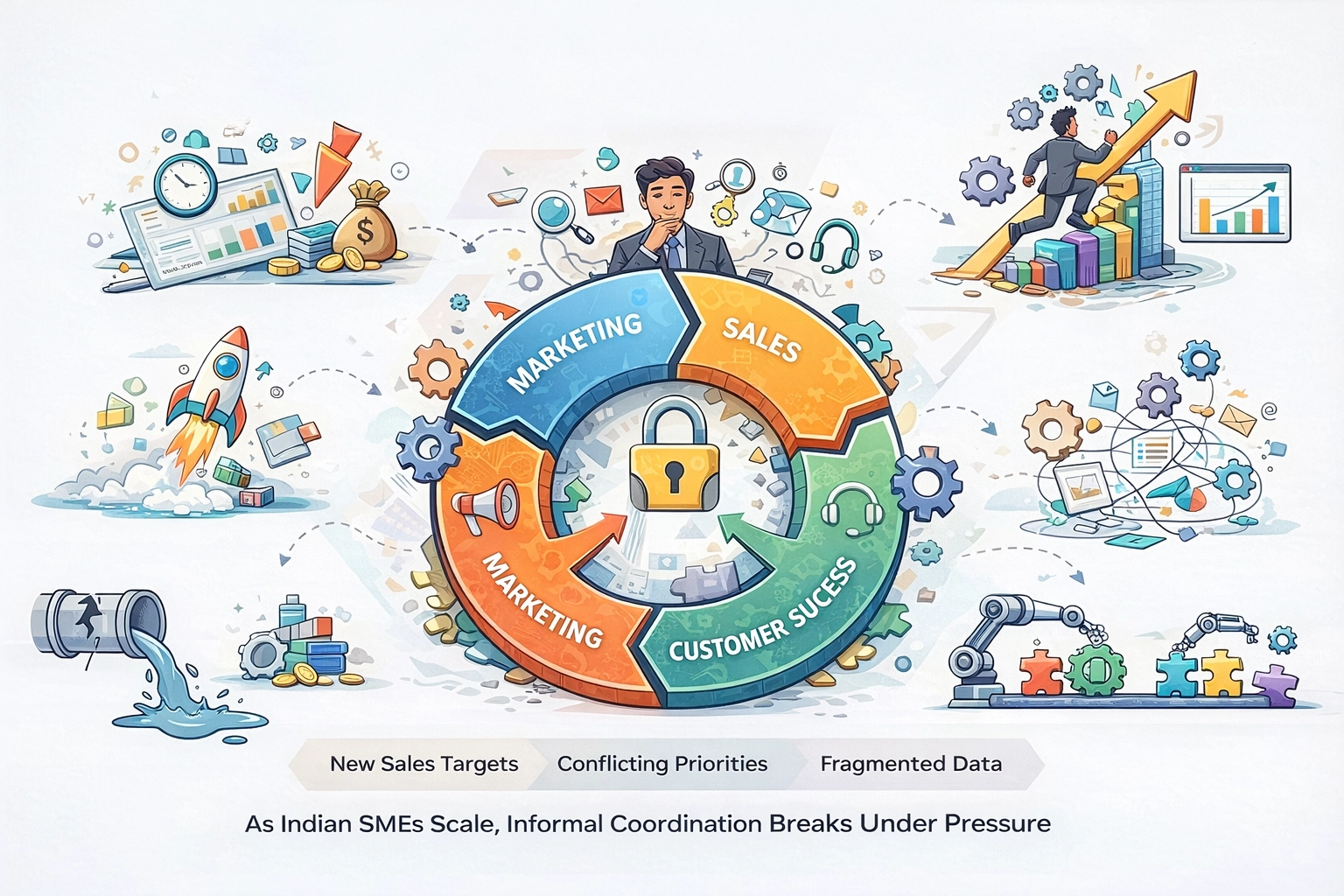
Every growing SME reaches an inflection point where informal coordination begins to fail. Initially, this shift is subtle. Founders are still involved, but not everywhere. Teams are still small, but no longer sitting in the same room. Decisions are still fast, but context is no longer shared evenly.
Over time, cracks begin to appear.
Marketing operates with limited visibility into which leads convert well. Sales closes deals based on assumptions that customer success later struggles to fulfil. Customer success uncovers recurring issues that never fully make their way back into acquisition or positioning decisions. Each team continues to perform its role competently. However, shared understanding begins to fade.
At this stage, organisations often misdiagnose the problem. They attribute friction to communication gaps, skill shortages, or accountability issues. As a result, they add more meetings, more tools, or more people. Activity increases, but alignment does not.
This is the moment when breaking silos in Indian SMEs becomes a structural necessity rather than an organisational preference. Growth has introduced distance, volume, and specialisation. Yet the revenue system has not been redesigned to accommodate these changes.
Without an intentional operating framework, coordination becomes dependent on individual effort and constant intervention. Alignment works only when specific people are present, informed, and available. As scale increases, this dependency becomes fragile and unsustainable.
It is at this inflection point that RevOps alignment across sales, marketing, and customer success becomes essential. RevOps replaces person-dependent coordination with system-led alignment. Instead of relying on intuition and proximity, it designs how revenue flows across the organisation. This shift allows Indian SMEs to continue scaling without sacrificing predictability, visibility, or control.
Why Breaking Silos in Indian SMEs Is Uniquely Challenging
Breaking silos in Indian SMEs requires an honest look at the operating realities that shape how these organisations grow. Unlike large enterprises, Indian SMEs scale under constraints that make informal coordination effective early on, but fragile over time. As growth accelerates, the same conditions that once enabled speed begin to introduce friction.
Structural Constraints That Shape Indian SMEs
Indian SMEs are built for capital efficiency. Teams stay lean longer than ideal. Founders continue to carry operational responsibility across multiple functions. As a result, speed and adaptability are prioritised over documentation, formal processes, or governance structures.
In the early stages, this environment creates agility.
Sales shares customer insight directly with marketing. Customer issues surface instantly. Decisions happen quickly because context lives in people’s heads rather than in systems. Instead of formal handoffs, coordination relies on proximity, intuition, and constant founder involvement. For a time, this works exceptionally well.
However, growth fundamentally alters this environment.
As headcount increases, direct access to context begins to disappear. Founders can no longer sit in every meeting or review every decision. Meanwhile, teams start operating at a pace and volume that informal coordination cannot sustain. What once felt efficient gradually becomes opaque.
This shift explains why breaking silos in Indian SMEs is not about fixing behaviour. It is about redesigning structure to match scale.
How Functional Success Gradually Creates Systemic Failure
As Indian SMEs grow, functions scale at different speeds and with different priorities. Typically, marketing expands first. It focuses on channels, campaigns, and lead volume to fuel growth. Sales scales next, introducing territories, pipeline stages, quotas, and forecasting discipline. Customer success then emerges as a dedicated function, often responsible for onboarding, delivery, renewals, and ongoing support at the same time.
Individually, each team optimises rationally within its own scope.
However, over time, these local optimisations reduce shared context. Marketing measures success by lead volume and cost efficiency. Sales focuses on deal velocity and closure. Customer success measures retention and delivery outcomes. Each team becomes effective within its own domain, yet disconnected from the full revenue lifecycle.
As a result, information fragments. Assumptions replace insight. Coordination shifts from being intentional to being accidental. Teams continue to collaborate, but without a shared operating framework, alignment depends on individual effort rather than system design.
This is how silos form in practice. Not because collaboration stops, but because coordination is no longer engineered.
Breaking silos in Indian SMEs therefore requires addressing structural design rather than cultural intent. Without a unifying revenue system, even well-run teams with strong leadership and good execution will struggle to scale predictably.
The Hidden Cost of Misalignment Across Revenue Teams
Misalignment across sales, marketing, and customer success rarely leads to immediate or visible failure. Instead, it introduces small inefficiencies that compound quietly over time. Early on, results may still look healthy. Pipelines remain active. Deals continue to close. However, beneath the surface, coordination begins to weaken.
How Partial Visibility Distorts Decision-Making
Each revenue function operates with a limited view of the customer lifecycle.
Marketing primarily sees top-of-funnel metrics such as traffic, lead volume, and campaign performance. Sales, meanwhile, focuses on pipeline progression, deal velocity, and closures. Customer success operates further downstream, tracking onboarding outcomes, renewals, retention, and churn.
Individually, these views are accurate. Collectively, they are incomplete.
Because no single team owns the full revenue lifecycle from first interaction to long-term value creation, decisions are made in isolation. Marketing may generate high lead volumes that sales struggles to qualify or prioritise. Sales may close deals based on expectations that customer success cannot realistically fulfil. Meanwhile, churn may rise without clear insight into whether the root cause lies in acquisition quality, positioning, onboarding, or post-sale engagement.
As a result, teams act on symptoms rather than causes.
How Misalignment Compounds Over Time
Over time, these gaps begin to reinforce one another.
Marketing responds to weak conversion by increasing lead volume. Sales reacts to pressure by accelerating deal cycles or lowering qualification standards. Customer success, in turn, inherits customers whose expectations are misaligned with delivery reality. Each function works harder within its own domain, yet overall performance becomes less stable.
Revenue volatility increases even when teams execute competently.
Instead of being treated as system-level signals, problems are framed as local execution failures. Teams optimise further within their own silos, while leadership spends more time firefighting and less time addressing structural issues. Forecasts miss targets. Customer experience becomes inconsistent. Trust in data erodes.
This compounding effect explains why breaking silos in Indian SMEs cannot be achieved through better communication or more frequent alignment meetings alone. Without a unifying revenue system, coordination depends on individual effort rather than design.
To restore predictability and control, Indian SMEs require a revenue operating model that aligns decisions across the entire lifecycle. This is precisely the role that RevOps alignment across sales, marketing, and customer success is designed to fulfil.
Why Traditional Fixes Fail to Break Silos
When silos become visible, most organisations respond with familiar and well-intentioned fixes. They increase meeting frequency to improve communication. They introduce new tools to gain visibility. They hire additional people to handle operational strain.
At first, these actions feel productive. Activity increases. Calendars fill up. Dashboards multiply. However, alignment does not improve.
Why Activity Increases While Alignment Declines
Meetings create discussion, but they rarely create shared accountability. Teams leave with different interpretations of the same conversation. Meanwhile, new tools generate more data, but without shared definitions, that data creates confusion rather than clarity. Each function builds its own reports, metrics, and views of success.
Hiring follows a similar pattern. Additional headcount increases throughput within individual teams, yet coordination gaps remain unresolved. Over time, more people are required to manage handoffs, resolve misunderstandings, and reconcile conflicting priorities. Instead of reducing friction, complexity increases.
As a result, silos become more entrenched.
Breaking silos in Indian SMEs therefore cannot be achieved by increasing motion within existing structures. It requires redesigning how decisions flow across teams. Without intentional design, every new meeting, tool, or hire simply adds another layer to an already fragmented system.
The Difference Between Functional Optimisation and System Design
This distinction explains why functional optimisation often feels effective while systemic improvement remains elusive. Improving parts of the organisation is tangible. Teams can move faster, close more deals, or generate more leads within their own domains.
However, revenue does not emerge from isolated functions. It emerges from how those functions interact.
Designing systems requires a different lens. It shifts focus away from individual performance and toward the connections between teams. It asks not how marketing, sales, or customer success can work harder, but how their decisions influence one another across the revenue lifecycle.
Revenue Operations exists to provide this system-level lens. By redesigning workflows, metrics, and accountability across sales, marketing, and customer success, RevOps addresses the root cause of silos rather than their symptoms. This is why it becomes essential for breaking silos in Indian SMEs as complexity increases.
Revenue as a System, Not a Departmental Outcome
Revenue does not come from one department alone. Instead, it is created through a connected series of decisions. These decisions span the full customer journey, from the first interaction to long-term retention and growth.
Because each step affects the next, revenue behaves like a system. When one part changes, the impact carries forward. This is why breaking silos in Indian SMEs requires looking beyond individual teams and metrics.
Revenue Is a Chain of Inherited Decisions
Every revenue outcome is shaped by earlier choices.
Marketing decides who enters the funnel and what message attracts them. Sales builds on that message through pricing, positioning, and commitments. Customer success then works within those expectations to drive adoption, retention, and expansion.
Each stage inherits what came before it.
For example, a marketing promise influences how sales presents the offering. A sales commitment affects how complex onboarding becomes. In turn, the onboarding experience plays a major role in whether customers stay or leave. Even small decisions made early can create large effects later.
Because of this, revenue issues rarely start where they become visible. They often begin upstream, long before they appear in conversion rates, churn reports, or forecasts.
Why Fragmented Ownership Makes Revenue Unstable
When no single system governs the full revenue journey, misalignment becomes inevitable.
Marketing may improve efficiency, while sales conversion declines. Sales may increase deal velocity, while churn quietly rises. Customer success may retain customers, yet have little influence over lead quality or deal expectations. Each team appears to perform well on its own metrics.
However, because decisions are made in isolation, gaps form between stages. Over time, these gaps reduce forecast accuracy, weaken customer experience, and increase revenue volatility.
As a result, leadership responds to outcomes without clear visibility into their causes.
This is why breaking silos in Indian SMEs requires reframing revenue as a shared system rather than a set of departmental scorecards. When teams optimise only their own targets, instability grows. When teams align around the full lifecycle, performance becomes more predictable.
This shift in perspective creates the foundation for RevOps alignment across sales, marketing, and customer success. Instead of improving parts in isolation, organisations improve how decisions connect. That is what turns effort into consistent, scalable revenue.
How RevOps Alignment Breaks Silos in Indian SMEs
Revenue Operations, often called RevOps, closes the gaps that form as teams scale. Instead of focusing on how each team performs on its own, RevOps looks at how sales, marketing, and customer success work together as one system.
This shift is critical for breaking silos in Indian SMEs. As complexity grows, coordination must be designed. It cannot be left to habit or individual effort.
RevOps alignment across sales, marketing, and customer success is built on a few shared foundations. These foundations remove confusion and make collaboration predictable.
Shared Definitions Across the Revenue Lifecycle
RevOps begins by creating shared definitions.
Leads, opportunities, customers, and revenue mean the same thing to every team. Marketing, sales, and customer success all work from the same understanding.
As a result, ambiguity is reduced. Friction decreases. Downstream teams no longer inherit confusion created upstream. Decisions become clearer because everyone is using the same language.
This clarity is a core requirement for breaking silos in Indian SMEs.
Designed Handoffs Instead of Assumptions
RevOps replaces assumptions with clear handoffs.
Leads move to sales only when agreed qualification criteria are met. Deals move to customer success only when expectations, scope, and commitments are documented. Progress is based on readiness, not urgency.
Because of this, context is preserved as work moves forward. Accountability is clearer. Teams know what they are receiving and what is expected next.
Over time, fewer issues fall through the cracks.
Metrics Aligned to Outcomes, Not Activity
RevOps also changes how success is measured.
Instead of tracking only local activity, teams align around shared outcomes. Conversion quality, deal velocity, retention, and expansion become common goals. These metrics reflect system health, not just individual effort.
As a result, teams optimise for what matters across the full lifecycle. Success in one stage no longer creates problems in another.
This alignment is essential for breaking silos in Indian SMEs where local optimisation often hides system-wide issues.
Consistent Data Across Revenue Tools
RevOps ensures that data flows cleanly across tools.
CRM systems, marketing platforms, and customer success tools reflect the same lifecycle stages and definitions. Reports connect actions to outcomes instead of showing isolated snapshots.
Because of this, leadership gains visibility into cause and effect. Decisions improve. Forecasts stabilise.
RevOps does not centralise control.
Instead, it centralises coherence.
This coherence is what allows Indian SMEs to scale revenue without adding friction, bureaucracy, or constant intervention. It is how breaking silos becomes a built-in outcome of the system, not an ongoing struggle.
A Revenue Operations Framework for Breaking Silos
Breaking silos in Indian SMEs requires more than intent or collaboration. It requires a clear operating framework. Revenue Operations provides this framework by aligning how teams work, measure success, and make decisions.
At its core, a revenue operations framework addresses silos through three connected layers. Each layer supports the others. When one is missing, alignment weakens.
Process Alignment Across Teams
RevOps begins with process alignment.
Processes are designed to span teams, not stop at departmental boundaries. Lead qualification aligns with actual sales capacity. Deal stages reflect delivery and onboarding realities. Renewal and expansion insights flow back into marketing and positioning decisions.
Because of this, work moves forward with fewer handoffs and less rework. Delays caused by confusion or missing context are reduced. Over time, cycle times shorten and execution becomes more predictable.
Process alignment removes friction before it appears. This is a key step in breaking silos in Indian SMEs.
Data Alignment Around the Revenue Lifecycle
RevOps also aligns data.
A single source of truth is created for revenue information. Metrics reflect how customers progress through the lifecycle, not just what each team produces. Dashboards show how actions in one stage affect outcomes in the next.
As a result, teams gain shared visibility. Leadership can spot issues early instead of reacting after problems escalate. Decisions shift from instinct-based to insight-led.
This data clarity replaces firefighting with proactive management.
Incentive Alignment That Reinforces Shared Outcomes
Finally, RevOps aligns incentives.
Targets are designed around shared revenue outcomes rather than isolated goals. Incentives discourage behaviour that helps one stage while hurting another. Teams succeed together, or they miss together.
Because incentives shape behaviour, this alignment drives real change. Teams begin to think beyond their own targets and consider the full customer journey.
When incentives support the system, coordination becomes natural.
Together, process alignment, data alignment, and incentive alignment create a revenue operations framework that scales with growth. These layers work as one. They allow breaking silos in Indian SMEs without adding heavy process or slowing execution.
Instead of relying on constant coordination, alignment becomes built into how the organisation operates every day.
Why RevOps Fits the Indian SME Operating Reality
Indian SMEs need structure, but they cannot afford rigidity. Growth must remain capital-efficient. Teams usually operate with limited headcount. Founders also stay closely involved in daily operations far longer than they would in large enterprises.
In this environment, heavy process does not create stability. Instead, it creates resistance.
RevOps fits the Indian SME operating reality because it introduces structure at the system level, not at the individual level. Rather than adding approvals, documentation, or extra layers of control, RevOps removes ambiguity. It clarifies how revenue is generated, measured, and managed across the organisation.
When roles are clear, handoffs are defined, and metrics are shared, teams move faster. Fewer decisions get stuck. Less time is spent resolving confusion. Execution becomes smoother.
This efficiency is critical for breaking silos in Indian SMEs, where misalignment becomes costly very quickly.
RevOps Consulting, Implementation, and Optimisation
Many Indian SMEs adopt RevOps through structured RevOps consulting. This usually happens when leadership realises that revenue challenges are not isolated execution problems. Instead, they are structural issues.
RevOps consulting focuses on diagnosis. It examines workflows, data models, metrics, and decision ownership across sales, marketing, and customer success. The goal is to identify where alignment breaks down and why.
Once gaps are clear, RevOps implementation services turn strategy into action. This includes redefining lifecycle stages, aligning CRM structures, standardising metrics, and designing clear handoffs. Importantly, this work is done without disrupting daily operations.
As businesses continue to grow, RevOps optimisation services help systems evolve. Products change. Markets shift. Teams expand. RevOps ensures the revenue system adapts instead of breaking under added complexity.
RevOps is not a one-time project. It is an operating discipline that matures as the organisation scales.
RevOps for SMEs vs RevOps for Growth-Stage Companies
RevOps for SMEs focuses on clarity first.
At this stage, the goal is stability, not sophistication. Effective RevOps for SMEs prioritises:
- Lightweight, repeatable processes
- Clear ownership across lifecycle stages
- Actionable metrics tied to decisions
- Foundations that can scale over time
RevOps for growth-stage companies builds on this base. It introduces stronger forecasting, deeper segmentation, and more deliberate expansion strategies. However, these additions work only when the foundation is already stable.
In India, this transition is increasingly supported by specialised revenue operations services. These services help organisations move from founder-led coordination to system-led execution without losing speed or agility.
Early Warning Signs That Silos Are Undermining Revenue
Breaking silos in Indian SMEs often starts with noticing the symptoms.
Common warning signs include:
- Inconsistent lead conversion despite strong demand
- Sales cycles that keep getting longer without a clear reason
- Customer churn rising unexpectedly
- Forecasts missing targets repeatedly
- Teams blaming outcomes on one another
These signals point to coordination failure, not weak execution. When they appear, alignment issues are already affecting revenue.
Final Perspective: Breaking Silos in Indian SMEs Starts With Alignment
Breaking silos in Indian SMEs is not about forcing collaboration or adding management layers. It is about designing revenue systems where alignment is built into daily operations.
When alignment depends on people alone, it remains fragile. As scale introduces distance, volume, and specialisation, that fragility becomes visible.
RevOps addresses this problem at its root.
By redesigning how revenue flows across sales, marketing, and customer success, RevOps creates a shared operating framework. Definitions align. Handoffs become clear. Metrics stay consistent. Data connects decisions across the lifecycle.
As a result, execution speeds up. Ambiguity drops. Predictability improves.
For Indian SMEs, this structural upgrade often determines whether growth becomes a lasting advantage or an ongoing strain. Organisations that adopt RevOps early turn complexity into clarity and scale with confidence.
This approach reflects how Xcellerators Hub views Revenue Operations—not as a set of tools, but as a foundational system that turns fragmented effort into coordinated execution and predictable revenue outcomes.
"RevOps isn't about adding more people or tools—it's about making sure the people and tools you already have are pulling in the same direction, especially when capital is tight and every rupee counts."
Key Takeaways
- Silos emerge naturally as Indian SMEs scale — informal coordination fails first.
- Functional success often creates systemic failure without alignment.
- RevOps replaces assumptions with shared definitions, handoffs, metrics, and data.
- Alignment is structural, not cultural — it fits lean SME realities.
- Adopt early: when forecasts wobble or blame increases, silos are already costing revenue.
Are Silos Slowing Your Revenue Growth?
Our RXF System helps Indian SMEs break silos and build aligned RevOps foundations that scale efficiently. Let's diagnose your revenue lifecycle today.
Book a Coffee Call