
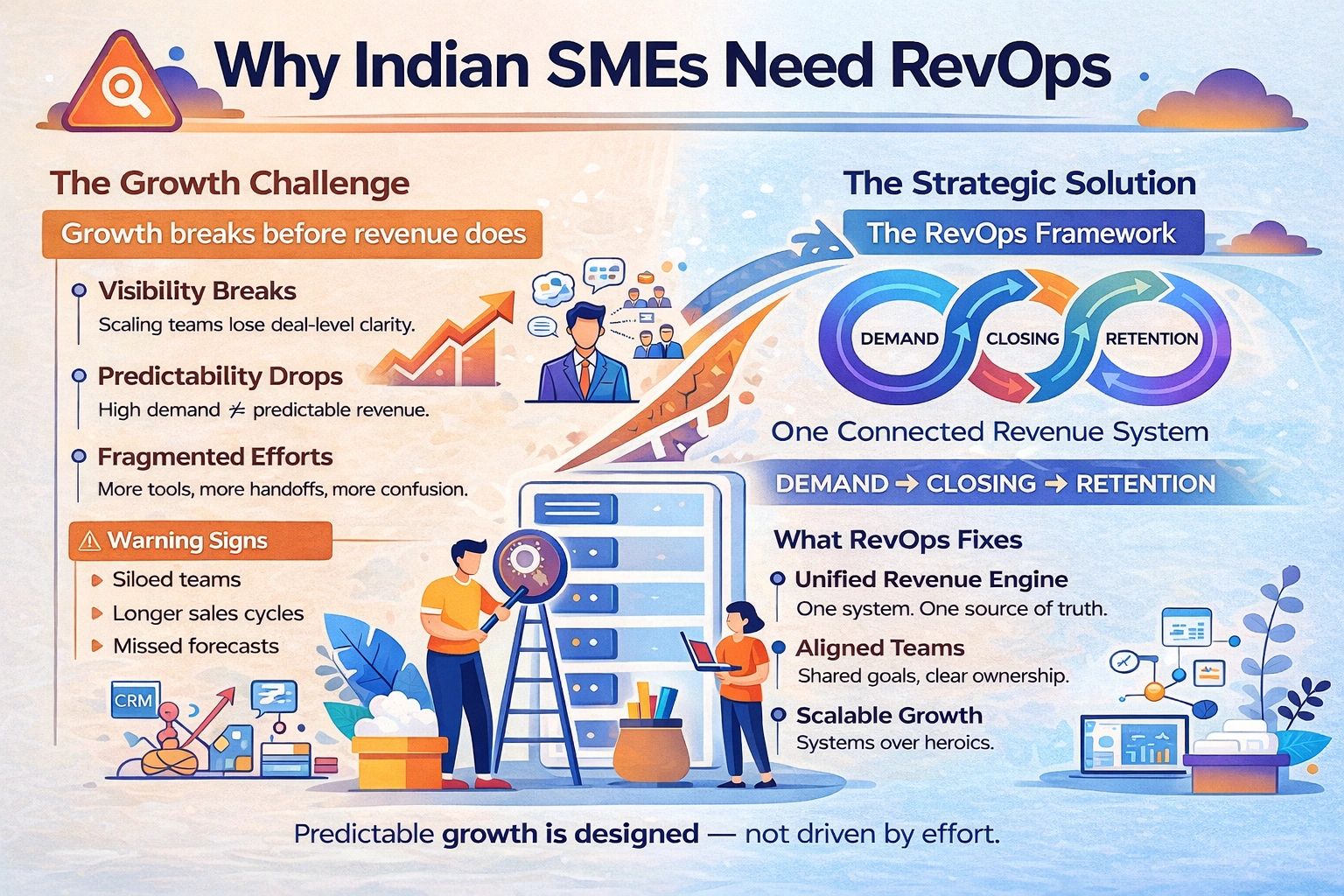
For many Indian SMEs, revenue growth begins as an instinctive process. Long before leaders ask what is RevOps in India, founders stay close to customers. They lead sales conversations themselves. They shape marketing decisions through observation, quick feedback, and constant iteration. Progress comes from effort, speed, and momentum rather than formal systems.
At this stage, structure feels unnecessary. Instead, execution feels like the only priority.
For a while, this approach works extremely well. Deals close quickly because decision-makers speak directly to customers. Feedback loops stay short. Problems surface early and are fixed fast. Revenue feels controllable because the same people who make decisions also negotiate deals, resolve objections, and handle delivery issues.
However, this model has a ceiling.
As the business grows, the same strengths that once enabled speed begin to introduce fragility. Teams expand. Customer volumes rise. More leads enter the system. More deals move through the pipeline. At the same time, outcomes become harder to explain. This is often the first moment founders quietly begin wondering what is RevOps in India, even if they do not name it yet.
Pipelines look full, yet forecasts miss targets. Customers are acquired, yet retention feels uneven. Revenue grows, yet predictability declines.
What once felt simple now feels unstable.
At this point, many Indian SMEs begin to sense that revenue is slipping out of their control. Importantly, this happens even though everyone appears to be working harder than before. Activity increases. However, clarity does not. Effort rises. Confidence in outcomes falls.
This tension explains why Indian SMEs need RevOps earlier than they expect.
The issue is not a lack of effort or intent. Instead, growth has outpaced the original operating model. Intuition worked when scale was low. As complexity increases, intuition alone can no longer manage revenue reliably. Without a system to replace proximity, coordination weakens and uncertainty grows.
This is precisely where the question what is RevOps in India becomes unavoidable. RevOps emerges not as a trend or a tool, but as a structural response to growing complexity. It exists because why Indian SMEs need RevOps is no longer theoretical-it is rooted in the daily reality of scaling revenue without losing control
Revenue Growth Feels Harder Before It Looks Broken
One of the most confusing phases for Indian SMEs arrives when revenue problems surface without an obvious failure. This is often the stage where leaders begin questioning what is RevOps in India, even though nothing appears visibly wrong.
Sales teams remain busy. Marketing campaigns continue to run. Customer success stays stretched, yet still delivers.
From the outside, the business looks healthy. Revenue may even be growing. However, internally, leadership feels increasing tension. Decisions take longer than before. Forecasts inspire less confidence. Teams look at the same numbers but reach different conclusions. Gradually, conversations shift from “what should we do next?” to “what is actually happening?”
This confusion is not accidental. It happens because revenue complexity increases silently.
In the early stages, revenue relies on proximity. As the organisation scales, revenue relies on systems.
During early growth, coordination works because people stay close to the work. Founders hear objections directly from customers. Sales understands exactly why deals stall or close. Marketing adjusts messaging based on real conversations, not reports. Customer feedback reaches decision-makers quickly. Because of this, context flows naturally across the business.
As scale increases, however, proximity fades. Founders cannot be everywhere at once. Teams specialise. Roles narrow. Decisions move further away from customers and closer to dashboards. Information spreads across CRMs, spreadsheets, reports, and tools. Over time, what was once shared understanding becomes fragmented data.
When systems do not replace proximity, misalignment fills the gap.
Marketing optimises based on campaign metrics without seeing downstream outcomes. Sales focuses on pipeline movement without full visibility into lead quality or post-sale impact. Customer success manages delivery and retention without influence over expectations set earlier. Each team works hard, yet coordination weakens.
Revenue does not break all at once. Instead, it weakens gradually. Small disconnects appear between teams. These disconnects seem manageable at first. However, they compound quietly. Over time, leadership notices that growth requires more effort for the same results. Forecast accuracy declines. Customer experience feels inconsistent. Predictability erodes.
This slow erosion explains why Indian SMEs need RevOps before revenue appears “broken.” The problem is not execution. The problem is that the operating model has not evolved with complexity.
At this point, the question what is RevOps in India becomes unavoidable. RevOps exists precisely to replace lost proximity with designed systems. It restores shared context, aligns decision-making, and reconnects teams across the revenue lifecycle. That is ultimately why Indian SMEs need RevOps-not to fix failure, but to prevent silent breakdown as scale increases .
Revenue Is a Lifecycle, Not a Function
To understand what is RevOps in India, Indian SMEs must first change how they think about revenue. Revenue does not come from one department. It does not belong to marketing, sales, or customer success in isolation. Instead, revenue is created across a lifecycle.
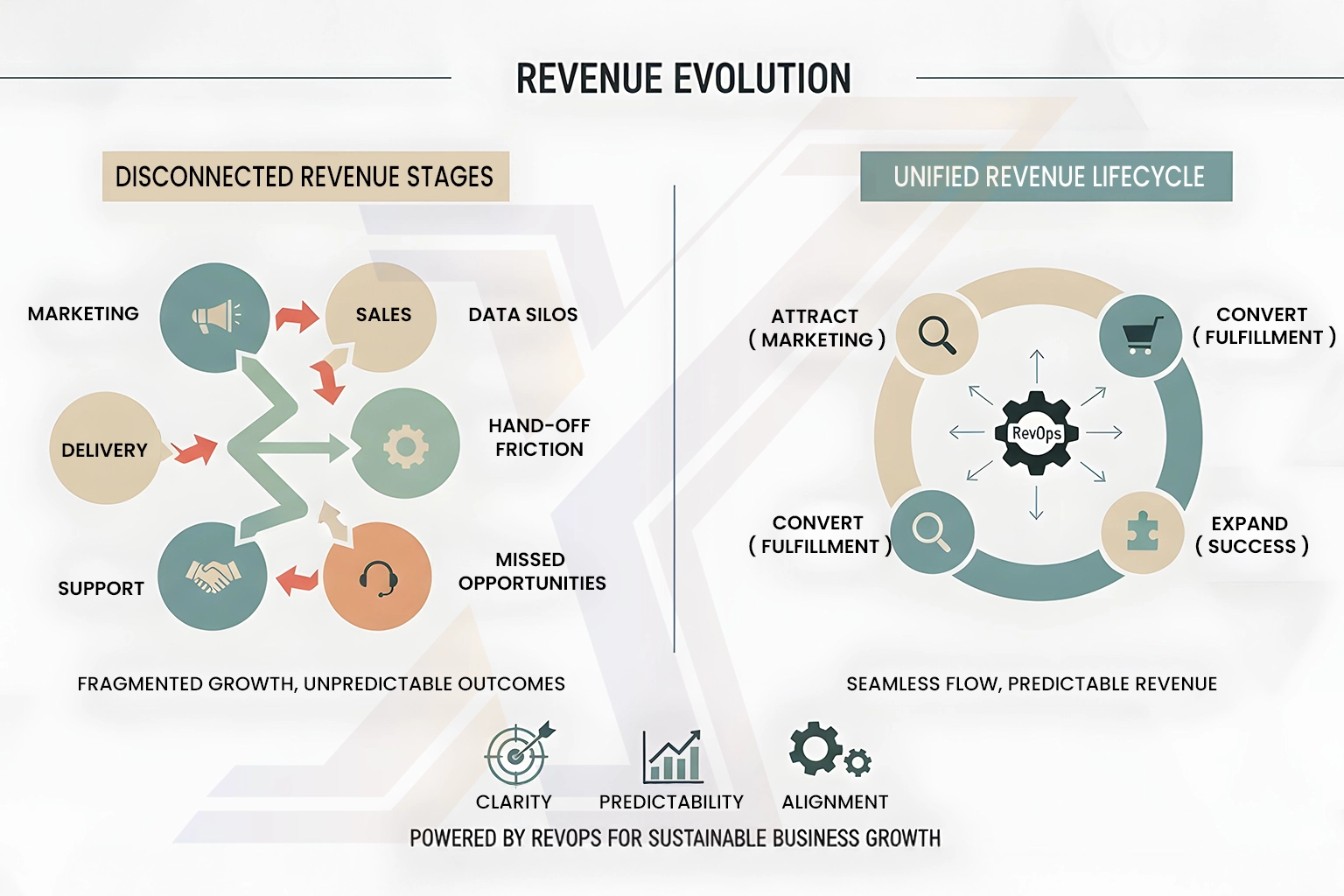
This lifecycle includes:
- How demand is generated
- How opportunities are qualified
- How deals are priced and closed
- How customers are onboarded
- How value is delivered
- How retention and expansion occur
Each stage influences the next. Decisions made early do not stay contained. They travel forward. A marketing promise shapes a sales conversation. A sales commitment defines onboarding complexity. The onboarding experience then affects adoption, retention, and long-term value. Because of this chain reaction, revenue outcomes rarely reflect the work of one team alone.
In many Indian SMEs, however, these stages evolve independently. This separation explains why Indian SMEs need RevOps as complexity increases.
Marketing optimises for lead volume, channels, and campaign efficiency. Sales focuses on closures, targets, and pipeline movement. Customer success prioritises onboarding, renewals, and support resolution. Each function may perform well against its own metrics. Each team may even hit its targets.
The problem lies in what connects them.
Over time, gaps begin to appear between stages. Leads move from marketing to sales without shared qualification standards. Sales commits to timelines or outcomes that delivery teams struggle to meet. Customer success uncovers recurring issues that never influence how future customers are acquired or positioned.
Each gap may seem minor on its own. Together, they create instability. These gaps are rarely dramatic. Instead, they are small, persistent, and compounding.
Each gap introduces friction. Each friction point adds delay. Each delay increases uncertainty. Over time, revenue becomes harder to predict even though teams continue to execute competently. Forecasts miss targets. Customer experience becomes inconsistent. Leadership struggles to trace outcomes back to decisions.
What looks like inconsistent execution is often weak coordination across the revenue lifecycle.
This is precisely why Indian SMEs need RevOps. The issue is not effort, skill, or intent. The issue is that revenue decisions span multiple teams, yet ownership of the system connecting those decisions remains unclear.
Understanding what is RevOps in India means recognising this reality. Revenue Operations exists to design and govern the connections across the lifecycle. It aligns decisions made upstream with outcomes realised downstream. By treating revenue as a system rather than a set of functions, RevOps replaces fragile coordination with deliberate structure.
That is the core problem RevOps is designed to solve—and exactly why Indian SMEs need RevOps as they scale.
"RevOps isn't about adding more people or tools—it's about making sure the people and tools you already have are pulling in the same direction, especially when capital is tight and every rupee counts."
The Silent Shift From Intuition to Operational Complexity: What Is RevOps in India Really Solving?
The most dangerous aspect of revenue breakdown in Indian SMEs is that it rarely happens suddenly. This is precisely why many leaders delay asking what is RevOps in India until the problem feels unavoidable.
There is no single failure point. There is no obvious warning sign. There is no dramatic drop in performance.
Instead, the business crosses a quiet threshold.
In the early stage, coordination remains people-driven. Founders hold most of the context. Sales conversations happen directly with decision-makers. Marketing adapts quickly based on real conversations, not reports. Customer feedback reaches leadership without delay. Knowledge lives in conversations rather than systems.
This works because complexity is low.
The same few people influence demand, close deals, and oversee delivery. When something goes wrong, it becomes visible immediately. Corrections happen fast. Revenue feels manageable because the system is small, tightly connected, and easy to control.
However, as the organisation grows, this operating model begins to fail. Teams specialise. Roles become narrower. New layers form between decision-makers and customers. Founders can no longer sit in every deal review or customer call. Information starts to spread across CRMs, dashboards, spreadsheets, emails, and reports. Over time, context fragments.
What was once shared understanding becomes scattered knowledge.
Teams begin to rely on summaries instead of first-hand insight. Decisions are made with partial information. Assumptions quietly replace clarity. As a result, coordination weakens even though effort remains high.
Without deliberate system design, coordination becomes accidental.
Marketing optimises for lead volume without visibility into which leads convert well. Sales focuses on closing deals without understanding long-term customer outcomes. Customer success manages onboarding and retention without influence over how expectations were set earlier. Each team executes its responsibilities. Each team works hard.
Yet no one owns the system connecting them.
This is how revenue complexity overtakes intuition.
The organisation does not stop performing. Deals still close. Customers still sign up. However, performance becomes harder to explain. Outcomes depend more on individual effort and heroics and less on repeatable structure. Growth continues, but confidence declines.
This silent erosion explains why Indian SMEs need RevOps before revenue appears “broken.” The problem is not execution. The problem is that the original, intuition-led operating model no longer scales.
Understanding what is RevOps in India means recognising this inflection point. RevOps exists to replace lost proximity with designed systems. It restores shared context, aligns decisions across teams, and reconnects the revenue lifecycle end to end. That is ultimately why Indian SMEs need RevOps—not as an optimisation layer, but as a response to growing operational complexity that intuition alone can no longer manage.
💡 Did You Know?
Indian SMEs with aligned revenue operations (RevOps) report up to 25–35% better forecast accuracy and significantly lower customer acquisition costs compared to those still relying on departmental silos (industry benchmarks 2025–2026).
Why Tactical Fixes Lose Their Impact at Scale
When revenue outcomes become unpredictable, most Indian SMEs respond in familiar ways. They launch more campaigns to “fix” the top of the funnel. They hire more salespeople to push deals through. They tighten reporting to gain visibility. They add new tools to track performance.
These actions increase activity. They do not increase alignment.
Meetings multiply, but decisions remain unclear. Dashboards grow, but definitions differ. Data becomes abundant, yet insight becomes harder to extract. Each team builds its own explanation for the same result.
Marketing blames lead quality. Sales blames pricing or competition. Customer success blames expectations or onboarding gaps.
Everyone may be partially right. The system remains broken.
The underlying issue does not change. Revenue decisions are still made within functional silos, even though revenue outcomes span the entire lifecycle.
At this stage, execution is no longer the main constraint. Coordination is.
Pushing harder produces diminishing returns. Each new hire increases handoffs. Each new tool adds another layer of data to reconcile. Each new report introduces another version of the truth.
Instead of restoring control, tactical fixes often amplify confusion.
This is why many Indian SMEs feel trapped in constant firefighting. Effort increases. Stress rises. Yet predictability does not improve.
Why Tactical Fixes Lose Their Impact at Scale: What Is RevOps in India Addressing?
When revenue outcomes become unpredictable, most Indian SMEs respond in familiar ways. At this stage, leaders rarely ask what is RevOps in India. Instead, they focus on visible, tactical actions that feel immediate and controllable.
They launch more campaigns to “fix” the top of the funnel.They hire more salespeople to push deals through faster.They tighten reporting to gain visibility.They add new tools to track performance.
At first, these actions feel productive.
Activity increases.Dashboards fill up.Meetings become more frequent.However, alignment does not improve.
Over time, meetings multiply, but decisions remain unclear. Dashboards grow, yet definitions differ across teams. Data becomes abundant, but insight becomes harder to extract. Each function builds its own explanation for the same outcome because no shared revenue framework exists.
As a result, blame replaces clarity.Marketing points to lead quality.Sales points to pricing, competition, or deal size.Customer success points to expectations, onboarding gaps, or product fit.Everyone may be partially right.Yet the system remains broken.
The underlying issue does not change. Revenue decisions continue to happen inside functional silos, even though revenue outcomes span the entire customer lifecycle. Because of this disconnect, fixes applied in one area often create pressure in another.
At this stage, execution is no longer the primary constraint. Coordination is.
Pushing harder produces diminishing returns. Each new hire increases handoffs and dependencies. Each new tool introduces another data source to reconcile. Each new report creates another version of the truth. Instead of restoring control, complexity increases.
This is exactly why Indian SMEs need RevOps. Tactical fixes fail because they optimise parts of the system without redesigning the system itself. They treat symptoms, not structure. They assume revenue problems can be solved through more effort, more tools, or more pressure.
Understanding what is RevOps in India requires recognising this limit.
RevOps exists to replace reactive fixes with deliberate system design. It aligns decisions across marketing, sales, and customer success instead of forcing each team to optimise in isolation. It ensures that effort compounds instead of colliding.
This is why many Indian SMEs feel trapped in constant firefighting before adopting RevOps. Effort keeps increasing. Stress rises. However, predictability does not improve. Only when coordination becomes intentional does control return.
That is precisely why Indian SMEs need RevOps at scale-not to work harder, but to make work connect.
What Is RevOps in India (Without the Buzzwords)
Revenue Operations, or RevOps, is often misunderstood-especially in the Indian SME context. Before leaders clearly define what is RevOps in India, it is important to understand what RevOps is not.
RevOps is not a tool. It is not a reporting layer. It is not a single team added to the org chart.
Instead, RevOps is an operating model.
It governs how revenue is produced across the entire customer lifecycle. Rather than improving marketing, sales, or customer success in isolation, RevOps focuses on how these functions interact as one connected system. This system-level focus explains why Indian SMEs need RevOps as complexity grows.
RevOps shifts the conversation away from isolated performance and toward shared outcomes. It does not ask whether marketing hit its targets or sales closed enough deals. Instead, it asks how decisions made in one stage affect outcomes in the next.
Because of this, RevOps asks system-level questions that traditional models avoid:
- Where does information break down as work moves between teams?
- Which upstream decisions create downstream risk?
- Which metrics reflect system health rather than local activity?
- Who owns revenue outcomes when responsibility is distributed?
Understanding what is RevOps in India means recognising that revenue problems rarely sit in one function. They emerge from the connections—or lack of connections—between functions. RevOps exists to design those connections deliberately, rather than relying on informal coordination or constant firefighting.
This design-first approach is precisely why Indian SMEs need RevOps once intuition stops scaling.
How RevOps Alignment Restores Control Across the Revenue Lifecycle
RevOps alignment restores control by removing ambiguity from how revenue flows. This clarity sits at the heart of what is RevOps in India in practice.
First, RevOps establishes shared definitions. Marketing, sales, and customer success agree on what a lead is. They align on what qualifies as an opportunity. They define revenue the same way across systems and reports. As a result, teams stop arguing about numbers and start discussing outcomes. This shared language alone reduces friction significantly.
Second, RevOps designs clear handoffs. Work moves forward based on readiness, not urgency or internal pressure. Leads reach sales only when qualification criteria are met. Deals move to customer success with expectations clearly documented. Because of this, context travels with the work instead of being recreated repeatedly.
Third, RevOps aligns metrics and incentives. Teams optimise for shared outcomes rather than isolated targets. Marketing cares about conversion quality, not just volume. Sales cares about long-term value, not just closures. Customer success influences acquisition strategy through real feedback. This alignment explains why Indian SMEs need RevOps to prevent local optimisation from damaging global results.
Finally, RevOps ensures data coherence. Information flows across tools with consistent meaning. Dashboards tell one story instead of many. Leadership sees cause-and-effect relationships across the lifecycle rather than disconnected snapshots. Decisions improve because data reflects reality, not interpretation.
RevOps does not centralise authority. Instead, it centralises coherence.
This coherence allows Indian SMEs to scale without multiplying confusion. It also clarifies what is RevOps in India beyond theory—RevOps creates alignment that holds even as teams grow, tools multiply, and complexity increases.
That structural alignment is exactly why Indian SMEs need RevOps to regain predictability without slowing execution.
Key Takeaways
- Founder intuition fuels early growth - but breaks down as complexity rises.
- Revenue issues creep in silently through misaligned teams and lost context.
- Revenue is one connected lifecycle - gaps anywhere create unpredictability.
- More campaigns/hires/tools only increase activity - not true alignment.
- RevOps gives Indian SMEs scalable control without added bureaucracy - adopt early.
RevOps as an Operating Discipline, Not a One-Time Initiative
One of the most important distinctions Indian SMEs must understand is that RevOps is not a one-time initiative. This distinction is central to what is RevOps in India as an operating reality.
Markets change. Products evolve. Teams grow.
As a result, the revenue system must evolve too.
Processes that once worked smoothly may introduce friction later. Metrics that once provided clarity may lose relevance as complexity increases. Without continuous adjustment, even well-designed systems degrade over time.
This is why many organisations engage RevOps consulting when they realise revenue issues are structural rather than tactical. Diagnosis comes first. Teams examine workflows, data models, metrics, and decision ownership across the lifecycle. This diagnostic phase reveals why previous fixes failed and why Indian SMEs need RevOps as a discipline, not a patch.
After diagnosis, implementation follows. RevOps implementation translates system design into execution. Lifecycle stages are clarified. CRM structures align with real workflows. Metrics standardise across teams. Governance supports decisions without slowing teams down.
Importantly, optimisation never stops.
As complexity grows, RevOps optimisation ensures the system continues to support scale. Adjustments happen deliberately rather than reactively. Over time, RevOps becomes part of how the business operates—not something it periodically “does.”
This long-term orientation explains what is RevOps in India at its highest level. RevOps is not about fixing today’s problems. It is about building a revenue system that adapts as the business grows.
That is ultimately why Indian SMEs need RevOps—not to solve a momentary challenge, but to create durable control as intuition gives way to scale.
Why Indian SMEs Specifically Cannot Ignore RevOps in India
To fully understand what is RevOps in India, it is necessary to look at the operating constraints Indian SMEs face every day. These constraints do not just make growth harder. They amplify the cost of misalignment.
Capital efficiency matters deeply. Headcount stays lean for longer than ideal. Leadership bandwidth remains limited and stretched.
Because of these realities, Indian SMEs rely heavily on informal coordination in the early stages. Founders bridge gaps manually. Teams communicate directly. Decisions move fast because context lives in people’s heads. However, as scale increases, this model begins to break.
Under these conditions, informal coordination fails quickly.
As complexity grows, intuition becomes risky. Decisions rely on partial information. Visibility lags behind reality. Short-term fixes stabilise outcomes briefly, but they create long-term instability. Each workaround adds friction instead of removing it.
This is exactly why Indian SMEs need RevOps earlier than larger organisations.
RevOps for Indian SMEs introduces structure without rigidity. Instead of adding bureaucracy, it removes ambiguity. It replaces person-dependent coordination with systems that scale. As a result, teams move faster with less friction, even as complexity increases.
For growth-stage companies, timing becomes critical.
Informal alignment fails precisely when complexity accelerates—when customer volumes rise, deal cycles lengthen, and retention begins to matter as much as acquisition. Without RevOps, leadership is pulled into constant firefighting. Decisions become reactive. Strategy takes a back seat.
With RevOps in place, visibility improves. Accountability aligns across teams. Growth becomes manageable instead of chaotic. This outcome clearly explains what is RevOps in India at a practical level—and why Indian SMEs need RevOps to sustain scale.
RevOps for SMEs vs Growth-Stage Companies in India
Although the core principles remain the same, what is RevOps in India looks different depending on the stage of the business. This distinction is critical to understanding why Indian SMEs need RevOps in a phased, evolving way.
RevOps for SMEs focuses first on clarity.
At this stage, the goal is not sophistication. The goal is stability.
Key priorities include:
- Clear ownership across the revenue lifecycle
- Lightweight processes that do not slow execution
- Decision-linked metrics instead of vanity KPIs
- Scalable foundations that can evolve over time
For early and mid-stage Indian SMEs, RevOps creates a shared understanding of how revenue flows through the organisation. It reduces dependence on informal coordination without introducing unnecessary control. This balance explains why Indian SMEs need RevOps even with small teams.
RevOps for growth-stage companies builds on this foundation.
As complexity increases, forecasting deepens. Segmentation improves. Expansion and retention strategies become deliberate rather than reactive. Governance matures, but agility remains intact. Systems support scale instead of resisting it.
In India, this transition is increasingly supported by RevOps consulting services. These services help organisations move from founder-led execution to system-led scale without disrupting momentum.
This progression clarifies what is RevOps in India as an evolving operating model, not a fixed template.
Early Indicators That RevOps Is No Longer Optional for Indian SMEs
Many Indian SMEs reach the RevOps inflection point without realising it. Revenue challenges appear gradually, often masked by continued activity and short-term growth. This is why leaders delay asking what is RevOps in India until symptoms become persistent.
Common warning signs include:
- Inconsistent conversion despite strong demand
- Lengthening sales cycles without clear reasons
- Rising churn or stagnant retention
- Forecasts missing targets repeatedly
- Inter-team blame replacing shared accountability
These signals point to coordination failure, not weak effort.
Marketing, sales, and customer success may all perform reasonably well in isolation. However, revenue outcomes remain unstable because the system connecting them is misaligned. At this stage, adding more effort produces diminishing returns.
This is the moment when why Indian SMEs need RevOps shifts from strategic discussion to operational necessity.
RevOps stops being a future improvement and becomes the only way to restore predictability, visibility, and control.
Is Your Revenue Growth Losing Predictability?
Our RXF System helps Indian SMEs build RevOps foundations that scale without bureaucracy. Let's assess where your revenue lifecycle stands today.
Book a Coffee CallFinal Perspective: What Is RevOps in India and Why Indian SMEs Can’t Ignore It Anymore
RevOps is not about growing faster. Instead, it is about growing with control.
For Indian SMEs, this distinction is decisive. Intuition-driven growth works in the early stages, but it does not scale. As complexity increases, reliance on individuals becomes fragile. Outcomes depend too heavily on heroics and constant intervention.
Understanding what is RevOps in India means recognising this shift.
RevOps replaces ad-hoc coordination with deliberate system design. It aligns marketing, sales, and customer success within a single revenue framework. Decisions reinforce each other instead of colliding. Information moves with context. Accountability becomes shared rather than fragmented.
Importantly, execution does not slow down. It becomes more reliable.
This philosophy reflects how XcelleratorsHub approaches Revenue Operations—not as a passing trend, but as a structural discipline that helps Indian SMEs move from effort-driven growth to system-driven scale.
In competitive markets with thin margins for error, growth without control is no longer sustainable. That is ultimately why Indian SMEs need RevOps now, not later. It is the difference between momentum that compounds and growth that eventually collapses under its own weight.