
CRM and Automation for RevOps — The Engine Most Indian SMEs Are Missing
CRM and automation for RevOps is not about buying the most expensive software. It is about connecting the right tools in the right way — so your revenue engine runs without the founder holding it together.
Most Indian SMEs have some tools already. A CRM they barely use. An email platform sending bulk messages. A WhatsApp broadcast list. A spreadsheet someone updates when they remember. However, these tools do not talk to each other. They sit in separate lanes. As a result, data gets lost, follow-ups get dropped, and the team operates on guesswork.
This is the tool chaos problem. And it is extremely common in Indian SMEs.
The issue is not the tools themselves. The issue is that tools without a system are just expensive habits. CRM and automation for RevOps fixes this. It takes the tools you already have — or simple, affordable ones — and connects them into a single revenue engine. One that tracks leads, automates follow-ups, flags at-risk customers, and gives every team member a clear view of the pipeline.
This blog breaks down exactly how to build that engine — step by step.
Why Most Indian SMEs Fail to Get Value from Their CRM
Before getting into the solution, it helps to understand why the problem exists.
Most Indian SME founders set up a CRM at some point. They add contacts. Maybe the sales team logs a few calls. However, within weeks, usage drops. Data becomes incomplete. The CRM becomes a glorified contact list — and nobody trusts it.
There are three core reasons this happens.
First, the CRM gets set up without a process behind it. Tools do not create process. Process creates process. When a CRM gets introduced before the pipeline stages, lead definitions, and follow-up rules are clear, the team does not know what to enter or when. Therefore, adoption fails fast.
Second, there is no ownership. In most Indian SMEs, nobody is responsible for CRM hygiene. Everyone uses it differently. Some do not use it at all. As a result, the data becomes unreliable — and unreliable data is worse than no data, because it creates false confidence.
Third, the CRM is not connected to anything else. It sits alone. It does not connect to the email tool, the WhatsApp platform, or the support inbox. Because of this, there is no unified customer view. Every team works from its own partial picture.
CRM and automation for RevOps fixes all three of these problems. However, it starts not with the tool — but with the system design.
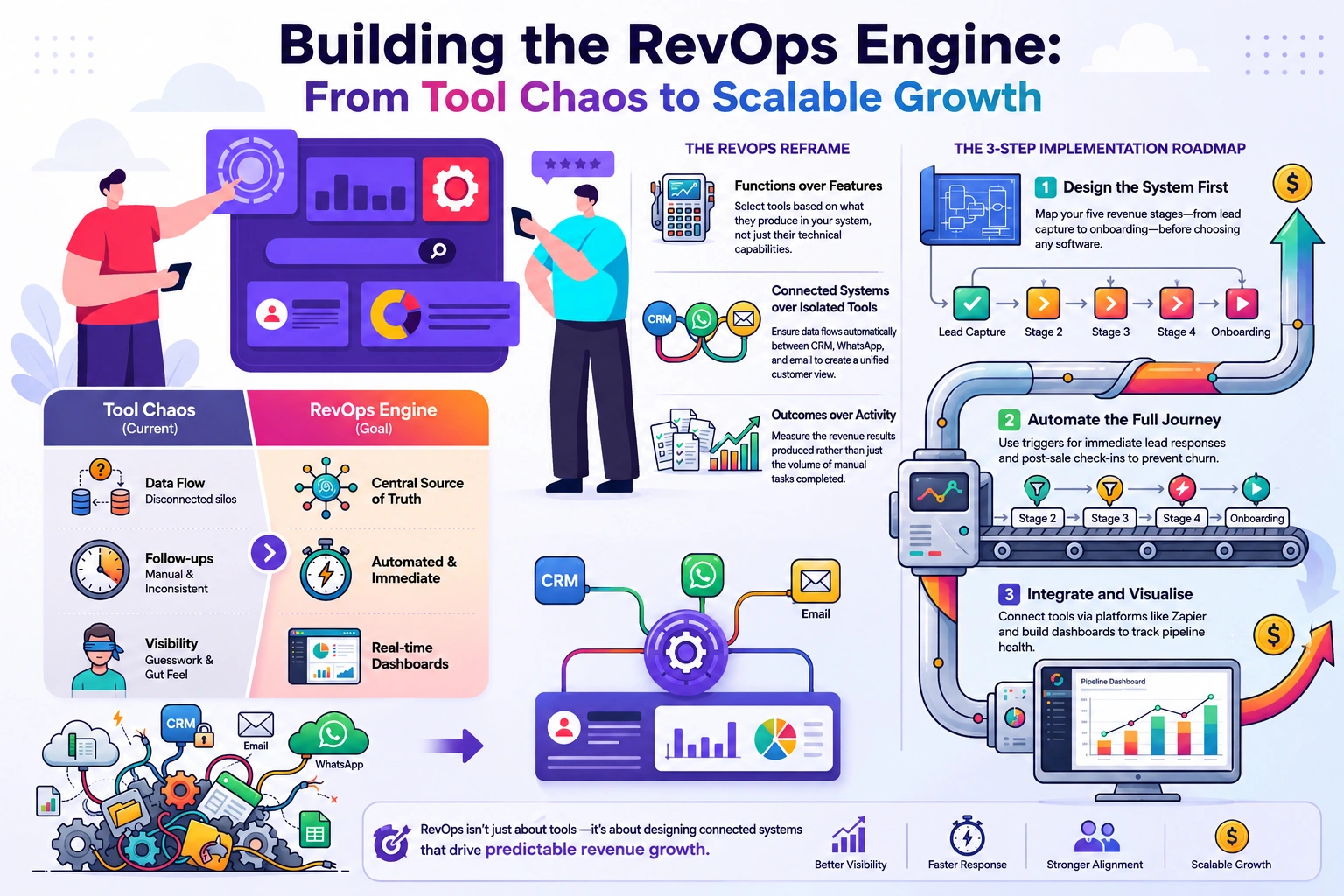
The RevOps Reframe: From Tool Stack to Revenue Engine
Most Indian SMEs think about their tools in terms of features. Does this CRM have a mobile app? Can this email tool send bulk messages? However, RevOps thinks about tools in terms of outcomes. What does this tool produce? How does it connect to the next step in the customer journey?
This reframe changes how you choose, set up, and use every tool in your stack.
The shift looks like this:
- Features → Functions: Instead of picking tools based on what they can do, pick them based on what they need to do in your specific revenue system.
- Separate tools → Connected system: Instead of running tools in isolation, connect them so data flows automatically from one to the next.
- Manual updates → Automated triggers: Instead of relying on someone to remember to follow up, build triggers that fire automatically when a customer takes a specific action.
- Activity tracking → Outcome tracking: Instead of measuring how many emails were sent, measure what those emails produced.
This is what building a RevOps engine with CRM and automation actually means. Not a better tool. A better system built around the right tools.
How to Build a RevOps Engine with CRM and Automation
Step 1 — Design the System Before Choosing the Tools
This is the most important step. And it is the one most Indian SMEs skip entirely.
Before opening any CRM or automation platform, you need to map your revenue process. What are the stages a lead goes through from first contact to closed deal? What happens after the deal closes? Who owns each stage? What action moves a prospect from one stage to the next?
Without answers to these questions, any CRM you set up will be incomplete. The tool reflects the process. If the process is unclear, the tool will be too.
For most Indian SMEs, the revenue process has five broad stages.
Stage 1 — Lead capture: A prospect shows interest. They fill a form, send a WhatsApp message, or get introduced through a referral.
Stage 2 — Qualification: The team checks whether the prospect fits the Ideal Customer Profile. Budget, need, and timeline get assessed.
Stage 3 — Proposal: A scoped proposal gets sent. The prospect evaluates it.
Stage 4 — Close: The deal either closes or gets marked as lost — with a reason recorded.
Stage 5 — Onboarding and success: The new client enters a structured onboarding journey. Customer success takes over from sales.
Once these stages are clear, you can build a CRM around them. Therefore, every field, every stage, and every trigger in the tool has a purpose.
Step 2 — Set Up Your CRM as the Central Source of Truth
The CRM is the foundation of CRM and automation for RevOps. Everything else connects to it.
For Indian SMEs, the CRM does not need to be expensive or complex. Tools like HubSpot's free tier, Zoho CRM, or Freshsales offer strong functionality at low or zero cost. However, what matters more than the tool is how it gets configured.
A RevOps-ready CRM setup has five key elements.
Clear pipeline stages: Each stage maps to the revenue process you designed in Step 1. No vague stages like "In Progress" or "Pending." Every stage has a clear definition and a trigger.
Defined lead fields: Every lead record captures the same core information. Company name, contact details, lead source, ICP fit score, and deal value. Consistency makes the data useful.
Ownership rules: Every lead, deal, and contact has a clear owner. When ownership is ambiguous, follow-up gets dropped. Therefore, ownership rules are non-negotiable.
Activity logging: Calls, emails, and meetings get logged in the CRM — not just in someone's head or inbox. Over time, this creates a full history of every customer interaction.
Loss reason tracking: Every lost deal gets a recorded reason. This data is extremely valuable. Over time, it reveals patterns — common objections, competitive losses, pricing issues — that help the team improve.
As a result of this setup, the CRM becomes a real source of truth. Every team member works from the same data. Therefore, decisions about pipeline, forecasting, and resourcing become reliable.
Step 3 — Build Automation for Lead Capture and Follow-Up
This is where CRM and automation for RevOps starts to save real time.
Most Indian SMEs lose leads not because they are bad at selling — but because follow-up is inconsistent. A lead comes in on Monday. Someone means to call back. However, a busy week happens. By Friday, the lead has gone cold.
Automation fixes this. When a lead enters the system — through a website form, a WhatsApp message, or a referral entry — a set of automatic actions fires immediately.
A basic lead automation sequence looks like this:
Trigger: New lead enters CRM.
Action 1: Automatic acknowledgement message sent to the lead within 5 minutes. This can be an email, a WhatsApp message, or both.
Action 2: Task created for the sales owner to call within 2 hours.
Action 3: If no call is logged within 24 hours, a reminder notification fires to the sales manager.
Action 4: If the lead has not moved stages within 3 days, an escalation alert goes to the founder or team lead.
This sequence removes the dependency on someone remembering. As a result, every lead gets a fast response. No lead goes cold because of an inconsistent follow-up habit. Therefore, lead response time drops — and conversion rates go up.
For Indian SMEs building a RevOps engine, this is one of the fastest wins available. It does not require expensive tools. Most mid-tier CRMs have basic workflow automation built in.
Step 4 — Automate the Post-Sale Customer Journey
CRM and automation for RevOps does not stop at the closed deal. In fact, the post-sale automation is often where the biggest revenue impact happens.
Most Indian SMEs treat the sale as the endpoint. The client gets onboarded informally. Communication becomes sporadic. The relationship drifts. As a result, churn happens quietly — and nobody sees it coming.
A RevOps-aligned post-sale automation sequence looks like this:
Day 1 — Welcome sequence: Automated welcome message with key information about the onboarding process. Warm, clear, and on-brand.
Day 7 — Check-in trigger: Automated prompt to the customer success owner to make a personal check-in call. Not an automated email — a triggered task for a human conversation.
Day 30 — Health check: A short feedback survey or a call to assess whether the client is seeing value. If the response signals dissatisfaction, an alert fires to the account owner immediately.
Day 60 — Upsell signal check: The system checks whether the client's usage or engagement signals readiness for an upsell conversation. If yes, a task fires for the account manager.
Day 90 — Renewal or expansion trigger: If the engagement is project-based, a renewal conversation gets triggered before the project ends — not after.
Because of this automation, no client falls through the gaps. The customer success team always knows what to do next. Therefore, churn drops and upsell revenue goes up — without the team having to manually track every client relationship.
Step 5 — Connect Your Tools So Data Flows Automatically
A RevOps engine only works when the tools talk to each other. However, in most Indian SMEs, they do not.
The CRM holds contact data. The email platform holds engagement data. The support tool holds complaint history. The billing system holds payment data. However, none of these connect. Therefore, every team works from a partial picture — and the customer experience suffers.
Building a RevOps engine means connecting these tools so data flows automatically between them.
Key Integrations to Build for CRM and Automation in RevOps
CRM ↔ Email platform: When a lead's stage changes in the CRM, the email sequence they receive changes automatically. A qualified lead gets a different nurture sequence than a cold prospect.
CRM ↔ WhatsApp tool: Follow-up messages trigger automatically based on lead stage and time elapsed. No manual sending required.
CRM ↔ Support inbox: When a client raises a support ticket, the CRM record updates automatically. The sales and account management team can see open issues before making a call.
CRM ↔ Billing or invoicing tool: When a payment is missed or a contract is due for renewal, the CRM creates an automatic task for the account owner.
For Indian SMEs, tools like Zapier or Make (formerly Integromat) can connect most of these platforms without any coding. Therefore, even a lean team with no technical background can build these integrations with the right setup guidance.
As a result, data flows freely across the business. Every team works from the same customer picture. And the revenue engine runs — even when the founder is not in the room.
Step 6 — Build a Dashboard That Shows Revenue Engine Health
The final step in building a RevOps engine is making everything visible.
A RevOps dashboard does not just show revenue. It shows the health of the entire system — from lead generation to customer retention. Therefore, problems surface early. Decisions happen fast. The team does not wait for the end-of-month review to find out something went wrong.
A basic RevOps dashboard for Indian SMEs should show the following:
Pipeline metrics: Number of leads by stage, conversion rate between stages, average deal size, pipeline coverage ratio.
Sales efficiency: Lead response time, sales cycle length, win rate, deals lost by reason.
Post-sale health: Onboarding completion rate, customer satisfaction score, churn rate, upsell conversion rate.
Automation performance: Email open and click rates, WhatsApp response rates, task completion rates by owner.
Over time, this dashboard becomes the operating system of the business. It tells the team what is working, what is not, and where to focus. Therefore, every decision connects back to data — not gut feel.
Common Mistakes Indian SMEs Make with CRM and Automation for RevOps
Mistake 1 — Buying Tools Before Designing the Process
This is the most common mistake. A founder reads about a CRM, signs up, spends time on onboarding, and then finds the team does not use it. The reason is almost always the same — the process was not designed before the tool was chosen.
Therefore, always design the revenue process first. Then choose the tool that fits it best.
Mistake 2 — Over-Automating Too Early
Automation is powerful. However, automating a broken process just produces broken results faster.
Start with simple automations — lead acknowledgement, follow-up reminders, stage-change triggers. Add complexity only after the basics are working well. Over time, the system gets smarter as the process gets clearer.
Mistake 3 — Not Assigning CRM Ownership
A CRM without an owner is a CRM nobody uses properly. Someone on the team needs to be responsible for data quality, stage updates, and tool health.
In lean Indian SMEs, this does not need to be a full-time role. However, it does need to be a defined responsibility. Therefore, assign it clearly from day one.
Mistake 4 — Treating Automation as a Replacement for Human Relationships
Automation handles the routine. Humans handle the relationship. The biggest mistake in CRM and automation for RevOps is thinking that automated messages replace genuine conversations.
They do not. Instead, automation frees up the team's time so they can have better, more timely human conversations. The goal is always a stronger relationship — not a faster sequence of automated messages.
How Xcellerators Hub Builds RevOps Engines for Indian SMEs
At Xcellerators Hub, CRM and automation for RevOps is a core part of every engagement. They do not just recommend tools. They design the revenue process first — then configure the CRM, build the automations, and connect the tools around that process.
For Indian SMEs that have tried and failed with CRM tools before, this approach creates a very different outcome. The tools finally work — because they are built around a clear system, not just installed and left to the team to figure out.
This connects directly to the pipeline principles covered in How to Redesign Your Sales Funnel with RevOps and the measurement systems in Measuring What Matters: Key RevOps KPIs for Indian SMEs.
"The Engine Does Not Run Itself — But It Can Run Without You"
Key Takeaways
- Design the revenue process before choosing tools
- Make the CRM the central source of truth with clear stages and ownership
- Automate lead capture and follow-up to eliminate dropped leads
- Extend automation into the post-sale journey for better retention
- Connect tools so data flows automatically across the business
Ready to Build Your RevOps Engine?
Our RXF System helps Indian SMEs implement CRM and automation that delivers real revenue growth without founder dependency.
Book a Coffee Call