
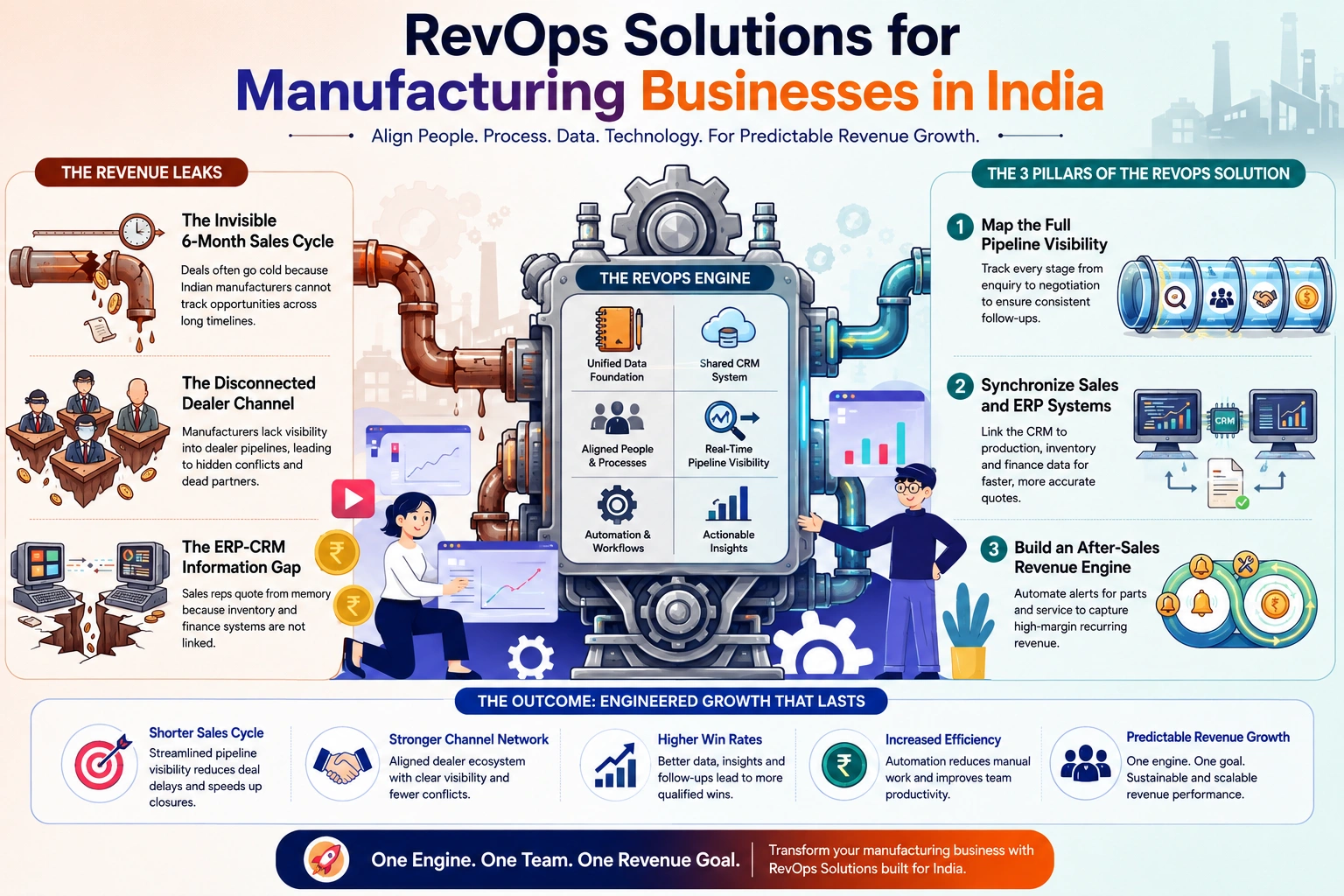
RevOps for Manufacturing Companies - Why This Sector Needs It Most
RevOps for manufacturing companies is one of the biggest untapped growth levers in Indian industry today. Most manufacturers still run sales the old way. Relationships. Field visits. On top of that, a dealer network held together by personal trust. However, that model leaks revenue at every turn, and few manufacturers can see where.
Indian manufacturing has a specific set of problems. Sales cycles run long, often six months or more. Deals pass through dealers and distributors nobody fully tracks. On top of that, the sales team lives in the field, and deal details sit in notebooks and email threads instead of a shared system. As a result, leadership never gets a clear picture of the pipeline.
RevOps for manufacturing companies fixes this. It connects sales, operations, and after-sales into one revenue engine. It makes the pipeline visible, even across a long cycle and a wide channel. Because of this, manufacturers stop losing deals to slow follow-up and blind spots.
This blog explains how a proper sales operations manufacturing system turns a scattered process into predictable revenue.
Why Indian Manufacturers Lose Revenue in the Sales Process
Manufacturing sales look different from software or services. The cycle is long. The buyers are many. On top of that, the channel adds layers between the maker and the end user. Each of these features creates a specific leak.
Four problems show up again and again.
The first is the long, invisible sales cycle. A manufacturing deal can take six months or more from first enquiry to order. However, most Indian manufacturers cannot track a deal across that whole span. As a result, deals go cold in the middle, and nobody notices until the order never comes.
A second problem is the disconnected channel. Dealers and distributors sit between the manufacturer and the customer. However, the manufacturer rarely sees real channel activity - pipeline, sell-through, or partner engagement. Because of this, channel conflict and dead partners stay hidden until a relationship breaks.
The third problem is the ERP-CRM gap. Sales works one way. Operations and finance live in the ERP. However, no bridge connects them. So reps quote from memory, account managers cannot see inventory, and leadership reconciles two sets of numbers that never match.
A fourth problem is lost after-sales revenue. Parts, service, and rebuilds often earn more than the original sale. However, this revenue lives in a silo. Nobody nurtures the installed base for renewals or upsells. As a result, easy revenue slips away year after year.
RevOps for manufacturing companies targets all four leaks. Rather than adding more salespeople, it builds the system that plugs the gaps.
The RevOps Reframe for Manufacturing
Traditional manufacturing sales lean on relationships and field effort. That approach built the sector. However, it does not scale cleanly, and it hides too much.
RevOps reframes manufacturing sales as a connected system. Instead of trusting that field reps remember every deal, it captures every deal in one place. Instead of hoping the channel performs, it makes channel activity visible. On top of that, it links sales to operations, so quotes and inventory finally talk to each other.
The shift looks like this:
- Field memory → Shared system: Deal intelligence flows into the CRM, not into notebooks.
- Blind channel → Visible channel: The manufacturer sees dealer pipeline and sell-through in real time.
- Siloed after-sales → Nurtured installed base: Service and parts revenue becomes a tracked, growing stream.
As a result of this reframe, sales operations manufacturing becomes a system the whole business can see and steer. Because of this, revenue stops depending on who remembers what.
How RevOps for Manufacturing Companies Works
Pillar 1 - Make the Long Sales Cycle Visible
The first job of RevOps for manufacturing companies is making the long cycle trackable.
A manufacturing deal moves through many stages over many months. Enquiry. Technical evaluation. Sample or demo. Quotation. Negotiation. On top of that, approval cycles that cross fiscal boundaries. Each stage needs a clear definition and a clear owner.
Once the cycle is mapped, every deal has a home. The team can see exactly where each opportunity sits and what moves it forward. As a result, deals stop going quiet in the middle. Follow-up happens on time, even six months in.
For Indian manufacturers, this visibility alone recovers real revenue. Because of it, deals that once slipped through the long cycle now reach the finish line.
Pillar 2 - Bring the Dealer and Distributor Channel into View
Most manufacturing revenue flows through a channel. However, most manufacturers cannot see inside it.
RevOps for manufacturing companies fixes this by tracking channel activity in one system. Which dealers have active pipeline? Which distributors are moving stock? On top of that, which partners have gone quiet and need attention?
With this view, the manufacturer manages the channel instead of guessing about it. Strong partners get support. Weak ones get addressed. Meanwhile, channel conflict surfaces early, before it damages a relationship.
As a result, sales operations manufacturing extends across the whole channel, not just the factory floor. Because of this, the manufacturer finally controls its full revenue path.
Pillar 3 - Connect Sales, Operations, and the ERP
A manufacturing deal touches production, inventory, and finance. However, in most Indian manufacturers, sales and operations run on separate systems that never talk.
RevOps for manufacturing companies bridges this gap. The CRM connects to the ERP and production data. So reps quote from real numbers, not memory. Account managers see live inventory. On top of that, leadership works from one set of figures, not two.
Because of this connection, quotes get faster and more accurate. Errors drop. Deals move quicker, which matters when a rival with faster quoting has a real edge. As a result, the whole revenue operations manufacturing process runs tighter and cleaner.
For Indian manufacturers competing on speed and reliability, this integration is a direct advantage.
Pillar 4 - Turn After-Sales into a Revenue Engine
After-sales is where manufacturers leave the most money on the table.
Parts, service, and rebuilds often out-earn the original equipment sale. However, this revenue usually sits in a silo. Nobody tracks it. Nobody nurtures the installed base. As a result, renewals and upsells happen by luck, not by design.
RevOps for manufacturing companies changes this. It tracks every customer's service history and renewal dates. It triggers timely outreach for maintenance, parts, and contract renewals. On top of that, it flags upsell chances across the installed base.
Because of this, after-sales becomes a steady, growing revenue stream. As a result, the manufacturer earns more from every customer it already has, at a far lower cost than winning new ones.
Common Mistakes Indian Manufacturers Make
Mistake 1 - Relying on Field Memory Instead of a System
Many manufacturers trust reps to remember every deal. However, memory fails across a six-month cycle and a wide channel. As a result, deals slip. Therefore, capture every deal in a shared system from the first enquiry.
Mistake 2 - Ignoring the Channel Until It Breaks
Some manufacturers treat dealers as a black box. However, a blind channel hides both weak partners and rising conflict. Because of this, problems only surface when a relationship snaps. Track channel activity early instead.
Mistake 3 - Keeping Sales and Operations Apart
When sales and the ERP never connect, quotes get slow and numbers clash. As a result, deals stall and trust erodes. Therefore, bridge the two systems so sales, operations, and finance share one truth.
Mistake 4 - Treating After-Sales as an Afterthought
Many manufacturers chase new orders while ignoring the installed base. However, service and parts revenue is often larger and cheaper to win. Because of this, a strong RevOps system always nurtures existing customers.
How Xcellerators Hub Delivers RevOps for Manufacturing Companies
At Xcellerators Hub, RevOps for manufacturing companies follows a system-first approach built for the sector's realities. Every engagement starts with a diagnostic of the full revenue path, from enquiry through channel to after-sales.
From there, the team maps the long sales cycle, brings the channel into view, connects sales to operations, and builds the after-sales engine. As a result, the manufacturer gets a revenue system that fits how the business actually works.
For Indian manufacturers that have grown on relationships and field effort, this structure creates a clear shift. Revenue becomes visible, trackable, and steady. To go deeper, see how it connects to RevOps Consulting Services and Sales and Marketing Alignment.
Manufacturing Revenue Deserves a System
The manufacturers that scale in India are not the ones with the biggest sales teams. Instead, they are the ones that see their whole revenue path clearly and act on it. RevOps for manufacturing companies makes that possible. It tracks the long sales cycle. It brings the channel into view. On top of that, it connects sales to operations and turns after-sales into a growing revenue stream. Each piece strengthens the next. As a result, the manufacturer stops losing deals to blind spots and slow follow-up. Revenue becomes engineered, not accidental. For Indian manufacturers ready to grow past relationship-led selling, sales operations manufacturing built on RevOps is the upgrade that changes the trajectory. Not more field visits. Not more guesswork. Instead, one clear system across the whole revenue path.
Key Takeaways
- RevOps for manufacturing companies plugs leaks in long cycles, channels, ERP gaps, and after-sales
- Make the long sales cycle visible with clear stages and owners
- Bring the dealer and distributor channel into one shared system
- Connect sales, operations, and the ERP so quotes and inventory align
- Turn after-sales into a tracked, growing revenue engine
Ready to Build a Manufacturing Revenue System?
Our RXF System helps Indian manufacturers connect sales, channel, operations, and after-sales into one predictable revenue engine.
Book a Coffee Call