
Sales and Marketing Alignment — The Fix Behind Faster Revenue Growth
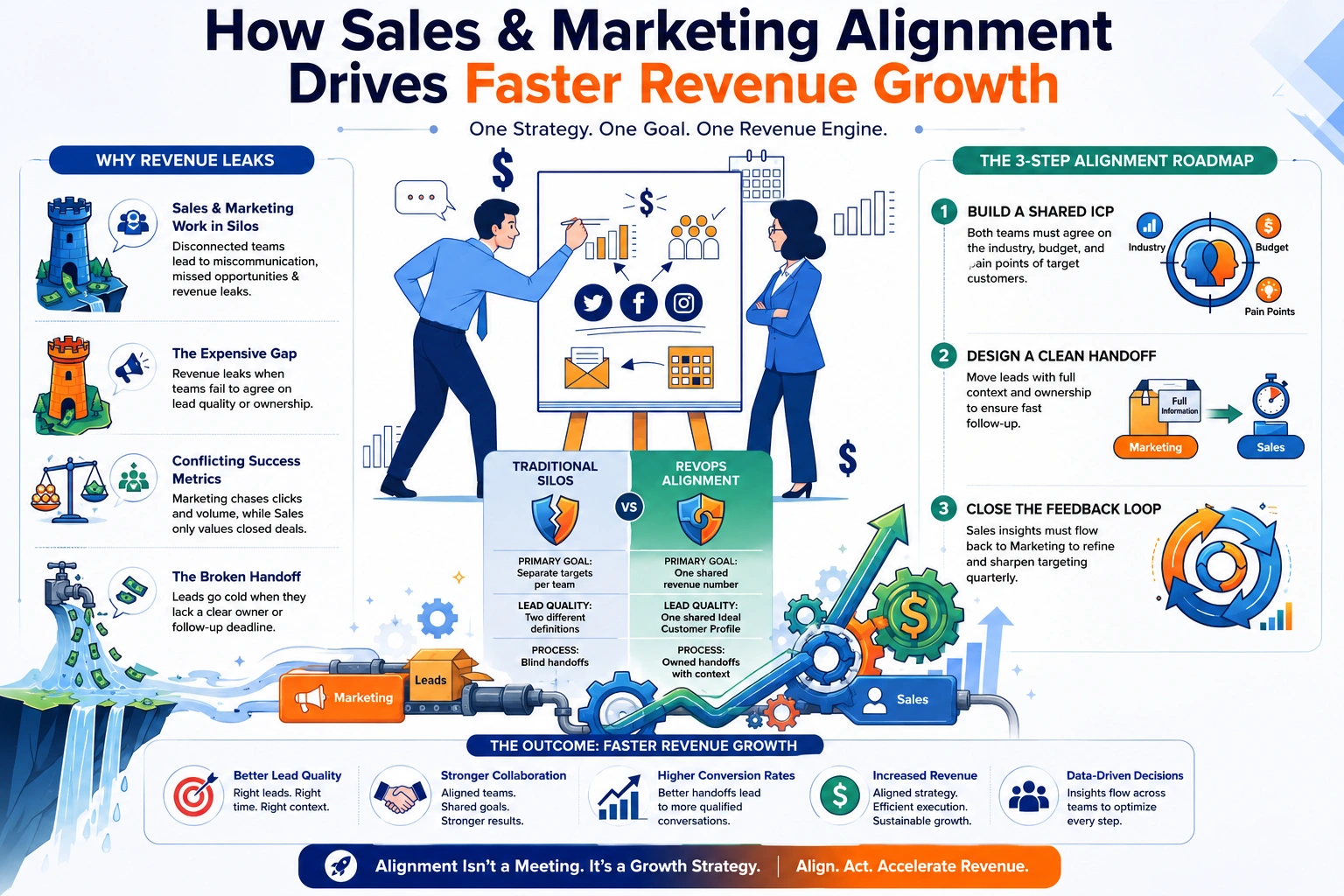
Sales and marketing alignment is one of the fastest ways for an Indian business to grow revenue without spending more. Most companies run these two teams apart. Marketing chases leads. Sales chases deals. However, the two rarely agree on what a good lead even looks like. As a result, revenue leaks in the gap between them.
This gap is expensive. Marketing generates leads and hands them over. Sales rejects most of them as poor quality. Both teams blame each other. Meanwhile, real opportunities go cold because nobody agreed on who owns what. The business spends on marketing but sees little return.
Sales and marketing alignment closes this gap. It puts both teams behind one shared goal, one shared definition of a good lead, and one clean handoff. Because of this, effort stops leaking and starts compounding.
This blog explains how alignment actually works, and how RevOps alignment turns two separate teams into one revenue engine that grows faster.
Why Sales and Marketing Fall Out of Sync
In most Indian businesses, sales and marketing were never designed to work as one. Each grew on its own. Each got its own targets. On top of that, each measures success in a different way. So friction is built in from the start.
Four problems keep the two teams out of sync.
The first is different definitions. Marketing calls a form fill a lead. Sales calls it a waste of time. However, nobody has agreed on a shared standard. As a result, marketing hits its numbers while sales gets nothing useful.
A second problem is separate metrics. Marketing measures clicks and leads. Sales measures deals closed. Because these numbers never connect, each team optimises for itself. Meanwhile, revenue, the number that actually matters, belongs to nobody.
The third problem is the broken handoff. A lead comes in, but nobody owns the next step. Marketing assumes sales will follow up. Sales assumes the lead was weak. As a result, the lead sits untouched until it goes cold.
A fourth problem is no shared feedback. Sales knows which leads convert. However, that insight never flows back to marketing. So marketing keeps generating the same poor-fit leads, quarter after quarter.
Sales and marketing alignment fixes all four. Rather than pushing each team harder, it connects them around one goal.
The RevOps Reframe: Two Teams, One Revenue Engine
Traditional thinking treats sales and marketing as separate departments with separate jobs. RevOps thinking treats them as two parts of one revenue engine.
This reframe changes everything. Instead of marketing throwing leads over a wall, both teams share one pipeline. Instead of two scorecards, they share one revenue goal. On top of that, they share one definition of a qualified lead, so nothing gets lost in translation.
The shift looks like this:
- Separate goals → One shared number: Both teams own revenue, not just their own slice.
- Two definitions → One ICP: Marketing and sales agree on exactly who a good customer is.
- Blind handoff → Owned handoff: Every lead has a clear next step and a clear owner.
As a result of this reframe, RevOps alignment turns friction into flow. Because of this, the same leads and the same budget produce more revenue.
How Sales and Marketing Alignment Works in Practice
Step 1 — Build a Shared Ideal Customer Profile
The foundation of sales and marketing alignment is a shared Ideal Customer Profile.
When the two teams define a good lead differently, waste is guaranteed. So the first step brings them into one room to agree on the ICP. It covers company size, industry, geography, budget range, and decision-maker type. On top of that, it names the pain points that signal a real fit.
Once the ICP is shared, marketing targets the right prospects from the start. Sales trusts the leads it receives. As a result, conversion rates climb without any extra spend. Because of this, the ICP is the single highest-leverage step in the whole process.
Step 2 — Agree on Lead Stages and Definitions
With a shared ICP in place, the teams agree on lead stages.
This means defining exactly what each stage means. What is a Marketing Qualified Lead? What makes it a Sales Qualified Lead? On top of that, what has to be true before marketing hands a lead to sales?
Clear definitions remove the endless argument over lead quality. Both teams now speak the same language. As a result, leads move through the funnel cleanly, and nobody wastes time debating whether a lead counts.
This shared language is the backbone of lead management optimization. Because of it, every lead gets handled the same way, every time.
Step 3 — Design a Clean Handoff
The handoff is where most revenue leaks. Therefore, sales and marketing alignment builds a clear, owned handoff process.
When a lead hits the agreed threshold, it moves to sales with full context. Who is the prospect? What did they engage with? On top of that, what pain point brought them in? Sales picks up the lead knowing exactly where it stands.
Just as important, every handed-off lead has an owner and a deadline. So no lead sits untouched. As a result, follow-up happens fast, while the prospect is still warm.
Because of this clean handoff, fewer leads go cold, and more turn into real deals.
Step 4 — Close the Feedback Loop
Alignment is not a one-way street. Sales holds insight that marketing needs. So the two teams build a feedback loop.
Sales reports which leads convert and which fall flat. Marketing uses that insight to refine targeting. On top of that, both teams review the data together on a regular rhythm. Which sources produce the best deals? Which campaigns bring in poor-fit leads?
As a result, marketing gets sharper every quarter. It stops chasing volume and starts chasing quality. Because of this loop, lead management optimization keeps improving instead of staying static.
Step 5 — Track Shared Metrics Together
The final step is shared measurement. Both teams track the same outcome metrics, together.
The metrics that matter span the full funnel. Lead-to-MQL rate. MQL-to-SQL rate. Conversion rate to closed deal. On top of that, revenue by lead source and cost per acquired customer.
When both teams watch these numbers together, accountability becomes shared. Marketing sees which leads actually close. Sales sees which sources are worth the effort. As a result, the two teams stop pointing fingers and start solving problems as one unit.
Over time, these shared metrics become the scoreboard for the whole revenue engine. Therefore, both teams pull in the same direction.
Common Mistakes That Break Sales and Marketing Alignment
Mistake 1 — Skipping the Shared ICP
Some businesses try to align without agreeing on the customer first. However, without a shared ICP, every other step wobbles. As a result, the teams keep arguing over lead quality. Always start with the ICP.
Mistake 2 — Aligning Once and Moving On
Alignment is not a one-time meeting. Markets shift. Products change. On top of that, teams turn over. Without a regular rhythm, alignment slips. Therefore, treat it as an ongoing practice, not a single event.
Mistake 3 — Keeping Separate Scorecards
When each team keeps its own metrics, old habits return fast. However, shared metrics force shared accountability. Because of this, both teams must watch the same numbers, not just their own.
Mistake 4 — Ignoring the Feedback Loop
Some businesses build the handoff but skip the feedback loop. As a result, marketing never learns which leads convert. Therefore, close the loop so insight flows back and targeting keeps improving.
How Xcellerators Hub Delivers Sales and Marketing Alignment
At Xcellerators Hub, sales and marketing alignment sits at the core of every RevOps engagement. The team starts by building a shared ICP, then defines the lead stages, designs the handoff, and closes the feedback loop.
For Indian businesses where the two teams have long worked apart, this structure creates a clear shift. Leads get better. Handoffs get cleaner. On top of that, revenue climbs without a bigger budget.
As a result, the whole revenue engine runs smoother. To go deeper, see how alignment connects to RevOps Consulting Services and Lead Management Optimization.
Aligned Teams Grow Faster
The businesses that grow fastest in India are not the ones with the biggest marketing spend. Instead, they are the ones where sales and marketing pull together as one engine. Sales and marketing alignment makes that possible. It builds a shared ICP. It agrees on lead stages. On top of that, it designs a clean handoff, closes the feedback loop, and tracks shared metrics together. Each step strengthens the next. As a result, effort compounds instead of leaking, and the same budget produces more revenue. For Indian businesses ready to grow faster without spending more, RevOps alignment is the highest-leverage move available. Not more leads. Not more pressure. Instead, two teams working as one toward the same number.
Key Takeaways
- Sales and marketing alignment closes the gap that leaks revenue
- Start with a shared Ideal Customer Profile before anything else
- Agree on lead stages and design a clean, owned handoff
- Close the feedback loop so marketing keeps improving
- Track shared metrics so both teams pull in the same direction
Ready to Align Sales & Marketing for Faster Growth?
Our RXF System helps Indian businesses turn sales and marketing into one revenue engine that grows without extra spend.
Book a Coffee Call