
Revenue Operations for SMEs - Why Small Businesses Need This Most
Revenue operations for SMEs is not a concept built for big corporations. In fact, it works best for small and mid-sized businesses. Here, every rupee of waste hurts more, every misalignment costs more, and every system gap lands directly on the founder's plate.
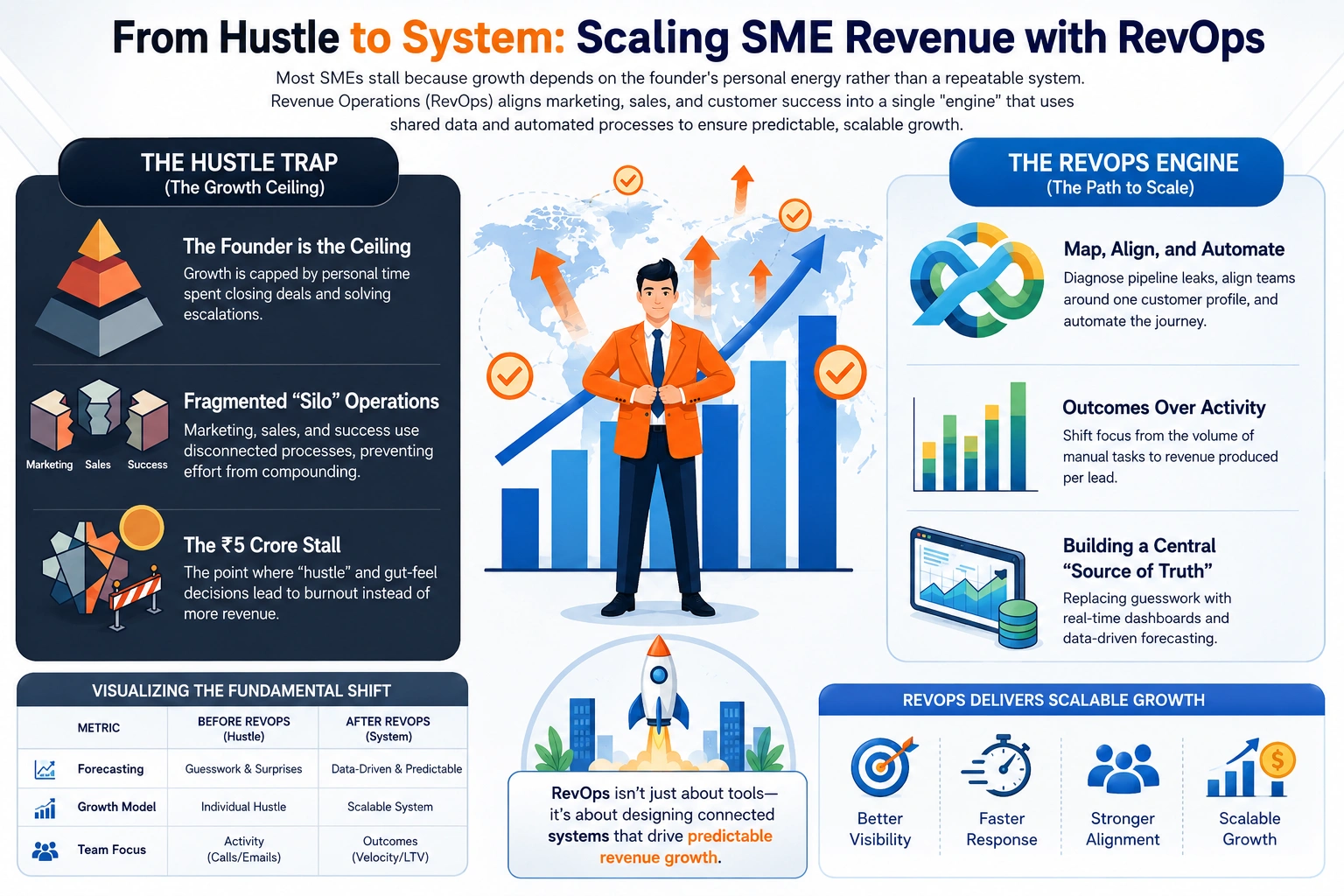
Most Indian SMEs grow to a point and then stall. The team is working. The product is solid. The market is there. However, revenue stays unpredictable. New clients come in. Others quietly leave. Meanwhile, the founder is stretched across sales, delivery, and client management, and growth depends on their personal energy.
This is not a motivation problem. It is a system problem, and revenue operations for SMEs exists to fix it.
However, most small business owners have never heard of RevOps. They link it to large SaaS companies and enterprise teams. As a result, they miss one of the most practical and cost-efficient growth frameworks available. This blog explains what revenue operations for SMEs involves, what it fixes, and how to build it, even with a lean team and limited tools.
Why SME Revenue Is Unpredictable Without a System
Unpredictable revenue is the defining frustration of most Indian SME founders. Good months follow bad months with no clear reason. The team works hard. However, results swing wildly.
The root cause is almost always the same. Revenue gets managed as a set of separate activities - calls, emails, proposals, deliveries - rather than as one connected system. Each function does its job. However, nothing ties them together.
Marketing generates leads without knowing what sales needs. Sales chases opportunities without a clear process. Meanwhile, customer success handles delivery without feeding insights back to marketing. Therefore, the business runs on effort instead of a designed system. And effort without alignment produces noise, not compound growth.
RevOps for small business fixes this by connecting all three functions around shared goals, shared data, and shared processes. As a result, effort starts to compound. Each function strengthens the next. Because of this, revenue becomes a system output rather than a lucky outcome.
The RevOps Reframe for SME Owners
Before the how, it helps to understand the shift in thinking that revenue operations for SMEs requires.
Traditional SME thinking treats revenue as the output of separate functions. Marketing brings in leads. Sales closes them. After that, customer success handles whatever comes next. Each team has its own targets, its own tools, and its own definition of success.
RevOps thinking treats revenue as the output of one connected system. Marketing, sales, and customer success all aim at the same goal - predictable, growing revenue from a defined customer base. They share data. They share definitions. On top of that, they share accountability.
The shift looks like this:
- Separate teams → One revenue system: Each function is part of the engine, not a standalone department.
- Activity metrics → Outcome metrics: The measure is not calls made or leads generated. Instead, it is revenue produced per lead, per team member, and per rupee spent.
- Founder dependency → System dependency: The business runs on the process, not on the founder's presence in every deal.
This reframe is the foundation of SME revenue growth built on RevOps. Without it, every tactic is just another activity that never compounds.
How to Build Revenue Operations for SMEs
Phase 1 - Map and Diagnose the Current Revenue System
Every RevOps build for small business starts with a map of what exists today.
This means documenting the full customer journey, from the first marketing touchpoint to the closed deal to the post-sale experience. At every stage, the team asks the same questions. How many leads enter this stage? How many move to the next? How long does it take? Who owns it? What causes drop-off?
For most Indian SMEs, this exercise reveals three to five specific leaks that together explain the stall. A low MQL-to-SQL conversion rate. A long, inconsistent sales cycle. On top of that, a post-sale experience that loses clients before they ever buy again.
As a result, the fix becomes targeted instead of generic. Therefore, revenue operations for SMEs delivers faster results than broad strategy advice, because it goes straight to the source of the problem.
Phase 2 - Align Marketing and Sales Around a Shared ICP
The single most impactful move in RevOps for small business is defining a shared Ideal Customer Profile.
When marketing and sales define "qualified lead" differently, waste gets baked into the system. Marketing sends leads. Sales rejects them. Both teams get frustrated. Because of this, conversion rates stay low and nobody agrees on why.
Revenue operations for SMEs fixes this by getting both teams in one room to build a single ICP. It covers company size, industry, geography, budget range, decision-maker type, and key pain points. From that point on, marketing generates leads that match the ICP. Sales then qualifies using the same criteria.
As a result, conversion rates climb, often sharply, without any extra marketing spend. For Indian SMEs with tight budgets, this is one of the highest-leverage moves available. In contrast to raising ad spend, fixing the ICP costs almost nothing and pays off immediately.
Phase 3 - Build a Structured Pipeline
Revenue operations for SMEs needs a pipeline that is visible, consistent, and measurable. Not a spreadsheet. Not a WhatsApp thread. Instead, a properly configured CRM with defined stages, clear ownership, and consistent team use.
Each stage needs three things. A clear entry criterion - what qualifies a deal to enter. A clear exit criterion - what action moves it forward. On top of that, a clear owner - one person responsible at this point.
Once all three exist for every stage, the pipeline becomes a system rather than a loose set of conversations. As a result, managers can see where deals stall. Founders can forecast with confidence. Because of this, the team always knows the next step at every point in the process.
Pipeline Stages for Indian SMEs
Stage 1 - Lead: Contact made. ICP fit not yet confirmed.
Stage 2 - Qualified: ICP match confirmed. Budget, timeline, and pain point identified.
Stage 3 - Proposal: Scope defined. Proposal sent or in preparation.
Stage 4 - Negotiation: Proposal received. Commercial discussion active.
Stage 5 - Closed Won / Closed Lost: Decision made. Reason recorded for both outcomes.
Phase 4 - Automate Routine Follow-Up
One of the biggest revenue leaks in Indian SMEs is inconsistent follow-up. Leads go cold because nobody called back. Proposals sit unanswered because the follow-up got lost in a busy week.
RevOps for small business fixes this with automation. Not complex, expensive automation. Instead, simple triggers built into the CRM. A new lead enters, and an acknowledgement goes out within minutes. A task fires for the salesperson to call within two hours. If the deal does not move within five days, a reminder alert reaches the manager.
Because of this automation, no lead goes cold from inaction. Every prospect gets a fast, consistent response. As a result, lead response time drops and conversion rates rise, without the team working any harder.
Phase 5 - Build the Post-Sale Retention System
SME revenue growth depends as much on keeping clients as on winning them. However, most Indian SMEs invest almost nothing in post-sale systems.
Revenue operations for SMEs builds a structured post-sale journey. This includes a documented onboarding process, regular check-in touchpoints, account health tracking, and proactive upsell and referral conversations at the right moments.
As a result, churn drops. Existing clients generate more revenue over time. On top of that, referrals become a steady source of new business rather than a happy accident. Therefore, the cost of acquiring each new client falls as the existing base grows.
For Indian SMEs trying to scale without raising marketing spend, this is one of the most powerful levers available. Over time, a strong retention system turns the client base into a compounding revenue asset.
Common Mistakes SMEs Make with Revenue Operations
Mistake 1 - Starting with Tools Instead of Process
Buying a CRM before defining the pipeline process is the most common RevOps mistake in Indian SMEs. The tool only reflects the process behind it. Without a clear process, the CRM becomes a contact database nobody trusts. Therefore, always define the process first.
Mistake 2 - Treating RevOps as a One-Time Project
Revenue operations for SMEs is not a project. Instead, it is an ongoing practice. The system needs regular review - weekly pipeline checks, monthly metric reviews, quarterly process audits. Without this rhythm, the system decays and old habits creep back.
Mistake 3 - Only Measuring Top-of-Funnel Activity
Leads generated and calls made are the easiest metrics to track. However, they are also the least useful. What matters is conversion rate, deal velocity, win rate, and churn rate. Therefore, build the measurement framework around outcomes, not activities.
Mistake 4 - Ignoring the Sales-to-Delivery Handoff
The moment a deal closes is where most Indian SMEs drop the ball. The salesperson knows what was promised. However, the delivery team does not. As a result, client expectations go sideways from day one. RevOps for small business makes this handoff structured and documented, every single time.
How Xcellerators Hub Builds Revenue Operations for Indian SMEs
At Xcellerators Hub, revenue operations for SMEs sits at the core of every engagement. They work with Indian small and mid-sized businesses to build connected revenue systems, from pipeline design and CRM setup to post-sale retention and measurement dashboards.
Their approach always starts with a diagnostic. From there, they build the system in phases - foundation first, alignment second, retention third. As a result, the business generates and keeps revenue without the founder at the centre of every decision.
For Indian SMEs serious about faster, more predictable SME revenue growth, this structured approach creates a real step-change. To go deeper, explore how it connects to How to Scale Your Business from ₹5 Crore to ₹10 Crore and the tools layer in CRM and RevOps Consulting.
"Build the System. Then Scale It."
Revenue operations for SMEs is not about adding more tools or hiring more people. Instead, it is about connecting what you already have into a system that compounds over time.
When marketing and sales share one ICP, lead quality improves. When the pipeline is visible, forecast accuracy improves. When follow-up is automated, conversion rates improve. On top of that, when the post-sale journey is structured, retention improves.
Each improvement feeds the next. As a result, the revenue engine grows more efficient every quarter, not just busier.
For Indian small business owners ready to move from unpredictable growth to engineered growth, revenue operations for SMEs is the framework that makes it possible. Not more effort. Not more spend. Instead, a better system, built once, improved continuously, and owned fully by the team. That is SME revenue growth done right.
Key Takeaways
- Revenue operations for SMEs connects marketing, sales, and customer success into one system
- Start with a diagnostic to find the real leaks
- Define a shared ICP and build a structured pipeline
- Automate routine follow-up and build post-sale retention
- Measure outcomes, not just activity
Ready to Build Revenue Operations for Your SME?
Our RXF System helps Indian SMEs implement revenue operations that delivers faster, more predictable growth without founder dependency.
Book a Coffee Call