
Scale Business from 5 Crore to 10 Crore - Why This Jump Is the Hardest
To scale business from 5 crore to 10 crore is one of the hardest jumps an Indian founder will face. On paper, it sounds simple. Just double the revenue. However, the business that reached ₹5 crore will not reach ₹10 crore on the same setup. The habits and founder-led methods that worked early on become the ceiling later.
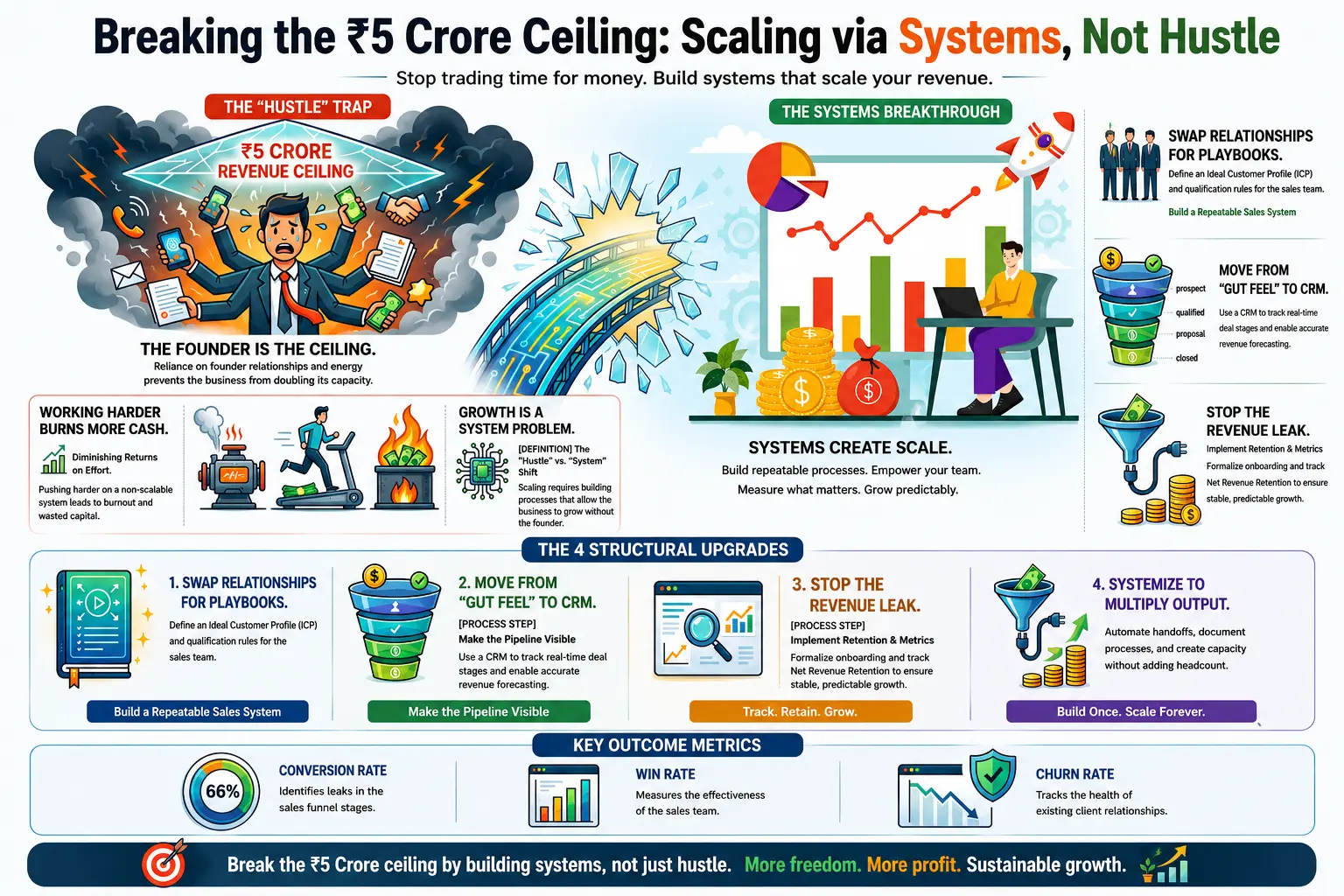
Most founders try to break this ceiling by working harder. They add more outreach. They put in longer hours. On top of that, they get personally involved in every deal. However, pushing harder on a system that was never built for scale gives less and less in return. Often, it just burns cash.
The founders who actually scale business from 5 crore to 10 crore do something else. Instead of treating growth as a hustle problem, they treat it as a system problem. They build the pipeline, the processes, the team, and the metrics that let the business grow without them holding it together. This blog breaks down what that shift looks like, and what business scaling consultants find again and again at the ₹5 crore ceiling.
Why the ₹5 Crore to ₹10 Crore Jump Breaks Most Indian Businesses
The jump from ₹5 crore to ₹10 crore is not just a bigger number. It is a structural change. And most Indian SMEs are simply not built for it yet.
At ₹5 crore, founder-led growth works well. The founder knows every client. They close the key deals. On top of that, they manage the important relationships personally. As a result, the business runs on trust and the founder's energy.
However, to scale business from 5 crore to 10 crore, the company has to generate and keep revenue at twice the rate, without doubling the founder's hours. That is impossible with a founder-dependent model. Therefore, something structural has to change.
Four specific reasons explain why the jump fails for most Indian SMEs.
The first reason is a sales process that does not scale. At ₹5 crore, the founder closes deals through relationships. However, that approach does not stretch to ₹10 crore. The business needs a repeatable process the team can run alone. Without one, every new deal pulls the founder back in, and growth stalls.
A second reason is the lack of a clear system to follow. Early on, the team learns by watching the founder. Later, though, they need documented processes, qualification rules, and defined handoffs. In contrast to informal knowledge, a written system lets the team act without constant guidance.
The third reason is an invisible pipeline. Most SMEs at this stage track deals in the founder's head, a WhatsApp chat, or a messy spreadsheet. Because of this, forecasting becomes impossible. Smart resource decisions cannot happen either.
A fourth reason is weak client retention. Reaching ₹10 crore takes more than winning new clients. It takes keeping them. However, most SMEs at this stage invest almost nothing in post-sale systems. As a result, churn quietly eats into growth, and the business keeps starting from zero.
The SME Scaling Strategy: What Actually Gets You to ₹10 Crore
To scale business from 5 crore to 10 crore, the company needs four structural upgrades. These are not optional extras. Instead, they are the minimum infrastructure for the next stage of growth.
Upgrade 1 - Build a Repeatable Sales System
The first upgrade swaps founder-led selling for a structured, repeatable process.
It starts with a clear Ideal Customer Profile. The team needs to know exactly who to chase - company size, industry, geography, budget range, and decision-maker type. Without that focus, sales energy scatters across poor-fit prospects. As a result, conversion rates stay low even when activity is high.
From there, the business needs defined pipeline stages, qualification rules, and conversion triggers. Every salesperson follows the same steps. Every deal moves through the same stages. Because of this, progress becomes measurable, and the founder is no longer the only person who knows how to close.
For Indian SMEs chasing the ₹10 crore mark, this single upgrade often delivers the biggest early impact. Win rates climb. Sales cycles shorten. On top of that, the team starts closing deals without the founder in the room.
What a Scalable Sales System Includes
Shared ICP: Marketing and sales agree on exactly what a qualified prospect looks like.
Pipeline stage definitions: Each stage has a clear entry point, exit criteria, and owner.
Qualification playbook: Every salesperson asks the same five to seven questions on every first call.
Follow-up automation: Lead response triggers fire within minutes, not hours.
Loss reason tracking: Every lost deal records a reason, which builds a learning loop over time.
Upgrade 2 - Make the Pipeline Visible
To scale business from 5 crore to 10 crore, the founder needs to see the revenue engine, not just feel it.
This calls for a properly set up CRM with consistent team use. Not a glorified contact list. Instead, a live, accurate view of every deal, at every stage, with a clear close date and next action.
When the pipeline is visible, problems surface early. Deals stuck too long get flagged. Weak coverage ratios show up before the quarter ends. Because of this, forecast accuracy improves sharply.
As a result, revenue growth planning becomes data-driven instead of gut-driven. The founder can make resourcing and investment calls with confidence, since the pipeline tells a clear story. In fact, this is one of the first things business scaling consultants build at the ₹5 crore stage. Without pipeline visibility, every other growth decision is just guesswork.
Upgrade 3 - Build a Client Retention System
Winning new clients is expensive. Keeping existing ones is where SMEs at this stage build real revenue stability.
To scale business from 5 crore to 10 crore, the company needs a structured post-sale system. That includes a documented onboarding journey, regular client health check-ins, and proactive account management that spots trouble before it becomes churn.
It also needs a system for upsells and referrals. Managed well, existing clients are both the cheapest revenue source and the most reliable referral channel. However, most SMEs at this stage handle existing clients informally. As a result, upsells happen by accident, and referrals get hoped for rather than generated.
Therefore, a retention system is not just a customer success project. Instead, it is a core revenue growth strategy for any Indian SME serious about ₹10 crore.
Upgrade 4 - Put the Right Metrics in Place
You cannot scale what you do not measure. However, most SMEs at ₹5 crore track the wrong things. Revenue and calls made get all the attention. Meanwhile, conversion rates, churn, sales cycle length, and customer lifetime value stay invisible.
To scale business from 5 crore to 10 crore, the company needs a small set of outcome metrics tracked consistently. These include conversion rate by stage, average deal size, sales cycle length, win rate, churn rate, and Net Revenue Retention.
Together, these metrics reveal the real story of the revenue engine. They show where growth leaks, where the team is improving, and where to invest next. Because of this, every strategic decision connects to evidence instead of intuition.
Business scaling consultants find this pattern over and over. SMEs that track these metrics make faster, sharper decisions. As a result, they reach ₹10 crore well ahead of those who rely on gut feel alone.
Common Mistakes Indian SMEs Make at the ₹5 Crore to ₹10 Crore Stage
Mistake 1 - Hiring Before Building the System
When growth stalls, the instinct is to hire more salespeople. However, a new hire in a broken system just learns the broken process. As a result, headcount rises but output does not. Build the system first. After that, hire to feed it.
Mistake 2 - Increasing Marketing Spend Before Fixing Conversion
More leads into a leaking funnel is not growth. Instead, it is faster waste. Therefore, fix the conversion process first, then scale the spend behind it. Business growth consultants call this the conversion-first rule, and it saves serious cash at this stage.
Mistake 3 - Treating Every Client the Same
At ₹5 crore, the founder manages all clients personally and knows each one well. However, to scale business from 5 crore to 10 crore, the team has to manage clients, and not every client deserves equal attention. A simple tiering system helps the team focus energy where it produces the most revenue.
Mistake 4 - Skipping the Revenue Forecasting System
Most SMEs at ₹5 crore cannot forecast revenue accurately. However, planning for ₹10 crore means knowing, with reasonable precision, what revenue is coming and when. Therefore, a forecasting system is not a finance luxury. Instead, it is a growth prerequisite.
How Business Growth Consultants Help Indian SMEs Scale
Working with business growth consultants who know SME scaling strategy gives Indian founders a real edge here. The right consultants have built these systems before. They know which gaps to fix first. On top of that, they know how to configure the tools, enable the team, and set up the measurement framework.
However, the biggest thing a good consultant offers is saved time. The founder already understands the business. The consultant brings the system design, the tools knowledge, and the implementation experience. Together, they build in months what would otherwise take years of trial and error.
At Xcellerators Hub, the SME scaling strategy follows one principle - fix the system first, then scale the spend. Their revenue growth planning starts with a full diagnostic, moves through system design and rollout, and ends with a measurement framework the team can run alone.
For Indian founders serious about the ₹5 crore to ₹10 crore jump, this approach consistently beats the add-more-budget alternative. To go deeper, explore how it connects to RevOps Consulting Services and Revenue Operations for SMEs.
"The Jump Is a System Problem, Not a Hustle Problem"
The founders who successfully scale business from 5 crore to 10 crore are not the ones who work the hardest. Instead, they are the ones who build the best system. They replace founder-led selling with a repeatable process. They make the pipeline visible with a CRM the team actually uses. On top of that, they build a retention system that stops revenue from leaking. Then they track the right metrics so every decision rests on evidence. As a result, growth becomes engineered rather than accidental. Revenue becomes forecastable rather than hopeful. Because of this, the business stops depending on one person's time and energy to function. For Indian SMEs ready to make the jump, the starting point stays the same. Stop treating the ceiling as a motivation problem. Start treating it as a system problem. Build the infrastructure for the next stage. After that, scale with confidence. That is how Indian founders scale business from 5 crore to 10 crore, and build something that keeps growing well beyond it.
Key Takeaways
- The ₹5 crore to ₹10 crore jump requires structural upgrades
- Build a repeatable sales system before hiring more people
- Make the pipeline visible with a proper CRM
- Invest in client retention and the right metrics
- Fix the system first, then scale the spend
Ready to Scale from ₹5 Crore to ₹10 Crore?
Our RXF System helps Indian SMEs build the systems needed to break through the growth ceiling and reach the next level predictably.
Book a Coffee Call