
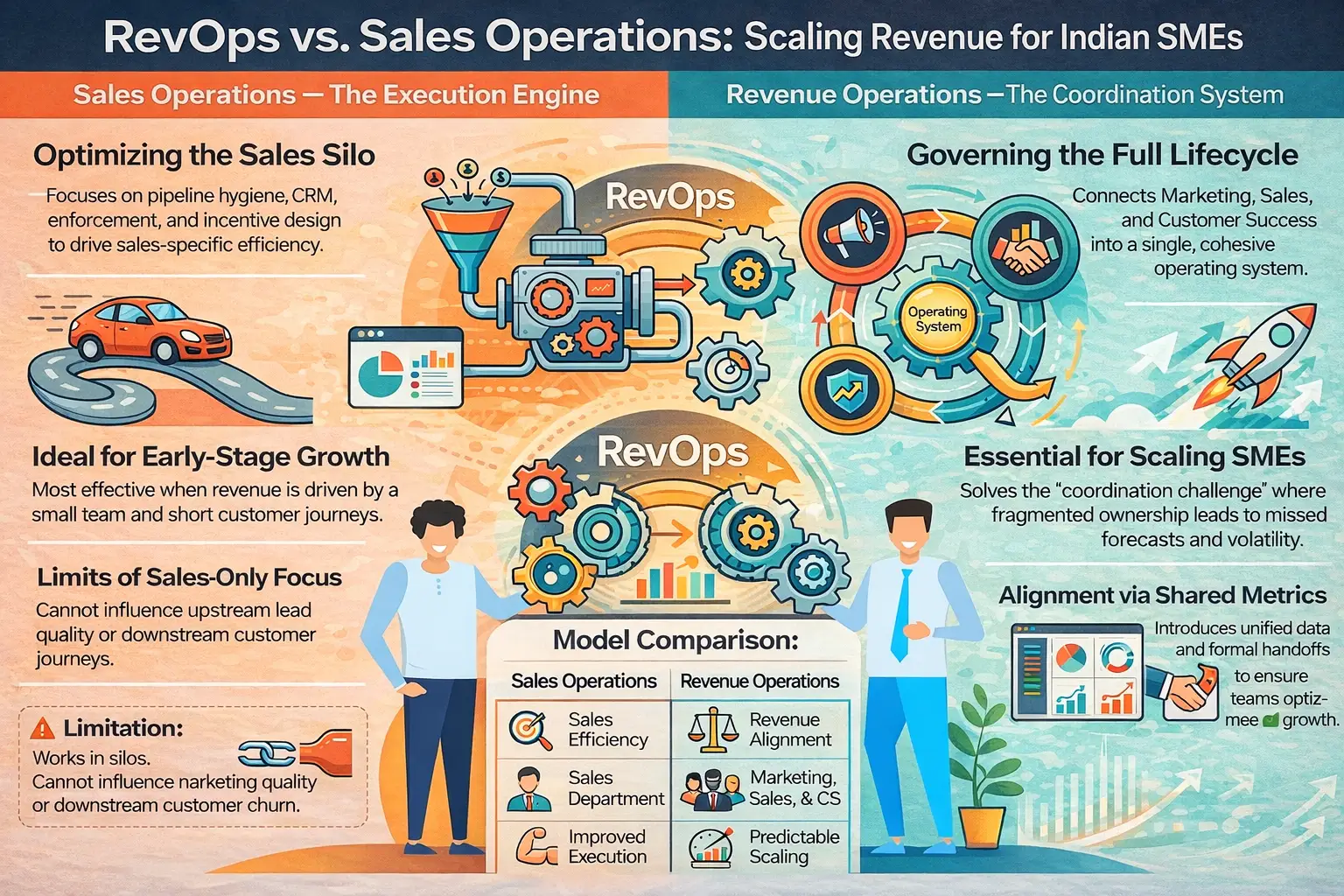
When revenue performance begins to wobble, most Indian businesses instinctively look toward sales. Pipelines are reviewed. Conversion rates are scrutinised. Sales processes are tightened. The underlying assumption is simple: if revenue is underperforming, then sales execution must be the problem.
For a long time, this assumption held true.
In the early stages of most Indian SMEs, revenue outcomes remain closely tied to sales activity. Deals are founder-led or handled by a small, tight-knit sales team. Customer journeys stay short. Marketing and delivery operate informally around sales conversations. In this environment, strengthening sales discipline often produces immediate and visible results.
As a result, traditional sales operations became the natural solution.
Sales operations emerged to bring structure to sales-led growth. It introduced pipeline discipline, forecasting rigor, incentive design, and CRM enforcement. For smaller teams and simpler revenue models, these changes meaningfully improved predictability. Better sales execution led directly to better revenue outcomes.
At this stage, the question is rarely RevOps vs Sales Operations.
Sales operations feels sufficient.
However, this logic begins to break down as businesses grow.
As Indian SMEs scale, revenue becomes more complex. Marketing starts influencing not just volume, but pipeline quality. Customer success becomes responsible for renewals, retention, and expansion. Technology mediates how customers discover, evaluate, and experience the business. Revenue outcomes no longer depend on sales execution alone.
This is where the distinction between RevOps vs Sales Operations becomes critical.
What once worked through sales optimisation alone begins to deliver diminishing returns. Sales teams continue to improve, yet forecasts remain volatile. Pipelines appear healthy, yet conversions fluctuate. Growth continues, but predictability declines. At this point, many leaders begin to ask whether strengthening sales operations is still enough.
This is also where RevOps for Indian SMEs enters the conversation.
RevOps does not assume that revenue performance lives inside the sales function. Instead, it treats revenue as a system that spans marketing, sales, and customer success. It focuses on how these functions interact, where coordination breaks down, and how decisions made upstream affect outcomes downstream.
Understanding RevOps vs Sales Operations is therefore not about choosing one discipline over the other. It is about recognising when the revenue system itself has outgrown a sales-only operating model.
The rest of this discussion explores that shift in detail—why traditional sales operations eventually reaches its limits, how RevOps changes the operating model, and which approach works better for Indian businesses at different stages of growth.
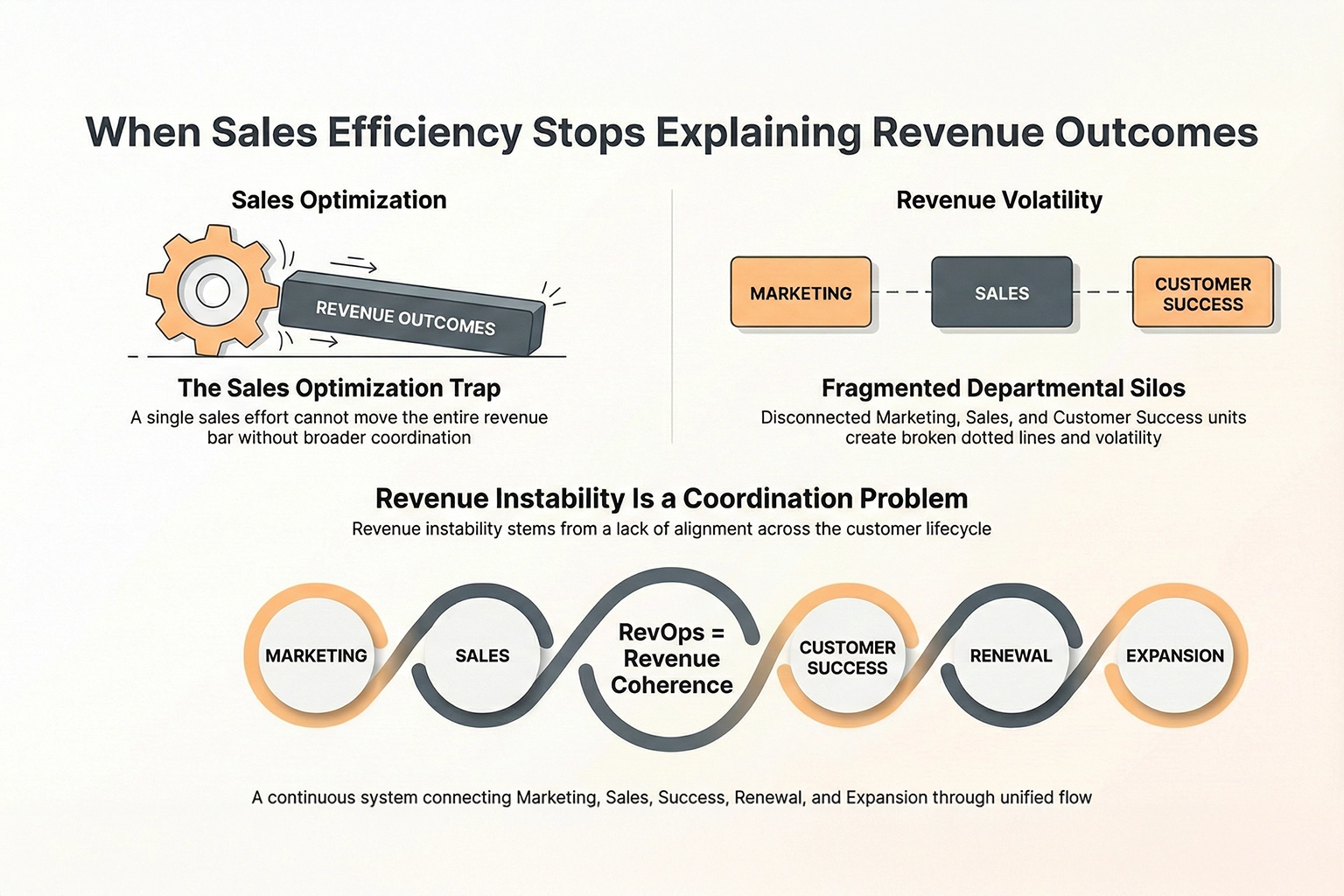
When Sales Efficiency Stops Explaining Revenue Outcomes
As organisations scale, revenue stops being shaped by sales execution alone. This shift marks the point where the limits of traditional sales optimisation begin to surface.
Marketing starts to influence revenue quality, not just volume. The source of demand matters as much as the size of the pipeline. Customer success takes ownership of renewals, retention, and expansion. At the same time, technology increasingly mediates how customers discover, evaluate, purchase, and experience the business.
As a result, revenue outcomes begin to reflect how well these functions work together.
Not how well any one of them performs in isolation.
This is where the RevOps vs Sales Operations distinction becomes visible in practice.
Despite this shift, many Indian businesses continue to diagnose revenue problems through a sales-only lens. Pipelines are reviewed again. Sales processes are refined again. Forecasting models are adjusted again. The assumption remains unchanged: if revenue is unstable, sales execution must still be the issue.
Traditional sales operations reinforces this mindset.
By design, sales operations focuses on improving consistency within the sales function. It tightens pipeline discipline. It enforces CRM usage. It improves forecasting accuracy. Within its scope, it delivers value. However, it cannot influence upstream demand quality or downstream customer behaviour in a sustained way.
This limitation creates a familiar and frustrating pattern.
Sales teams are optimised repeatedly. New playbooks are rolled out. Incentives are recalibrated. Tools are upgraded. Yet revenue volatility persists. Forecasts continue to miss. Conversion rates swing unexpectedly. Churn quietly offsets new growth.
Each iteration improves sales execution.
Each iteration delivers less impact.
At this stage, what appears to be a sales problem is often a coordination problem.
Revenue instability does not originate inside the sales function. It emerges at the intersections—between marketing and sales, between sales and customer success, and across the full customer lifecycle. Sales operations is not designed to govern those intersections.
This is precisely why RevOps for Indian SMEs becomes relevant as complexity increases.
RevOps shifts the focus from improving sales efficiency to managing revenue coherence. Instead of asking how sales can perform better, it asks how decisions made across marketing, sales, and customer success combine to produce revenue outcomes. This system-level view explains why RevOps vs Sales Operations is not a question of replacement, but of scope.
Sales efficiency stops explaining revenue outcomes once revenue becomes a shared responsibility. At that point, coordination—not execution—becomes the primary constraint.
And that is where RevOps begins to outperform a sales-only operating model.
Revenue as a Coordination Challenge, Not a Sales Issue
To understand why traditional sales operations starts to lose effectiveness, it helps to rethink how revenue is actually produced as businesses scale.
Revenue is not a departmental output.
It is not created by sales alone.
Instead, revenue is the result of a coordinated process that spans the entire customer lifecycle.
Demand generation shapes opportunity quality.
Sales execution sets expectations and commercial terms.
Customer success determines adoption, satisfaction, retention, and expansion.
Each stage builds on the one before it. As a result, every handoff between these stages directly affects the final outcome.
This reality sits at the heart of the RevOps vs Sales Operations debate.
When ownership of the revenue process is fragmented across functions, misalignment becomes unavoidable. Marketing may optimise for lead volume while sales struggles with qualification. Sales may close deals that customer success cannot realistically support. Customer insights may never influence how future customers are acquired or positioned.
None of these issues stem from poor intent or weak execution.
They stem from a lack of coordination.
Under these conditions, optimising individual functions can feel productive without being effective. Sales operations improves execution within the sales function. It brings structure, discipline, and visibility to sales activity. However, it does not govern how revenue flows across the organisation.
This limitation becomes especially visible in RevOps for Indian SMEs.
As Indian businesses grow, revenue outcomes depend less on how well sales executes in isolation and more on how well decisions connect across teams. Lead quality affects sales efficiency. Sales commitments affect onboarding success. Customer experience influences renewals and future growth. These interdependencies sit outside the scope of traditional sales operations.
This is where the distinction between sales operations and Revenue Operations becomes critical.
Sales operations optimises one part of the system.
RevOps governs the system itself.
By treating revenue as a coordination challenge rather than a sales issue, RevOps provides a more accurate operating model for modern Indian businesses. It aligns marketing, sales, and customer success around shared outcomes instead of isolated targets.
That shift explains why RevOps vs Sales Operations is not a debate about which team performs better. It is a question of which operating model reflects how revenue is actually created at scale.
What Traditional Sales Operations Is Designed to Do
Traditional sales operations exists to make sales execution more efficient, repeatable, and predictable. Its purpose is clear and well defined. It strengthens how the sales function operates day to day.
In most organisations, the scope of sales operations typically includes:
- Pipeline structure and stage definitions
- Pipeline hygiene and deal tracking
- Forecasting models and reporting cadence
- Incentive design and quota management
- CRM administration, enforcement, and usage discipline
- Sales process documentation and optimisation
Within this domain, sales operations plays a valuable role.
It brings discipline to sales activity. It improves consistency across deals. It creates visibility into pipeline movement and forecast performance. For many Indian SMEs, especially in the early stages, this discipline is essential. Removing sales operations at this point would often create confusion rather than clarity.
This is why RevOps vs Sales Operations is not a question of replacement.
Sales operations works well when revenue performance is primarily driven by sales behaviour. In smaller or early-stage Indian businesses, this assumption often holds true. Deals are short. Customer journeys are simple. Sales decisions directly influence outcomes. Improving sales execution leads to measurable gains.
However, this assumption becomes less accurate as businesses scale.
As revenue grows more complex, outcomes depend less on sales execution alone and more on factors outside the sales function. Marketing quality begins to shape conversion rates. Onboarding experience affects early churn. Customer success execution influences renewals, expansion, and lifetime value. Lifecycle management becomes critical.
At this stage, a sales-only operational model reaches its limits.
Sales operations can optimise how deals move through the pipeline. It cannot control how those deals are sourced. It cannot shape how expectations are delivered after closing. It cannot govern how customer insights flow back into acquisition or positioning decisions.
This gap explains why RevOps for Indian SMEs becomes necessary as scale increases.
Sales operations strengthens one part of the system.
RevOps governs the system as a whole.
Understanding this boundary is central to the RevOps vs Sales Operations conversation. Sales ops remains important. It simply stops being sufficient once revenue depends on coordination across the entire customer lifecycle.
How RevOps Changes the Operating Model
Revenue Operations changes the operating model by expanding the focus from sales execution to the entire revenue lifecycle. This shift sits at the centre of the RevOps vs Sales Operations distinction.
Instead of asking how sales can perform better in isolation, RevOps asks a different question. It asks how marketing, sales, and customer success collectively produce revenue—and where that system breaks down as scale increases.
This change in perspective fundamentally alters how revenue is managed.
Under a traditional sales operations model, each function optimises within its own boundaries. Sales improves pipeline discipline. Marketing focuses on demand generation. Customer success manages delivery and retention. RevOps connects these functions into a single operating system.
RevOps introduces shared definitions across teams. A lead, an opportunity, a customer, and revenue mean the same thing everywhere. This alignment removes one of the most common sources of friction inside growing organisations.
RevOps also formalises handoffs across the lifecycle. Work moves forward based on readiness rather than urgency or internal pressure. Marketing hands off leads that meet agreed criteria. Sales hands off deals with expectations clearly documented. Customer success inherits context instead of reconstructing it.
Metrics shift as well.
Rather than measuring isolated activity, RevOps aligns teams around outcomes. Conversion quality, velocity, retention, and expansion become shared responsibilities. As a result, teams optimise for system health instead of local targets.
Data coherence completes the model.
RevOps ensures that information flows consistently across CRM, marketing automation, and customer success platforms. Leadership gains system-level visibility instead of fragmented dashboards. Decisions improve because data reflects the full lifecycle, not disconnected snapshots.
For many organisations, this operating model is formalised through revenue operations services. These services redesign processes, align metrics, and establish governance across the revenue lifecycle. For growth-stage companies, revops consulting helps shift the business from function-centric optimisation to system-level coordination. For a comprehensive guide on implementing RevOps effectively, check out this detailed overview from Salesforce on What is Revenue Operations (RevOps).
Importantly, RevOps does not replace sales operations.
This point matters in the RevOps vs Sales Operations conversation.
Sales operations continues to optimise execution within the sales function. It strengthens discipline, forecasting, and pipeline management. RevOps absorbs and contextualises this work. It ensures that sales execution aligns with upstream demand quality and downstream customer outcomes.
This integration explains why RevOps for Indian SMEs becomes essential as scale increases.
Sales operations improves one part of the system.
RevOps ensures the entire system works together.
By changing the operating model in this way, RevOps allows Indian businesses to scale revenue without multiplying confusion, misalignment, or dependency on individual heroics.
Why Sales Ops Alone Becomes Insufficient at Scale
The limitation of traditional sales operations is not that it stops working. Instead, it stops being enough once an organisation crosses a certain level of complexity. This reality sits at the core of the RevOps vs Sales Operations debate.
In the early stages, revenue outcomes remain closely tied to individual sales performance. Improving pipeline discipline, tightening processes, refining incentives, and enforcing CRM usage directly influence results. In this environment, sales operations plays a critical role. It stabilises execution and introduces predictability, which is why many Indian SMEs rely on it early.
However, as scale increases, the nature of revenue begins to change.
Revenue outcomes depend less on individual effort and more on how decisions connect across teams. Lead quality starts to matter as much as lead volume. Expectations set during the sales process directly affect onboarding success and long-term retention. At the same time, customer feedback begins to influence future acquisition economics. Each function now contributes meaningfully to the final result.
At this point, sales operations operating in isolation lacks the scope to manage these interdependencies.
Sales ops can optimise how deals move through the pipeline. However, it cannot control how those deals are sourced or how they perform after closing. As a result, issues that originate in marketing or customer success often surface as sales problems—poor conversion rates, stalled pipelines, or missed forecasts—even though their root causes sit elsewhere. For a deeper comparison of these limitations, see this excellent breakdown from Clari: Revenue Operations vs. Sales Operations – A Complete Guide.
This dynamic creates a cycle of diminishing returns.
Sales teams are optimised repeatedly. Processes are refined. Tools are upgraded. Targets are recalibrated. Yet each iteration delivers smaller gains, because the real constraints on revenue performance no longer live inside the sales function. Optimisation continues, but leverage declines.
At this stage, execution is no longer the bottleneck.
Coordination is.
This shift explains why RevOps for Indian SMEs becomes necessary at scale.
RevOps addresses this limitation by redefining how accountability for revenue performance is structured. Revenue no longer sits implicitly with sales alone. Instead, it becomes a shared outcome governed across marketing, sales, and customer success through a unified operating framework.
By aligning definitions, handoffs, metrics, and incentives across the revenue lifecycle, RevOps makes interdependencies explicit and manageable. Teams diagnose problems at the system level rather than misattributing them to individuals. Improvements compound because they reinforce one another instead of cancelling out.
In this sense, RevOps does not replace sales operations—it contextualises it.
Sales ops continues to strengthen execution within sales. Meanwhile, RevOps ensures that sales execution operates inside a coherent, aligned revenue system. This balance ultimately defines the practical difference in the RevOps vs Sales Operations discussion for Indian businesses scaling without losing control.
What This Means for Indian SMEs and Growth-Stage Companies
For Indian SMEs, the distinction between RevOps vs Sales Operations carries far more weight than it does for large enterprises. The margin for error is smaller, and the cost of misalignment compounds faster.
Limited resources amplify every inefficiency. Teams stay lean deep into the growth phase. Individuals wear multiple hats. Budgets remain tight, and leadership bandwidth is finite. As a result, small coordination gaps do not stay contained. Instead, they ripple across the organisation.
When teams work hard but move in slightly different directions, friction builds quickly.
Marketing may generate demand that sales struggles to convert. Sales may close deals that stretch onboarding or delivery capacity. Customer success may fight churn without visibility into how expectations were set upstream. These issues rarely stem from poor effort. Instead, they reflect weak system-level alignment.
In this context, sales operations remains valuable.
Sales ops brings structure to execution inside the sales function. It stabilises performance and enforces discipline. For many Indian SMEs, removing sales operations would create immediate disruption rather than improvement.
However, as organisations scale, sales operations alone stops being sufficient.
As revenue becomes increasingly shaped by acquisition quality, customer experience, renewals, and expansion, performance depends less on sales execution in isolation and more on how the entire revenue system works together. Continuing to rely on a sales-only operating model creates blind spots that no amount of sales optimisation can fix.
This is where RevOps for Indian SMEs becomes essential.
RevOps for growth-stage companies introduces a more resilient operating model—one that reflects how revenue is actually generated in modern Indian businesses. It replaces fragmented ownership with shared accountability. It reduces dependence on individual judgement and heroics by embedding alignment into processes, metrics, and decision flows.
Most importantly, RevOps reduces constant firefighting.
Instead of reacting after revenue problems surface, leadership gains early visibility into where misalignment occurs and why. Decisions shift from corrective to proactive. Growth becomes more predictable, even as complexity increases.
The real question, then, is not whether sales operations still matters.
It is whether it is enough—and for many Indian SMEs navigating scale, the answer becomes clear sooner than expected.
Choosing the Right Model at the Right Stage
Sales operations and Revenue Operations are not opposing choices. Instead, they represent different levels of operational maturity. Each model fits a specific stage of organisational growth. The real mistake many Indian businesses make is not choosing the wrong model, but applying the right model at the wrong time. This misunderstanding sits at the heart of the RevOps vs Sales Operations discussion.
Sales operations works best when revenue remains primarily sales-driven and organisational complexity stays limited. In early-stage and smaller Indian SMEs, most revenue outcomes can still be traced directly to sales activity. Lead sources remain few. Customer journeys stay short. Post-sale processes remain simple and informal. In this environment, strengthening sales discipline delivers real impact.
Better pipeline management improves visibility.
Tighter forecasting increases confidence.
Clear incentives drive consistent behaviour.
CRM usage brings order to execution.
At this stage, sales operations materially improves performance.
However, as the business grows, revenue stops being shaped by sales execution alone.
Marketing begins to influence not just pipeline volume, but pipeline quality and predictability. Customer success becomes central to retention, renewals, and expansion. Technology increasingly shapes how customers discover, evaluate, purchase, and experience the business. Revenue outcomes now depend on how these functions interact, not simply on how well they perform independently.
This shift marks the turning point in the RevOps vs Sales Operations equation.
This is the point at which RevOps for Indian SMEs becomes necessary.
RevOps is designed for environments where revenue emerges from a broader, interconnected system. It introduces a unifying framework that governs how decisions flow across the entire lifecycle. It ensures that improvements in one function do not create friction in another. Most importantly, it replaces fragmented optimisation with coordinated execution.
For many Indian businesses, the transition from sales operations to RevOps is not optional. It is a structural response to scale.
Continuing to rely on a sales-only operating model beyond this point produces diminishing returns. Sales teams are optimised repeatedly, yet revenue remains volatile because the underlying system stays misaligned. Forecasts miss. Churn rises. Internal friction increases.
Organisations that recognise this shift early gain an advantage.
They redesign their operating model proactively. They introduce shared definitions. They align handoffs across teams. They establish system-level metrics before complexity overwhelms intuition. As a result, growth continues with greater predictability and less strain.
Those that delay often spend years optimising sales while struggling with inconsistent forecasts, rising churn, and internal friction. By the time the need for RevOps becomes undeniable, misalignment has already hardened into process debt.
Choosing the right model at the right stage is therefore not a theoretical decision. It is a practical one. For Indian SMEs navigating growth, it often determines whether scale becomes a lasting competitive advantage or a persistent source of instability.
Key Takeaways
- Sales Operations excels in early-stage Indian SMEs where revenue is sales-driven.
- RevOps outperforms at scale by aligning the full revenue lifecycle (marketing, sales, customer success).
- Sales ops optimises execution; RevOps governs coordination and system coherence.
- Diminishing returns from sales-only optimisation signal the need for RevOps.
- Adopt RevOps proactively when forecasts wobble or inter-team friction rises.
Struggling with Revenue Predictability?
Our RXF System helps Indian businesses transition from Sales Operations to RevOps for scalable, aligned growth. Let's assess your revenue model today.
Book a Coffee Call