
Sales Process Optimization — The Fix Most Indian Sales Teams Actually Need
Sales process optimization is not about pushing the team to work harder. Instead, it is about fixing the process they work within. Get that right, and the same effort brings in far more revenue.
Most Indian businesses with a stalling sales function blame the people. However, in most cases, the team already works hard. The real problem sits in the process around them. Leads are poorly qualified. Follow-up is patchy. On top of that, pipeline stages are vague and handoffs are loose.
Sales process optimization fixes all of this. It maps the current sales journey. It finds the leaks. Then it rebuilds each stage with clear rules, clear triggers, and clear ownership. As a result, the same team converts more leads, closes deals faster, and needs the founder far less.
For Indian SMEs and B2B businesses, this is one of the best investments around. The output is not just more revenue. It is steadier revenue. And steady revenue is what lets a business plan, invest, and scale with confidence. This blog breaks down how to do it.
Why Most Indian Sales Processes Underperform
Before the fix, it helps to see why most Indian sales processes leak revenue. Five problems show up again and again.
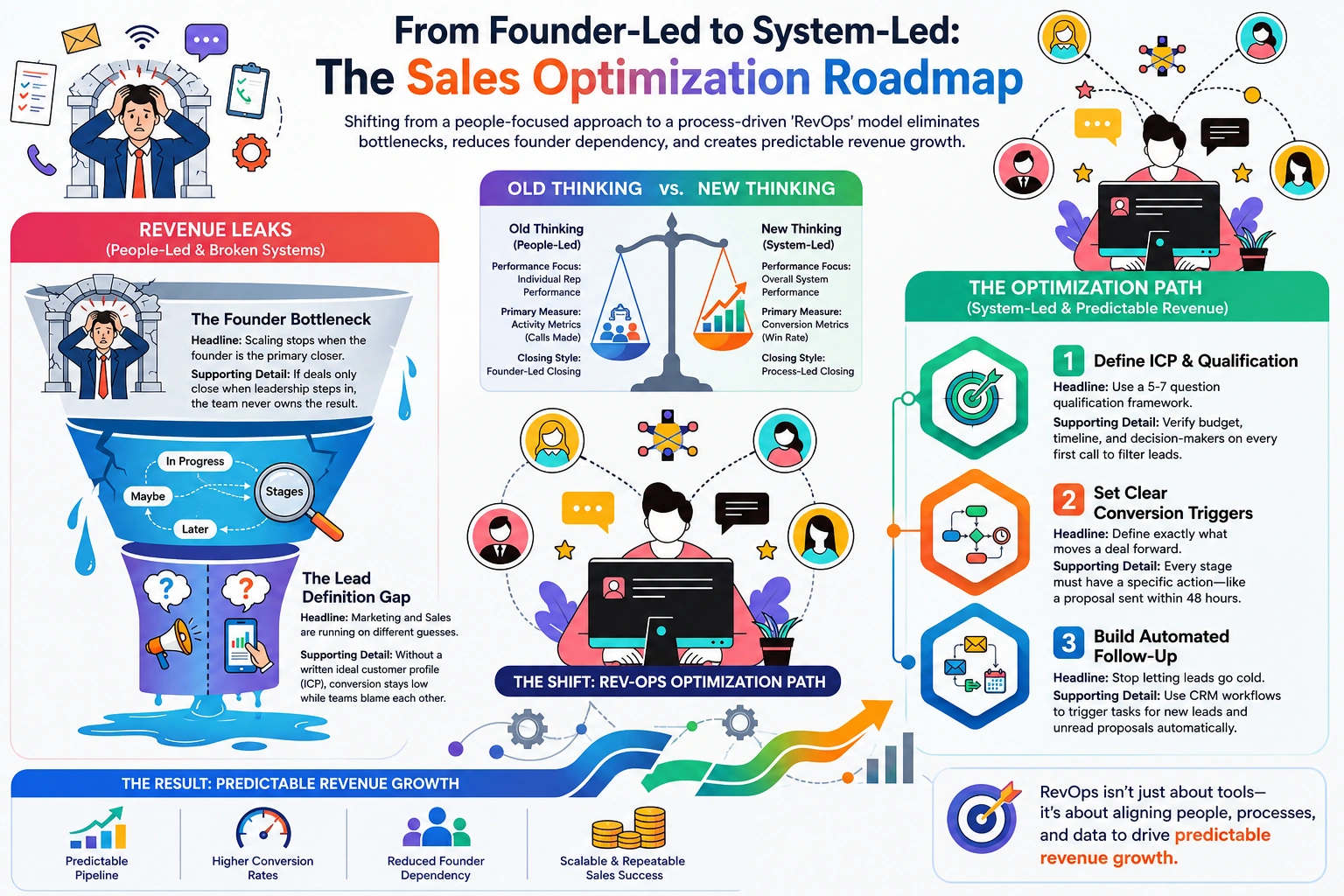
The first is a missing lead definition. Marketing sends leads to sales. Sales rejects most as poor quality. However, nobody has written down what a good lead looks like. Therefore, both teams run on different guesses. Conversion stays low, and each side blames the other.
A second problem is vague pipeline stages. Labels like "In Progress" mean nothing. They never tell the team what to do or what moves a deal forward. As a result, deals sit untouched for weeks. Nobody can explain why.
The third is patchy follow-up. One rep calls within an hour. Another waits three days. One sends a proposal the same day. Another takes a week. Because of this, results swing wildly between people, and the average stays low.
A fourth problem is lost deals nobody learns from. A deal falls through, gets marked lost, and is forgotten. As a result, the same objections come back over and over. The same rival keeps winning the same fights. However, since nothing is recorded, nothing improves.
The fifth is the founder as backup. A deal stalls, so the rep escalates. The founder steps in and closes it. This feels useful. However, it builds a bottleneck into the process. Deal speed gets capped, and the team never owns the result.
Sales process optimization removes all five, step by step.
The RevOps Lens: Why Sales Process Optimization Is a System Fix
Old thinking treats sales as a people problem. Train the reps. Set bigger targets. Push call volume up. However, RevOps thinking treats it as a system problem. Build a better process, and the team does better inside it.
This shift matters because it changes what you fix. Instead of trying to upgrade each salesperson, you rebuild the world they work in. They get better leads. They get clearer stages. On top of that, they get steady follow-up and better data.
The shift looks like this:
- Individual performance → System performance: The process drives the result, not just the person.
- Activity metrics → Conversion metrics: The measure is not calls made. It is revenue per qualified lead.
- Founder-led closing → System-led closing: The process is written down and repeatable, not stuck in the founder's head.
Because of this shift, the gains last. Not a quick spike from one training day. Instead, a real change in how deals get found, qualified, and closed.
How Sales Process Optimization Works in Practice
Step 1 — Map the Current Sales Journey
Sales process optimization starts by mapping every step, from the first enquiry to the signed deal.
This map shows the exact spots where leads slip away. A big drop from lead to MQL usually means weak leads or a missing ICP. A long gap between proposal and close usually means unclear next steps or weak follow-up. Meanwhile, a low win rate after the demo usually means the proposal misses the real pain points.
As a result, the work becomes targeted. Each fix solves a real, mapped leak, not a generic tip that may not fit. Therefore, the gains add up instead of scattering.
Step 2 — Define the ICP and Qualification Framework
The biggest single step in sales pipeline management is defining what a good lead looks like.
This means building a shared Ideal Customer Profile that both teams agree on. It covers company size, industry, geography, budget range, decision-maker type, and urgency. From then on, every lead gets checked against the ICP before it enters the pipeline.
On top of that, the team needs a short qualification framework. Five to seven questions, asked on every first call. Is the budget confirmed? Is the timeline clear? Who is the decision-maker? After that, what other options is the buyer weighing, and what is the real pain point?
Because of this, the team spends time on deals that can close. As a result, conversion rates rise right away, with no extra leads or spend.
Step 3 — Redesign Pipeline Stages with Clear Conversion Triggers
Good sales pipeline management needs stages clear enough to drive action.
Each stage needs three things. A definition — what does it mean for a deal to sit here? An entry rule — what must be true for a deal to enter? On top of that, a trigger — what one action moves the deal forward?
For example:
Qualified → Proposal trigger: Discovery call done. Budget and timeline confirmed. Decision-maker identified. Pain point written down.
Proposal → Negotiation trigger: Proposal sent within 48 hours. Follow-up call booked for 72 hours later.
Negotiation → Close trigger: All objections handled. Terms agreed or close to agreed.
Once every stage has a trigger, the team always knows the next move. As a result, deals stop stalling. Pipeline speed picks up. Because of this, the sales cycle gets shorter.
Step 4 — Build Consistent Follow-Up Automation
Patchy follow-up is one of the costliest leaks in any Indian sales team. Leads go cold. Proposals sit unread. On top of that, deals drift past their close dates.
Sales process optimization fixes this with automation. Simple CRM workflows make sure every new lead gets a reply within minutes and a call task within two hours. Every proposal sent creates a follow-up task for 72 hours later. Meanwhile, any deal that does not move within five days triggers a manager alert.
Because of this, follow-up becomes part of the system, not a habit that changes by rep. As a result, conversion improves across the whole team, not just the disciplined few.
Step 5 — Track Conversion Metrics and Loss Reasons
The last step in sales process optimization is measurement. To be exact, measuring results, not activity.
The metrics that matter for B2B sales strategy and sales pipeline management are simple. Conversion rate by stage. Sales cycle length by deal type. Win rate by lead source. On top of that, loss reasons by category.
Over time, these numbers show clear patterns. Some lead sources convert better. Some objections keep landing at the proposal stage. Some deal types close faster than others. Each pattern is a chance to improve.
Therefore, a weekly review — 30 minutes on these metrics — is what turns sales process optimization from a one-time fix into a system that keeps getting better.
Common Mistakes in Sales Process Optimization
Mistake 1 — Optimizing the Top of the Funnel Instead of the Middle
More leads do not fix a leaking process. Instead, they waste money faster. Therefore, fix the conversion rate at each stage before raising lead volume. Lead conversion optimization starts in the middle of the funnel, not the top.
Mistake 2 — Running Sales Enablement Without a Fixed Process
Training reps on closing is useful. However, if the process is broken, better closing skills just bring faster rejections. Fix the process first. After that, add training on top.
Mistake 3 — Measuring the Wrong Things
Calls made and emails sent are easy to count. However, they say nothing about whether the process is improving. Instead, track conversion rate, win rate, sales cycle length, and loss reasons. These are the numbers that drive real decisions.
Mistake 4 — Not Involving Marketing in the Process Fix
A fix that ignores the top of the funnel stays incomplete. Marketing and sales have to agree on the ICP, the qualification rules, and the handoff. Without that, the process keeps getting poor-fit leads, no matter how clean the later steps are.
How Xcellerators Hub Delivers Sales Process Optimization
At Xcellerators Hub, sales process optimization sits at the heart of every RevOps engagement. They map the current journey, find the leaks, redesign the stages, build the qualification framework, and set up the CRM and automation around the new process.
For Indian B2B businesses and SMEs where the process leans on the founder and conversion is low, this approach brings clear, measurable gains within the first 60 to 90 days.
To go deeper, see how it connects to the wider revenue system in RevOps Consulting Services and the measurement work in Revenue Operations for SMEs.
"The Process Wins, Not Just the People"
Sales process optimization is not about replacing the team or doubting their effort. Instead, it is about building a better place for them to work.
When leads are better qualified, the team works on real chances. When stages are clear, every rep knows the next step. When follow-up runs on its own, no lead goes cold in a busy week. On top of that, when metrics track results, every review ends in a decision.
As a result, the sales function moves from shaky to steady. From founder-led to system-led. Because of this, it shifts from chasing activity to driving outcomes.
For Indian businesses ready to stop blaming the team and start fixing the process, this is where the real revenue growth lives.
Key Takeaways
- Sales process optimization fixes the system, not the people
- Define ICP and qualification first
- Clear stages with triggers stop deals from stalling
- Automation makes follow-up consistent
- Measure conversion and loss reasons, not just activity
Ready to Optimize Your Sales Process?
Our RXF System helps Indian sales teams convert more leads, close faster, and run without founder dependency.
Book a Coffee Call