
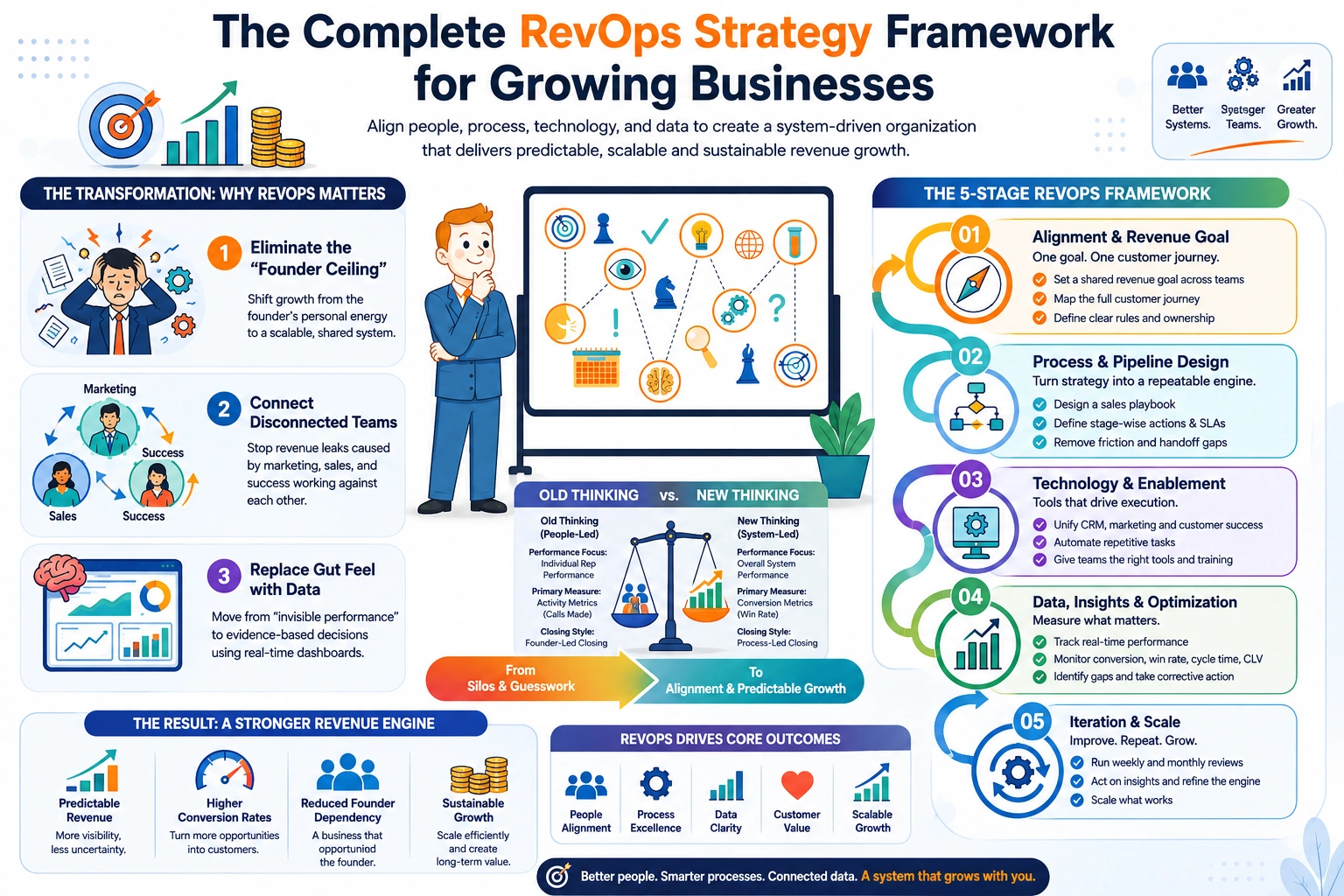
RevOps Strategy Framework - Why Most Indian Businesses Grow Without One
A RevOps strategy framework is the missing piece for most growing Indian businesses. They have a sales team. They have marketing. On top of that, they have some kind of customer success. However, these three functions rarely work as one system. Each runs on its own, and revenue pays the price.
Most Indian founders never sit down to design how revenue actually gets made. Instead, the process grows by accident. A marketing tactic here. A sales habit there. A follow-up method someone invented on a busy Tuesday. As a result, the revenue engine is a patchwork, not a plan.
A RevOps strategy framework fixes this. It gives the business one clear structure that connects marketing, sales, and customer success around shared goals, shared data, and shared steps. Because of this, effort stops leaking at the gaps between teams.
This blog lays out the full framework, stage by stage. It also shows how a strong revops implementation strategy turns scattered activity into a predictable revenue system.
Why a RevOps Strategy Framework Matters More in India
Indian businesses face a specific set of pressures. Teams are lean. Budgets are tight. On top of that, the founder usually wears three or four hats at once. In this setting, a broken revenue process hurts far more than it would in a large, well-funded company.
Without a framework, three things go wrong again and again.
The first is wasted effort. Marketing chases leads that sales cannot use. Sales pushes deals that never fit the ideal customer. Meanwhile, customer success fights fires that better onboarding would have prevented. As a result, everyone stays busy while revenue stays flat.
A second problem is invisible performance. Nobody knows the real conversion rate. Nobody tracks how long deals take. Because of this, the business runs on gut feel, and gut feel does not scale.
The third is founder dependency. Since no shared system exists, the founder becomes the glue. They close the big deals. They fix the escalations. They hold the whole thing together by sheer effort. However, that is a ceiling, not a strategy.
A RevOps strategy framework removes all three problems. It replaces guesswork with structure. Therefore, the business can grow on a system instead of on the founder's energy.
The Core RevOps Strategy Framework
A complete revops strategy framework has five parts. Each builds on the one before it. Together, they form a single, connected revenue engine.
Part 1 - Alignment: One Goal Across Three Teams
The foundation of any RevOps strategy framework is alignment.
In most Indian businesses, each team chases its own target. Marketing counts leads. Sales counts deals. Customer success counts tickets closed. However, none of these targets connect to a shared revenue goal. As a result, the teams often work against each other without realising it.
Alignment fixes this. It puts marketing, sales, and customer success under one shared number - revenue. It also builds a shared Ideal Customer Profile, so all three teams chase the same kind of customer. On top of that, it sets shared definitions, so "qualified lead" means the same thing to everyone.
Because of this, effort starts to compound. Each team hands the next a cleaner input. Therefore, the whole engine runs smoother, with less friction at every step.
Part 2 - Process: Define How Revenue Actually Gets Made
Once the teams share a goal, the framework defines the process.
This means mapping the full journey, from first touch to closed deal to repeat business. Each stage gets a clear definition. Each stage gets an entry rule and an exit rule. On top of that, each stage gets one owner responsible for moving deals forward.
For most Indian SMEs, this step alone brings huge clarity. Suddenly, everyone can see where a deal sits and what happens next. As a result, deals stop stalling in the gaps, and the team always knows the next move.
A strong revops implementation strategy treats process as the backbone. Tools and data come later. Because of this order, the process shapes the tools, not the other way around.
Part 3 - Technology: Make the Tools Reflect the Process
With the process defined, the framework sets up the technology.
The CRM gets built around the agreed pipeline stages. Automation handles lead capture and follow-up. Email and WhatsApp tools connect to the pipeline. On top of that, dashboards make the whole engine visible in real time.
However, the order matters here. In a good RevOps strategy framework, tools always follow process. In contrast, most Indian businesses buy tools first and hope process appears later. As a result, those tools sit half-used and mistrusted.
When the tools reflect the process, the team actually uses them. Because of this, the data stays clean, and clean data powers every decision downstream.
Part 4 - Data: Track the Numbers That Predict Revenue
A RevOps strategy framework runs on data. To be exact, it runs on a small set of outcome metrics tracked with discipline.
The metrics that matter most are simple. Conversion rate by stage. Sales cycle length. Win rate. Churn rate. On top of that, customer lifetime value and Net Revenue Retention.
These numbers tell the real story. They show where the engine leaks. They show where the team improves. They also show where the next rupee should go. As a result, decisions rest on evidence, not on hunches.
Over time, this data layer becomes the control panel of the business. Therefore, problems surface early, and fixes happen before they turn expensive.
Part 5 - Iteration: Review, Adjust, Improve
The final part of the framework is iteration.
A revops strategy framework is not a one-time build. Instead, it is a system that improves through regular review. Weekly pipeline checks catch stalled deals. Monthly metric reviews catch bigger trends. On top of that, quarterly audits catch process drift before it spreads.
Because of this rhythm, the engine keeps sharpening. Win rates climb. Sales cycles shrink. Churn falls. As a result, the business gets more efficient every quarter, not just busier.
This is what separates a real revops implementation strategy from a one-off project. The framework lives, adapts, and compounds.
Common Mistakes When Building a RevOps Strategy Framework
Mistake 1 - Starting with Tools Instead of Alignment
Many Indian businesses buy a shiny CRM and call it RevOps. However, a tool is not a strategy. Without alignment and process first, the tool just digitises the chaos. Therefore, always start with shared goals, not software.
Mistake 2 - Building the Framework Only for Sales
RevOps is not sales ops with a new name. A framework that ignores marketing and customer success stays incomplete. Instead, it must connect all three functions. Because revenue leaks most at the handoffs between them.
Mistake 3 - Skipping the Data Layer
Some businesses build the process but never track the outcomes. As a result, they cannot tell whether anything improved. A framework without metrics is a guess. Therefore, the data layer is not optional.
Mistake 4 - Treating It as a One-Time Project
A framework built once and left alone slowly decays. Old habits creep back. However, a light review rhythm keeps it alive. Because of this, iteration is what turns the framework into a lasting advantage.
How Xcellerators Hub Builds a RevOps Strategy Framework
At Xcellerators Hub, the RevOps strategy framework is the backbone of every engagement. They start with alignment, then design the process, then set up the tools, then build the data layer, and finally install the review rhythm.
For Indian businesses that have grown on effort alone, this structure creates a clear shift. The revenue engine becomes visible, connected, and steady. As a result, the founder can step back from daily firefighting and focus on growth.
To go deeper, see how the framework connects to broader work in RevOps Consulting Services and Revenue Operations for SMEs.
"Strategy Beats Effort Every Time"
The businesses that scale in India are not the ones that work the hardest. Instead, they are the ones that build the best system. A RevOps strategy framework is that system, laid out clearly.
It aligns three teams around one goal. It defines how revenue actually gets made. It makes the tools reflect the process. On top of that, it tracks the numbers that predict revenue and improves through steady review.
Each part strengthens the next. As a result, the engine compounds over time, turning scattered effort into predictable growth.
For Indian founders ready to stop guessing and start engineering, a revops implementation strategy is the highest-leverage move on the table. Not more hustle. Not more spend. Instead, one clear framework, built once and improved forever.
Key Takeaways
- A RevOps strategy framework connects marketing, sales and customer success
- Start with alignment and process before tools
- Track outcome metrics, not just activity
- Review weekly, monthly and quarterly to keep the system sharp
- The goal is a revenue engine the team can run without the founder
Ready to Build Your RevOps Strategy Framework?
Our RXF System helps growing Indian businesses turn scattered effort into a connected, predictable revenue engine.
Book a Coffee Call