
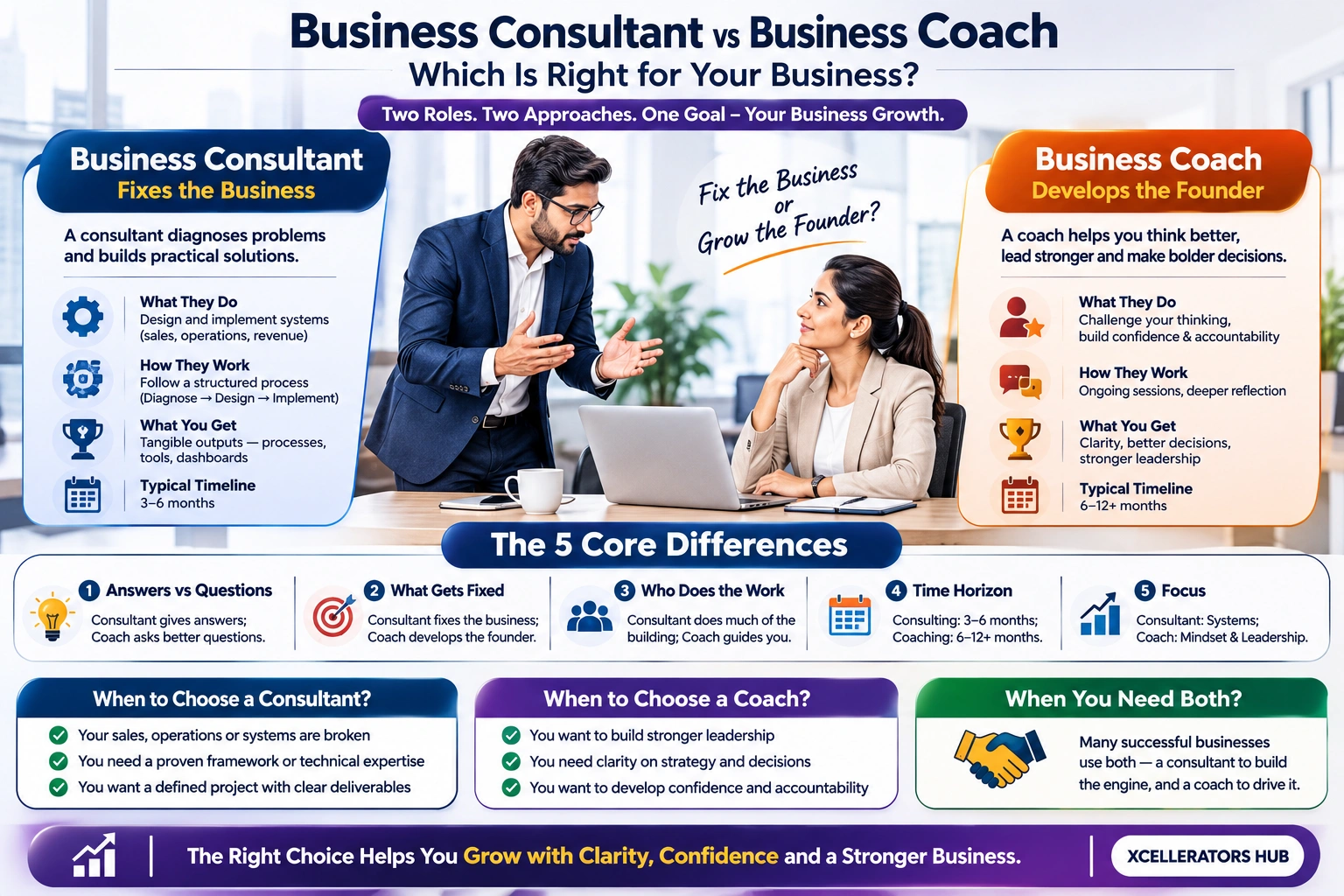
Business Consultant vs Business Coach — Why Founders Mix Them Up
Business consultant vs business coach is one of the most common questions founders ask when growth slows. Both roles promise help. Both charge fees. Both talk about unlocking growth. However, they work in very different ways, and the wrong pick can cost months of time and a lot of money.
Here is the confusion in plain terms. A consultant fixes a specific business problem. A coach grows the person who runs the business. Those are two different jobs. As a result, a founder who needs a working sales system but hires a coach gets great conversations and no system. In contrast, a founder who needs sharper decisions but hires a consultant gets neat processes that nobody feels confident running.
Indian founders face this choice often. Teams are lean and budgets are tight. The founder usually carries sales, delivery, and hiring at once. Because of this, every rupee spent on outside help has to count.
This blog explains business coaching vs consulting in simple language. You will see what each role does, where they differ, and when each one fits. By the end, you will know how to settle the business consultant vs business coach question with confidence.
What a Business Consultant Actually Does
A business consultant is a specialist who diagnoses a problem and builds the fix. Think of the role as a mechanic for your business engine. You bring the problem. The consultant finds the cause, designs the repair, and often does much of the building.
Consultants work on defined topics. Examples include sales process design, pricing, operations, CRM setup, and revenue systems. They bring frameworks from other businesses they have helped. They also bring technical skill that most founders have no time to learn.
The Typical Consulting Process
Most consulting engagements follow a clear path:
- Diagnosis: The consultant studies how the business runs today. They review data, processes, and team habits.
- Design: Next comes a plan or system to fix what they found.
- Implementation: They set up the tools, write the documents, and train the team.
- Handover: Finally, they pass the finished system to your team to run.
This path has a start, a middle, and an end. In most cases, you can name the deliverables before the work begins.
What You Get from a Consultant
The output is tangible. You might get a written sales process, a configured CRM, a pricing model, or a live dashboard. You can point at it. Your team can use it on Monday morning.
Where Consulting Falls Short
Consulting has limits too. A consultant can build a perfect system, yet the system fails if the founder does not lead the change. Likewise, consultants rarely work on a founder's habits, confidence, or leadership style. They fix the business. They do not usually fix the person steering it.
What a Business Coach Actually Does
A business coach works on you, not on your spreadsheet. The role is closer to a personal trainer than a mechanic. The coach does not build the system for you. Instead, they ask hard questions, hold you accountable, and help you think more clearly.
Good coaches rarely hand out answers. They believe founders already hold most of the answers and need space to find them. Therefore, sessions feel like structured conversations rather than project reviews.
The Typical Coaching Process
Coaching runs on a steady rhythm:
- Goal setting: You and the coach agree on what you want to change.
- Regular sessions: Meetings happen weekly, fortnightly, or monthly.
- Reflection and challenge: The coach questions your assumptions and blind spots.
- Accountability: You commit to actions, and the coach checks progress at the next session.
Because the work targets mindset and habits, coaching often runs for six to twelve months or longer.
What You Get from a Coach
The output is less tangible, yet still real. Founders often report clearer priorities, better decisions under pressure, stronger leadership, and more confidence. Your team may notice the change before you do.
Where Coaching Falls Short
Coaching cannot replace technical expertise. A coach may help you realise your pipeline is a mess. However, most coaches will not rebuild it. If your business has a broken process, motivation alone will not fix it.
Business Coaching vs Consulting: The 5 Core Differences
Business coaching vs consulting comes down to five differences. Once you see them, the choice gets much easier.
Difference 1 — Answers vs Questions
A consultant gives answers. They say, "Here is what is broken, and here is how to fix it." A coach gives questions. They ask, "What do you think is broken, and what will you do about it?" Each style suits a different kind of problem.
Difference 2 — What Gets Fixed
Consultants fix the business. Coaches develop the founder. A leaking pipeline is a consulting problem. A founder who avoids hard conversations with the team is a coaching problem. Many businesses have both. Still, one usually makes the other hurt more.
Difference 3 — Who Does the Work
In consulting, the consultant does much of the building. You review, approve, and adopt. In coaching, you do all the work between sessions, while the coach guides and challenges. As a result, consulting suits founders short on time. Coaching suits founders ready to do the thinking themselves.
Difference 4 — Time Horizon
Consulting projects usually run three to six months and then end. Coaching relationships often run much longer. A consulting engagement ends when the system works. A coaching engagement ends when you no longer need the support.
Difference 5 — How You Measure Success
Consulting success is easy to measure. Conversion rate rises. Sales cycles shorten. Churn drops. Coaching success is harder to measure, since it shows up in decision quality, leadership, and personal growth. Both matter, yet they need different yardsticks.
When a Business Consultant Is the Right Choice
Hire a consultant when you can name a specific business problem and lack the time or skill to fix it yourself.
Typical signs include:
- Revenue is unpredictable, and you cannot say why.
- Your pipeline lives in WhatsApp chats and spreadsheets.
- You close most deals yourself, and the team cannot do it without you.
- A CRM exists, but nobody trusts it.
- You plan to grow from ₹5 crore to ₹10 crore, and you know your systems will not hold.
In each case, the problem is structural. You need someone who has built the solution before. Therefore, consulting gives you a faster route than learning through trial and error.
For example, a services firm that wants predictable revenue needs pipeline stages, qualification rules, and a clean handoff from sales to delivery. A coach can motivate the founder to care about this. Only a consultant will build it.
When a Business Coach Is the Right Choice
Hire a coach when the problem sits with you or your leadership rather than with a missing system.
Common signs include:
- You know what to do but keep putting it off.
- Nobody at work understands the pressure you carry, and you feel isolated.
- Delegating feels hard, so everything routes through you.
- Hard decisions stall because you doubt your own judgment.
- Your team has grown, and your leadership style has not caught up.
In these cases, a new process will not help. The real constraint is how the founder thinks, decides, and leads. As a result, a coach adds more value than a technical expert would.
Many Indian founders built their companies through personal hustle. That strength can turn into a weakness at scale. A coach helps you move from doing everything to leading people who do it.
Business Consultant vs Business Coach: Can You Use Both?
Yes, and many growing businesses do. The two roles work well together when you sequence them properly.
A common pattern looks like this. First, bring in a consultant to diagnose the business and build the core systems. Then use a coach to help you lead the team through the change and keep the new habits alive. Alternatively, start with a coach if you are unsure what the real problem is. A good coach often helps founders see whether they face a system problem or a leadership problem.
However, avoid running both on the same problem without clear roles. Conflicting advice slows everything down. Instead, decide who owns what. The consultant owns the system. The coach owns your growth as a leader.
Some firms also blend both approaches. They build the system, and then they train your team until the habits stick. This blend suits founders who want results and capability together.
How to Choose Between a Business Consultant vs Business Coach
Use these five questions to decide.
Question 1 — Can I Name the Problem?
If yes, and it is a business problem such as low conversion or weak retention, choose a consultant. If you only feel stuck without knowing why, a coach may help you find clarity first.
Question 2 — Do I Lack Time, Skill, or Willpower?
If you lack technical skill, hire a consultant. If you have the skill but struggle to act, hire a coach.
Question 3 — Do I Want Deliverables or Development?
Deliverables point to a consultant. Personal growth points to a coach.
Question 4 — How Fast Do I Need Results?
Consulting usually produces visible change within three to six months. Coaching works on a longer arc. Therefore, if the pressure is urgent, start with a consultant.
Question 5 — What Will I Own at the End?
A consultant leaves you with a working system. A coach leaves you with a sharper mind. Both have value. Match your spend to your biggest constraint, and compare the total cost across the full engagement, not just the monthly fee.
Common Mistakes When Choosing Between Business Coaching vs Consulting
Mistake 1 — Hiring a Coach to Fix a Broken Process
Coaching builds clarity and confidence. It does not configure a CRM or design a pipeline. Therefore, if the real problem is structural, a coach alone will leave the gap open.
Mistake 2 — Hiring a Consultant to Fix a Leadership Gap
A consultant can document every process in your business. However, if you will not delegate or enforce the new way of working, nothing changes. In that case, fix the leadership gap first.
Mistake 3 — Choosing on Price Alone
The cheaper option often delivers advice without results. Instead, ask what you will own when the engagement ends. Then compare options on that basis.
Mistake 4 — Skipping References
Anyone can call themselves a consultant or a coach. Ask for examples of past work and speak to former clients. This step shows whether they deliver real change or just good meetings.
How Xcellerators Hub Fits In
At Xcellerators Hub, the approach sits clearly on the consulting side, with a strong focus on enablement. The team starts with a diagnostic, builds the revenue system, and trains your people to run it. Because of this, founders get working systems and stronger team capability together, without long-term dependency on outside help.
For Indian SMEs that have hit a growth ceiling, this system-first approach often delivers the fastest, most measurable gains. It answers the business consultant vs business coach question in a practical way: fix the system first, then grow the leader who runs it.
Business Consultant vs Business Coach: The Short Answer
Choose a consultant when your business has a problem you can name and a system you need built. Choose a coach when your leadership, focus, or confidence limits what the business can become. Choose both when you need the system and the leader to grow together. The wrong choice is rarely a disaster. Still, it costs time that growing businesses cannot spare. Spend a week on honest diagnosis first. Then pick the role that matches your biggest constraint.
Key Takeaways
- Consultants fix the business system; coaches develop the founder
- Hire a consultant for structural problems you can name
- Hire a coach when leadership, focus, or confidence is the constraint
- You can use both if roles stay clear
- Match the role to your biggest constraint, not the lowest price
Need Help Choosing the Right Path?
Our RXF System starts with a diagnostic so you know whether the constraint is the system or the leader — and then builds the fix that actually moves revenue.
Book a Coffee Call