
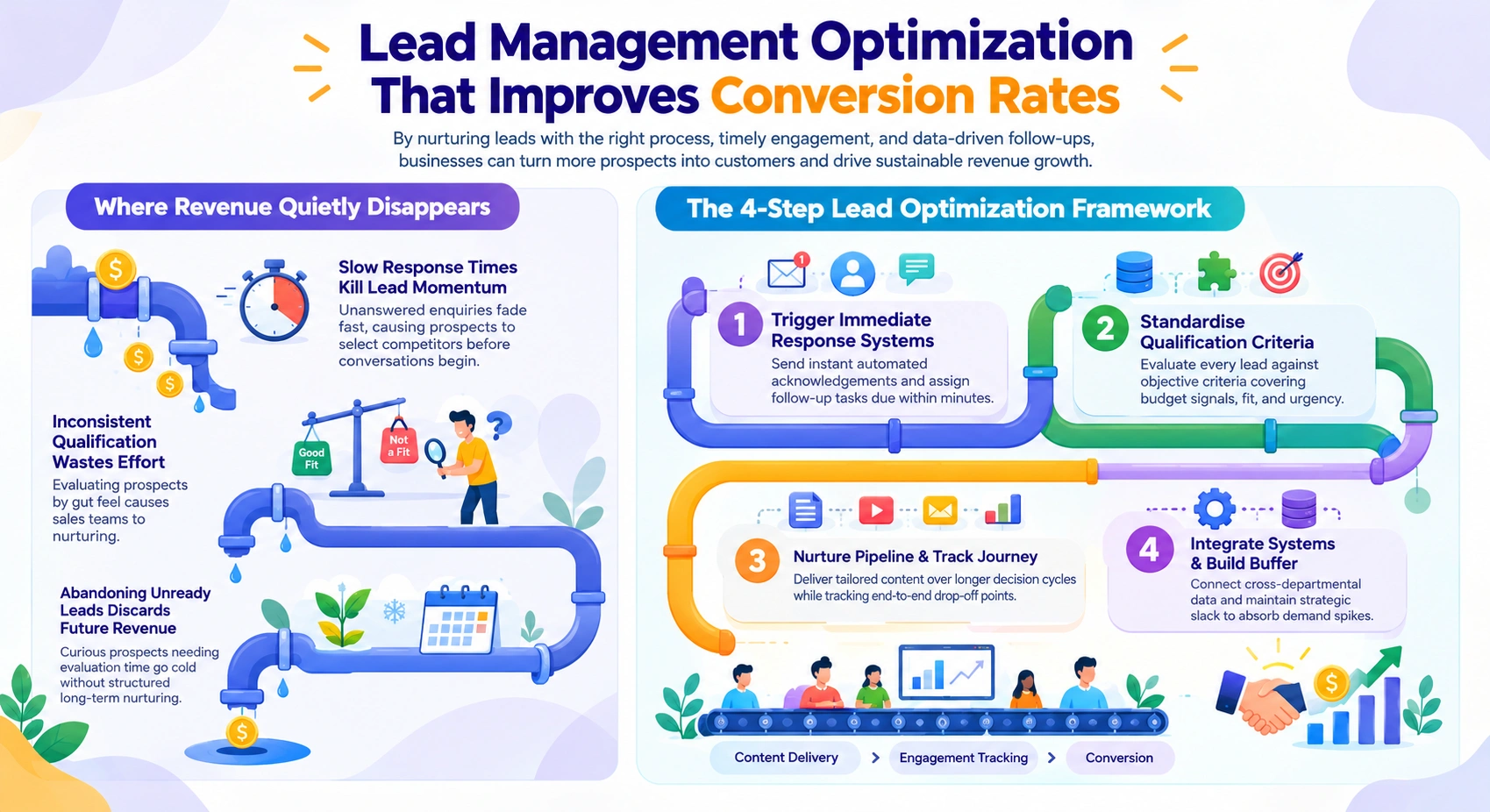
Lead Management Optimization_Where Most Revenue Quietly Disappears
Lead management optimization matters because most businesses lose revenue not from a genuine lack of leads, but from poor handling of the leads they already have sitting in front of them. A lead comes in through a form, a call, or a referral, and then what happens next is often inconsistent, slow, or simply forgotten entirely in the daily rush of running the business.
This is one of the most fixable problems in any Indian business, and also one of the most quietly expensive. Marketing works hard, often for weeks, to generate genuine interest through ads, content, and outreach. However, if that interest is not captured properly, qualified consistently, and followed up on with real discipline, all of that upstream effort simply goes to waste the moment the lead goes cold.
The frustrating part is that this waste rarely shows up as an obvious, visible failure. Nobody sees a lead quietly slip away the way they would notice a client complaint or a missed deadline. Instead, it shows up only indirectly, as a conversion rate that never quite improves no matter how much marketing spend increases, or as a sales team that always feels busy but somehow never closes as much as the pipeline volume would suggest it should.
Lead management optimization builds the system that captures every single lead reliably, qualifies it against consistent criteria, and moves it through a clearly defined journey toward conversion, rather than leaving that journey to chance or to whoever happens to notice the lead first. This blog explains exactly how that system works, from the first moment of contact through to long-term nurturing.
Why Leads Get Lost Without a System
Lead loss is rarely dramatic or sudden. It happens quietly, one small gap at a time, which is precisely what makes it so hard to notice and fix without deliberately looking for it.
The first gap is slow response time. A lead submits genuine interest, whether through a form, a chat message, or a phone enquiry, and then nobody replies for hours, sometimes even days, simply because the notification got buried or nobody was clearly assigned to respond. However, interest fades remarkably fast once someone has taken the initiative to reach out. A slow response often means a lost opportunity before the conversation has even properly started, regardless of how good the eventual follow-up message turns out to be.
A second gap is inconsistent qualification across the team. Without genuinely clear, agreed-upon criteria, some leads get chased hard and persistently while very similar leads get quietly ignored, based on nothing more meaningful than who happened to see them first or how busy that particular salesperson felt that day. As a result, the business's actual conversion rate depends far more on individual habits than on the underlying quality of the leads themselves.
A third gap, often the most costly over time, is the complete absence of nurturing for leads that are genuinely interested but not yet ready to buy. Many leads fall into exactly this category, curious and engaged but not at the decision point yet, whether because of budget timing, internal approvals, or simply needing more time to evaluate. However, without a deliberate nurturing strategy in place, these leads simply go cold and quietly disappear, even though they might well have converted three or six months later with the right ongoing touch.
A fourth gap is the lack of any feedback loop between what happens to a lead and how future leads get generated or handled. Sales knows, from direct experience, which leads actually convert and which never had a real chance. However, that insight rarely makes its way back to marketing in any structured way, so the same patterns of poor-fit leads keep recurring quarter after quarter without anyone connecting the dots.
Lead management optimization closes all four of these gaps at once, through a consistent, deliberately designed process rather than through individual habits that vary wildly from person to person.
Building Lead Management Optimization That Works
Step 1_Build Lead Conversion Systems for Fast Response
The first and often highest-leverage fix is speed of response. A properly built lead conversion system triggers an immediate acknowledgement message the moment a lead comes in, along with a clear follow-up task assigned to a specific person, due within a defined and genuinely short window, often measured in minutes rather than hours.
As a result of this speed, leads get contacted while their interest is still genuinely fresh and top of mind, which dramatically improves the odds of a real, substantive conversation actually happening, rather than the lead having already moved on to a competitor or simply lost momentum by the time anyone reaches out.
This step alone, implemented properly, often produces the single fastest, most visible improvement in conversion rate of anything in a lead management optimization project, since it addresses a gap that is almost entirely about process discipline rather than requiring any deep skill or persuasion technique.
Step 2_Standardise Qualification Criteria
Every lead that enters the system should get evaluated against the exact same clear, written criteria, rather than being assessed informally based on gut feel alone. Budget signals gathered during the first conversation. Genuine fit against the business's ideal customer profile. Clear urgency indicators that suggest a real, near-term decision is coming.
Because of this consistency, sales effort ends up going toward the leads genuinely most likely to convert, rather than being spread evenly, and somewhat wastefully, across leads of very different quality and readiness. Standardised criteria also make it far easier to have honest, data-backed conversations between marketing and sales about lead quality, since both teams are working from the same definitions rather than arguing past each other.
Over time, this standardisation also reveals which lead sources and campaigns consistently produce genuinely qualified leads, which then feeds directly back into where marketing chooses to invest its budget and effort going forward.
Step 3_Build a Nurturing Strategy for Leads Not Yet Ready
Sales funnel optimization is not just about pushing every single lead forward immediately toward a decision. Some leads genuinely need time, whether for internal budget cycles, competing priorities, or simply building enough trust before committing. A structured nurturing strategy keeps these leads meaningfully engaged over that time, through genuinely useful content, relevant updates, and periodic, well-timed check-ins that do not feel pushy or repetitive.
Therefore, when these leads eventually become ready to make a real decision, often weeks or months after the first contact, the business that stayed present and useful throughout that period is the one they remember and trust, rather than the one that gave up after two unanswered emails and moved on.
A genuinely good nurturing strategy also segments leads by their specific interests or concerns, rather than sending identical, generic messages to everyone in the pipeline regardless of what actually brought them in or what they care about.
Step 4_Track the Full Customer Journey Optimization
Lead management genuinely does not end at the moment of first conversion into a customer. Customer journey optimization means carefully tracking how leads move all the way from first contact, through qualification and nurturing, through to eventually becoming a loyal, repeat customer who continues generating revenue well beyond that first purchase.
As a result of this end-to-end tracking, the business can clearly spot exactly where in that longer journey people tend to drop off, whether that is during the initial follow-up, at the proposal stage, or well after the first sale during onboarding, and then fix that specific point directly rather than guessing at where the real problem sits.
This broader view also helps connect lead management work to genuinely business-level outcomes, like overall revenue and retention, rather than treating lead conversion as an isolated metric disconnected from what happens to the customer afterward.
Common Mistakes in Lead Management
Mistake 1_Treating Every Lead the Same
Not every lead genuinely deserves equal time and effort, however tempting it feels to treat every enquiry with the same enthusiasm out of politeness or hope. Clear qualification criteria should deliberately direct energy toward the leads most likely to actually convert, rather than spreading effort evenly regardless of underlying fit or readiness.
Mistake 2_Giving Up on Leads Too Early
Leads that are genuinely not ready today may well be ready in three months, once their internal timeline or budget situation changes. Without a real nurturing system in place, that future opportunity simply disappears entirely, and the business ends up paying, in effect, to reacquire a lead it had actually already earned the first time around.
Mistake 3_Responding Too Slowly to New Enquiries
Even a delay of just a few hours can meaningfully cost a conversion, particularly for enquiries that came in with real urgency or strong intent. Speed of response remains one of the single highest-leverage, lowest-cost fixes available in any lead management effort.
Mistake 4_Never Closing the Loop Between Sales and Marketing
When sales insight about which leads actually convert never makes its way back to marketing, the same patterns of poor-fit leads keep recurring indefinitely. Building a simple, regular feedback loop prevents this waste from repeating quarter after quarter.
How Xcellerators Hub Delivers Lead Management Optimization
At Xcellerators Hub, lead management optimization covers fast, reliable response systems, standardised qualification criteria, a structured nurturing strategy, and full journey tracking from first contact through to long-term retention. For Indian businesses currently losing meaningful revenue to poor lead handling, this closes the gap directly and measurably.
To go deeper into how this connects to the wider revenue system, explore How to Redesign Your Sales Funnel with RevOps and Sales and Marketing Alignment.
Every Lead Deserves a Consistent Process
Lead management optimization is genuinely not about generating more interest from scratch. It is about making sure the interest a business has already earned, often at real cost through marketing spend and time, actually turns into revenue rather than quietly disappearing somewhere between first contact and a closed deal. Fast response, consistent qualification, a deliberate nurturing strategy, and full journey tracking together close the specific gaps where most leads quietly disappear, without anyone in the business fully realising it was happening until the system is finally built to catch it.
Key Takeaways
- Most revenue loss comes from poor lead handling, not a lack of leads
- Respond fast_ideally within minutes_while interest is still fresh
- Standardise qualification so effort goes to the best-fit leads
- Nurture leads that are interested but not yet ready to buy
- Track the full journey from first contact through to loyal customer
Ready to Stop Losing Leads Quietly?
Our RXF System helps Indian businesses build fast response systems, clear qualification criteria, structured nurturing, and full journey tracking so more leads convert into real revenue.
Book a Coffee Call