
Business Systems Consulting — Building the Infrastructure Growth Depends On
Business systems consulting exists because sustainable growth genuinely needs infrastructure underneath it, not just ambition and effort at the top. A great product or a genuinely strong service can only carry a business so far on its own. Beyond a certain point, meaningful growth starts depending almost entirely on the systems sitting underneath it, the workflows, the tools, the processes that let a company operate reliably once it is meaningfully larger than when it started.
Many Indian companies grow past their existing systems well before they consciously realise it has happened. What worked comfortably with ten people quietly starts breaking with fifty, even though nobody made a deliberate decision to change how things worked along the way. However, by the time the strain becomes genuinely obvious to leadership, real damage has often already occurred, whether in delivery quality, in client trust that took years to build, or in team burnout that quietly drives good people out the door.
This pattern shows up with remarkable consistency across very different industries and company types in India. A services firm sees delivery quality slip as client volume grows faster than the team's actual capacity to manage each relationship well. A manufacturer sees order errors climb as production volume outpaces the informal tracking systems that worked fine at a smaller scale. A software company sees support tickets pile up as user numbers grow faster than the team's ability to respond thoughtfully to each one.
Business systems consulting fixes this before it becomes a genuine crisis that threatens the business's reputation or its ability to retain the clients it worked hard to win. It builds the operational systems that let a company genuinely grow without outgrowing its own ability to function well, deliver consistently, and treat its people fairly along the way. This blog explains in detail what that work involves, from the earliest diagnostic through to building infrastructure for the company's next stage.
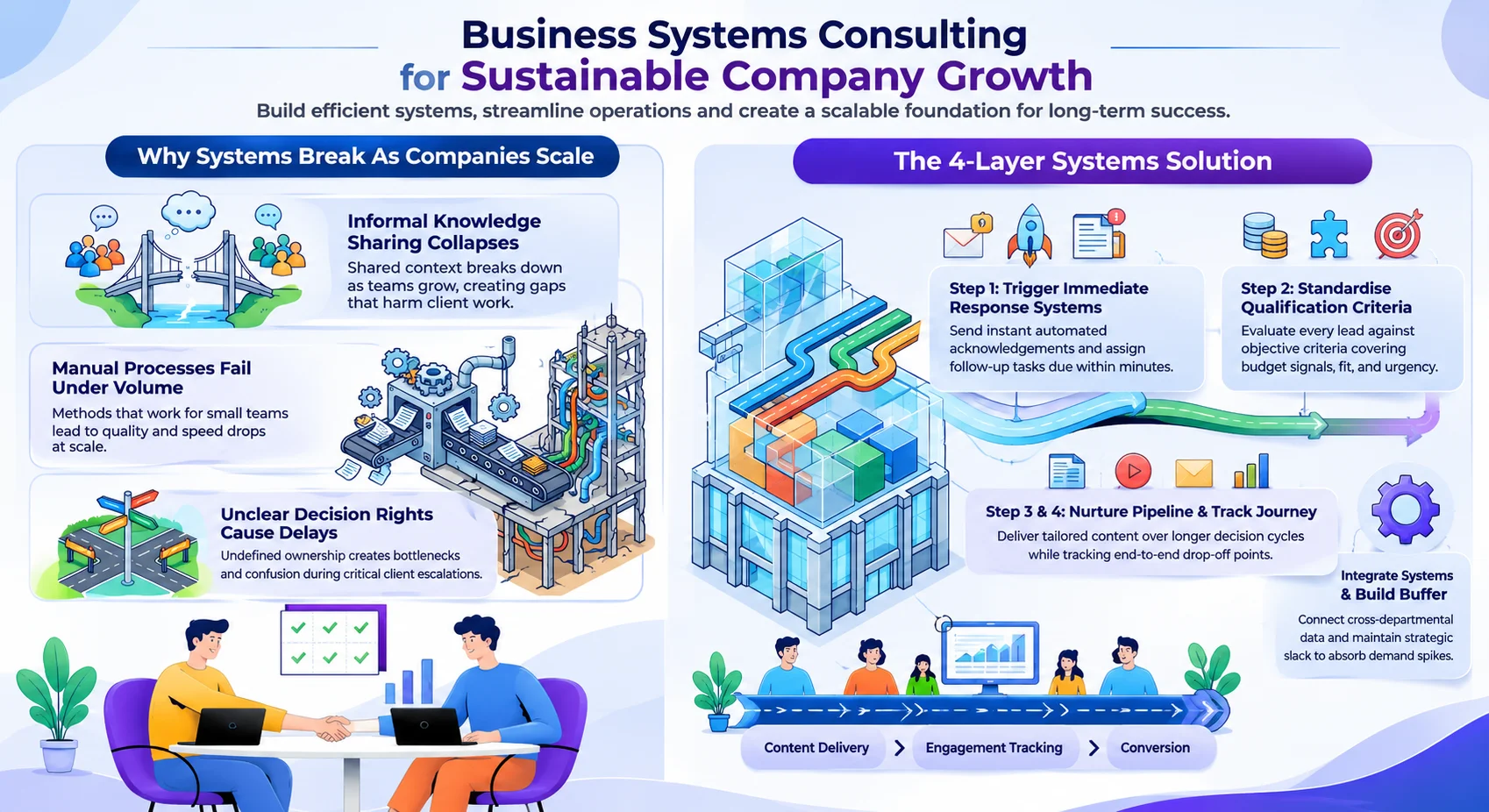
Why Companies Outgrow Their Own Systems
Systems that genuinely work well at one size often fail quite badly at another, and the underlying reasons behind this pattern are strikingly consistent across most growing Indian companies, regardless of their specific industry or product.
The first reason is heavy reliance on informal knowledge sharing. Early on, a small, tightly-knit team shares context naturally, through daily conversation, physical proximity, and the simple fact that everyone already knows what everyone else is working on. However, as the team grows meaningfully larger, this informal transfer of knowledge breaks down almost entirely, and real gaps in shared understanding start to show up in ways that directly affect client-facing work.
A second reason is manual processes that were never designed to handle real scale. What one person can comfortably handle by hand, tracking a handful of client accounts in a personal notebook, for instance, becomes genuinely impossible once that same process needs to handle ten times the original volume. Because of this mismatch, both quality and speed suffer noticeably as volume rises, even though the underlying team may be working just as hard, or harder, than before.
A third reason is unclear decision rights across a growing organisation. In a small company, everyone genuinely knows who decides what, often without it ever needing to be written down explicitly. However, as the org chart grows and more people join, unclear ownership creates real delay and confusion at exactly the moments when speed and clarity matter most, typically during a client escalation or a time-sensitive opportunity.
A fourth reason, closely connected to the first three, is the complete absence of any deliberate review rhythm for how the company actually operates. Even where a particular system was reasonably well designed originally, when the company was smaller, nobody revisits it as circumstances change around it. Therefore, small inefficiencies quietly accumulate over many months and years, until the gap between how work should genuinely flow and how it actually flows becomes significant and costly.
Business systems consulting addresses all three, or really all four, of these root causes directly and deliberately, before they harden into structural problems that become considerably harder, slower, and more expensive to fix once the company has grown even larger around them.
What Business Systems Consulting Delivers
Layer 1 — Operational Systems Setup
The genuine foundation of business systems consulting is building the operational systems a growing company actually needs, meaning clear workflows, explicitly defined roles, and thoroughly documented standard procedures that anyone on the team can follow without guessing.
As a result of this foundational work, the company can bring on genuinely new people and maintain consistent, reliable quality from their very first week, rather than depending on tribal knowledge that only a small handful of long-tenured employees happen to carry around in their heads, often without even realising how much the business depends on them personally.
Operational systems setup also typically involves a careful audit of existing tools to see which ones are genuinely being used well, which are being underused, and which have quietly been abandoned in favour of workarounds that nobody has ever formally documented.
Layer 2 — Workflow Consulting Across Departments
Workflow consulting carefully maps how work actually moves through the organisation, department by department and handoff by handoff, and then removes the specific friction points where those handoffs typically break down or slow to a crawl.
Because of this detailed mapping work, work ends up flowing considerably faster and with noticeably fewer errors, since each individual step in the process now has a genuinely clear owner and a genuinely clear next action, rather than depending on someone remembering to follow up or chase the next person along the chain.
Workflow consulting frequently uncovers handoff points that nobody in the company had previously recognised as a problem, simply because each individual team assumed the delay or confusion was happening somewhere else, outside their own area of responsibility.
Layer 3 — Process Management Systems
Beyond fixing individual workflows one at a time, process management systems give leadership genuine visibility into how the whole company operates as a connected system, rather than only seeing isolated, disconnected pieces of it through occasional team updates.
Therefore, problems get caught at a genuinely systemic level, across the business as a whole, rather than only being noticed once they show up as a specific client complaint, a missed deadline, or a frustrated team member raising the issue directly to leadership.
Process management systems also typically include some form of regular reporting rhythm, giving leadership a consistent, reliable way to monitor operational health over time, rather than only checking in reactively whenever something has already gone visibly wrong.
Layer 4 — Scaling Infrastructure for the Next Stage
Business systems consulting also deliberately looks ahead, building infrastructure genuinely suited not just for the company's current size and needs, but specifically for where the company is realistically heading over the next one to two years.
As a result of this forward-looking design, the company does not have to redo this same foundational work again in another year or two, since the systems built now are deliberately designed with meaningful headroom built into them from the start, rather than being sized exactly to fit today's team and volume alone.
This forward-looking layer often involves conversations with leadership about realistic growth plans, hiring timelines, and new markets or product lines under consideration, so the systems being built can genuinely anticipate that trajectory rather than only reflecting the present moment.
Common Mistakes in Business Systems Work
Mistake 1 — Waiting Until Systems Visibly Break to Fix Them
By the time operational strain becomes genuinely obvious to leadership, real damage has often already happened, whether to client relationships, team morale, or the company's broader reputation in its market. Building systems proactively, well ahead of that visible breaking point, costs meaningfully less than repairing the fallout afterward, both in money and in time.
Mistake 2 — Copying Systems from Other Companies Wholesale
Systems built originally for a different company's specific structure, culture, and client base rarely transfer cleanly to a business with genuinely different circumstances. Effective business systems consulting adapts thoughtfully to the specific company being worked with, rather than simply applying a generic template borrowed from elsewhere.
Mistake 3 — Building Systems Without Genuine Team Input
Systems designed purely from the top down, without meaningful input from the people who actually use them every single day, often miss real, practical friction points that only become obvious from ground level, where the day-to-day work actually happens. Include the team directly in the design process for considerably better, more workable outcomes.
Mistake 4 — Treating Systems Work as a One-Time Project
Some companies treat business systems consulting as a single project with a clear beginning and end, after which the systems are simply left to run indefinitely without revisiting them. However, as the company continues to change, growing headcount, entering new markets, launching new offerings, those systems need periodic review to stay genuinely fit for purpose.
How Xcellerators Hub Delivers Business Systems Consulting
At Xcellerators Hub, business systems consulting builds operational systems from the ground up, carefully maps workflows across departments, sets up process management visibility for leadership, and plans deliberately for the company's next stage of growth. For Indian companies genuinely feeling the strain of outgrowing their own processes, this creates real, tangible relief rather than another layer of theoretical advice.
To go deeper into how this connects to broader growth work, explore Scaling Operations: Build Systems That Support Revenue Growth and SME Business Scaling Services.
Systems Are What Let Ambition Actually Land
Business systems consulting turns genuine ambition into something a company can actually sustain over years, rather than just months. Clear workflows that anyone can follow. Thoroughly documented processes that do not depend on any one person's memory. Genuinely visible operations that leadership can actually monitor. Infrastructure deliberately built for what comes next, rather than only for today. Without this kind of foundation, growth eventually and predictably outpaces the company's ability to deliver on it well, regardless of how talented or hardworking the team is. With it firmly in place, growth becomes something the business can genuinely carry forward, year after year, rather than something that quietly threatens to overwhelm it.
Key Takeaways
- Companies outgrow informal systems long before leadership notices
- Build clear workflows, roles, and documented procedures early
- Map handoffs across departments to remove friction and errors
- Give leadership visibility into the whole operation, not isolated pieces
- Design systems with headroom for the next one to two years of growth
Ready to Build Systems That Support Growth?
Our RXF System helps Indian companies build operational systems, map workflows, create process visibility, and plan infrastructure for the next stage of growth.
Book a Coffee Call