
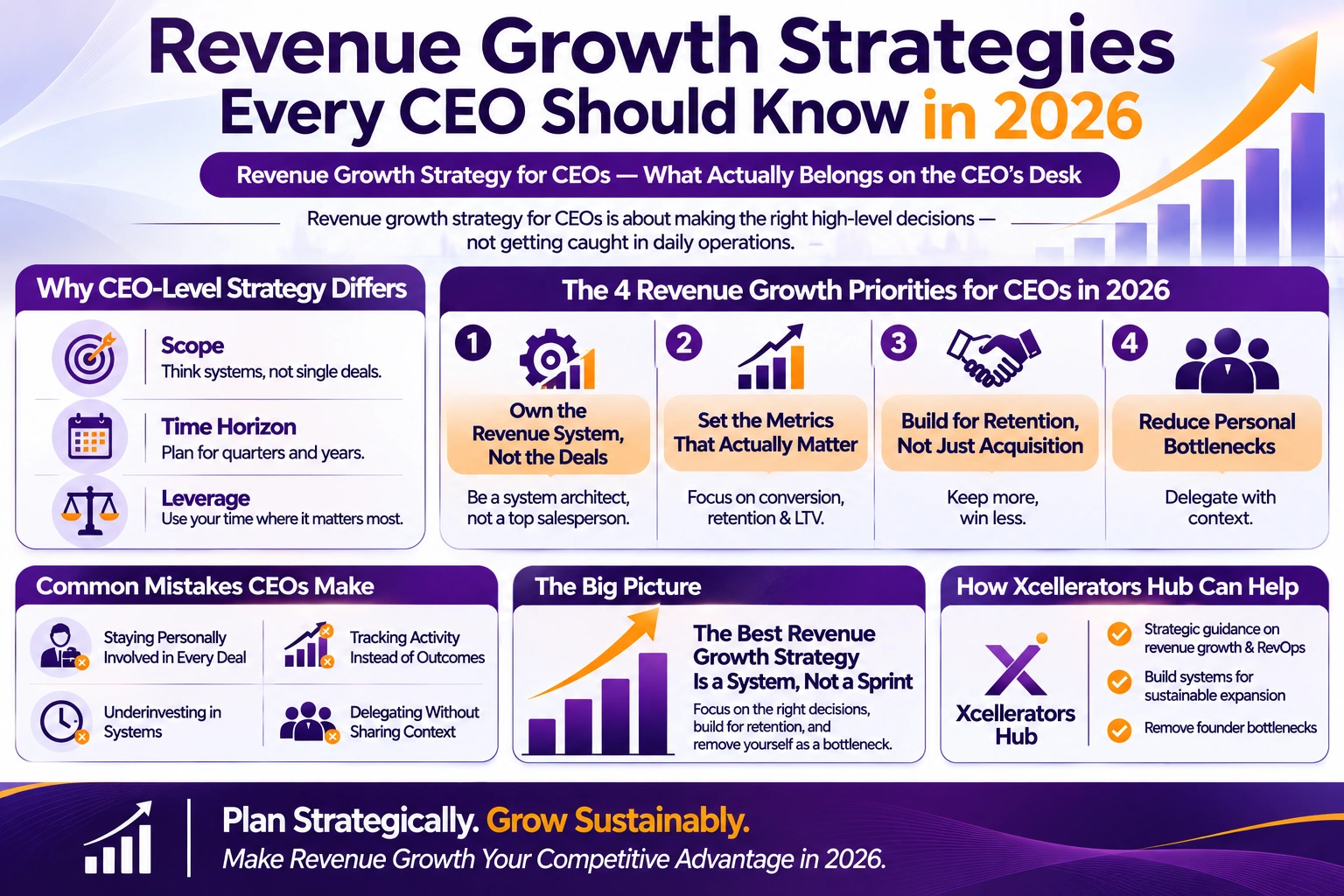
Revenue Growth Strategy for CEOs — What Actually Belongs on the CEO's Desk
Revenue growth strategy for CEOs is genuinely different from strategy conversations happening at any other level of the business. A CEO does not particularly need to know how to build a specific ad campaign or configure a specific CRM field. Instead, they need real clarity on which structural, higher-level decisions actually move revenue in a meaningful way, and which ones simply feel productive in the moment without genuinely changing the trajectory of the business.
Many CEOs, especially in fast-growing Indian companies, spend a surprising amount of their limited time and energy on the wrong layer of the business entirely. They get pulled directly into individual deals that a capable sales manager could handle alone. They get involved in individual hiring decisions well below their level. They review individual campaigns that a marketing lead is already qualified to run. However, the decisions that genuinely shape a company's revenue trajectory over years sit at a considerably higher level, in the systems, the incentives, and the priorities the CEO deliberately sets for the whole organisation to operate within.
This misallocation of attention is not usually a sign of poor judgment on the CEO's part. It often comes from genuine care about quality and a natural instinct to help wherever help seems needed in the moment. However, that same instinct, if left unchecked as the company grows, quietly becomes the single biggest constraint on how large and how resilient the business can actually become, since the CEO's own bandwidth becomes the effective ceiling on growth.
This blog covers the revenue growth strategy for CEOs that genuinely matters heading into 2026, focusing specifically on the decisions worth a CEO's direct, personal attention, and the ones that should be deliberately delegated well before they ever reach the CEO's desk.
Why CEO-Level Strategy Differs From Team-Level Execution
A CEO who tries to manage revenue growth the exact same way a capable sales manager would ends up spread far too thin across too many small decisions, while genuinely important structural questions quietly go unanswered in the background.
The first meaningful difference is scope. CEO business strategy operates at the level of systems and organisational structure, not at the level of any individual deal or campaign. Whether the sales pipeline is genuinely visible company-wide, and whether teams are working from consistent, shared data, matters considerably more to long-term revenue health than the specific status of any single deal on any given Tuesday.
A second meaningful difference is time horizon. Growth leadership consulting typically pushes CEOs to think deliberately in terms of quarters and years, rather than getting pulled entirely into the current week or month's pressing concerns. Short-term wins that come at the cost of damaging longer-term systems, cutting corners on hiring quality to fill a role quickly, for instance, are rarely genuinely worth the trade-off once the full cost becomes visible later.
A third meaningful difference is leverage. A CEO's own time is, without question, the single scarcest resource inside the entire company, considerably scarcer than budget or even than most specific skill sets, since it genuinely cannot be hired for or purchased more of. Therefore, that limited attention should go specifically toward the small number of decisions only the CEO can genuinely make, rather than toward tasks a well-supported team could handle competently without them.
Executive growth planning starts by honestly recognising these three differences and then deliberately structuring the CEO's time and attention around them, rather than letting the calendar simply fill up reactively with whatever feels most urgent on any given day.
The Revenue Growth Strategy Every CEO Should Prioritise in 2026
Priority 1 — Own the Revenue System, Not the Deals
Scaling business strategy genuinely asks CEOs to focus their attention on whether the underlying revenue system works reliably as a whole, rather than on personally closing every important deal that comes through the pipeline.
As a result of this shift in focus, the CEO's actual role moves from being the company's top individual salesperson toward being its system architect, someone who ensures the pipeline, the team, and the underlying process all function well together without requiring their constant, personal involvement in every step along the way.
This shift often feels uncomfortable initially, particularly for founder-CEOs who built the company's early growth through their own personal relationships and hands-on deal-closing. However, it is precisely this shift that allows revenue growth to eventually outpace what any single person's calendar could ever support alone.
Priority 2 — Set the Metrics That Actually Matter
CEO business strategy heading into 2026 means deliberately choosing a genuinely small set of metrics that reflect true revenue health, conversion rate, churn, and customer lifetime value, rather than defaulting to vanity numbers like total leads generated or total meetings booked, which look impressive without necessarily reflecting real business health.
Because of this deliberate choice, the whole organisation ends up optimising for outcomes that genuinely matter to the business's long-term trajectory, rather than for activity that merely looks productive in a weekly update without actually moving the needle on profitable, sustainable growth.
The specific metrics a CEO chooses to review regularly send a powerful, often underappreciated signal throughout the company about what genuinely matters, since teams naturally tend to optimise for whatever leadership is visibly paying attention to.
Priority 3 — Build for Retention, Not Just Acquisition
Growth leadership consulting increasingly points CEOs toward retention as genuinely the highest-leverage growth lever available to most established businesses, considerably more so than most CEOs initially assume. Acquiring a genuinely new customer is expensive, often surprisingly so once fully accounted for. Keeping an existing one, by comparison, is considerably cheaper across almost every business model.
Therefore, CEOs should be asking about churn rates and retention systems just as often, and with just as much genuine curiosity, as they ask about new customer acquisition numbers in a typical leadership review, rather than treating retention as a secondary concern that customer success alone should worry about.
Priority 4 — Reduce Personal Bottlenecks Deliberately
Executive growth planning means actively and deliberately identifying where the CEO has personally become a bottleneck within the organisation, and then building the specific systems, documentation, and delegated authority that remove that dependency over time.
As a result of this deliberate work, the business can genuinely grow past what the CEO alone could ever personally manage or oversee, which is ultimately the ceiling that every growing company eventually runs directly into if this work is left undone. Removing that ceiling, deliberately and well ahead of hitting it, is arguably the single most valuable thing a CEO can do for the company's long-term trajectory.
Common Mistakes CEOs Make with Revenue Growth Strategy
Mistake 1 — Staying Personally Involved in Every Deal
This feels genuinely like strong leadership in the moment, and it often comes from real care about outcomes. However, it reliably caps the company's growth at the CEO's own personal bandwidth and quietly prevents the broader team from developing real ownership and confidence in running deals independently.
Mistake 2 — Tracking Activity Instead of Genuine Outcomes
Watching how busy the team appears to be, through meeting counts or activity logs, tells a CEO remarkably little about whether revenue is actually healthy underneath the surface. Track conversion, retention, and profit instead, since these reflect genuine business health far more reliably than raw activity ever will.
Mistake 3 — Underinvesting in Systems Because They Feel Slow to Build
Building genuine systems takes noticeably longer upfront than simply pushing the existing team harder for another quarter. However, well-built systems compound in value over time, while raw individual effort, however impressive in the short term, eventually and predictably plateaus.
Mistake 4 — Delegating Authority Without Also Delegating Genuine Context
Some CEOs attempt to remove themselves as a bottleneck by handing off decisions without also sharing the underlying context and reasoning that informed how they previously made those same decisions. As a result, the team ends up making inconsistent choices, and the CEO gets pulled back in anyway to correct course.
How Xcellerators Hub Supports CEOs on Revenue Growth Strategy
At Xcellerators Hub, work with CEOs focuses deliberately on the system-level decisions that actually drive sustainable growth, choosing the metrics that genuinely matter, building real retention systems, and removing founder bottlenecks in a structured, thoughtful way. This is executive growth planning built specifically around how growth actually works in practice, rather than around generic leadership advice.
To go deeper into how this connects to broader strategic work, explore Business Growth Consulting and RevOps Strategy Framework.
The Best Revenue Growth Strategy Is a System, Not a Sprint
Revenue growth strategy for CEOs heading into 2026 ultimately comes down to focus, more than to any single tactic or quick win. Own the underlying system, rather than every individual deal. Track genuine outcomes, rather than surface-level activity. Build deliberately for retention, not just for new acquisition. Remove yourself as the operational bottleneck, deliberately and well ahead of when it becomes urgent. That is genuinely what scaling business strategy looks like when it actually compounds over years, rather than strategy that simply keeps a CEO personally busy without meaningfully changing the company's underlying trajectory.
Key Takeaways
- CEO strategy operates at system level, not deal or campaign level
- Own the revenue system rather than personally closing every deal
- Track conversion, churn, and LTV — not vanity activity metrics
- Prioritise retention as a high-leverage growth lever
- Deliberately remove yourself as the operational bottleneck
Ready to Focus on the Decisions That Actually Move Revenue?
Our RXF System helps CEOs own the revenue system, set the right metrics, build retention, and remove founder bottlenecks for sustainable growth.
Book a Coffee Call