
CRM and RevOps Consulting — Where Tools Meet Strategy
CRM and RevOps consulting sits at the intersection of two things Indian businesses usually end up handling as if they were completely separate projects. The revenue strategy on one side, and the tool meant to actually run that strategy on the other. Most businesses treat these as two unrelated purchases, made at different times, by different people, for different reasons. As a result, they end up with a CRM that does not genuinely reflect how the business actually sells, delivers, or retains customers.
This mismatch is remarkably common across Indian SMEs and mid-market companies alike. A business buys a CRM because everyone in the industry says they need one, or because a competitor mentioned using one at a conference. However, nobody then goes back and connects that CRM to the actual sales process, the real customer journey the business follows, or the specific metrics that genuinely matter for that business's growth. Because of this disconnect, the CRM slowly becomes an expensive, half-used contact list that the sales team quietly resents rather than relies on.
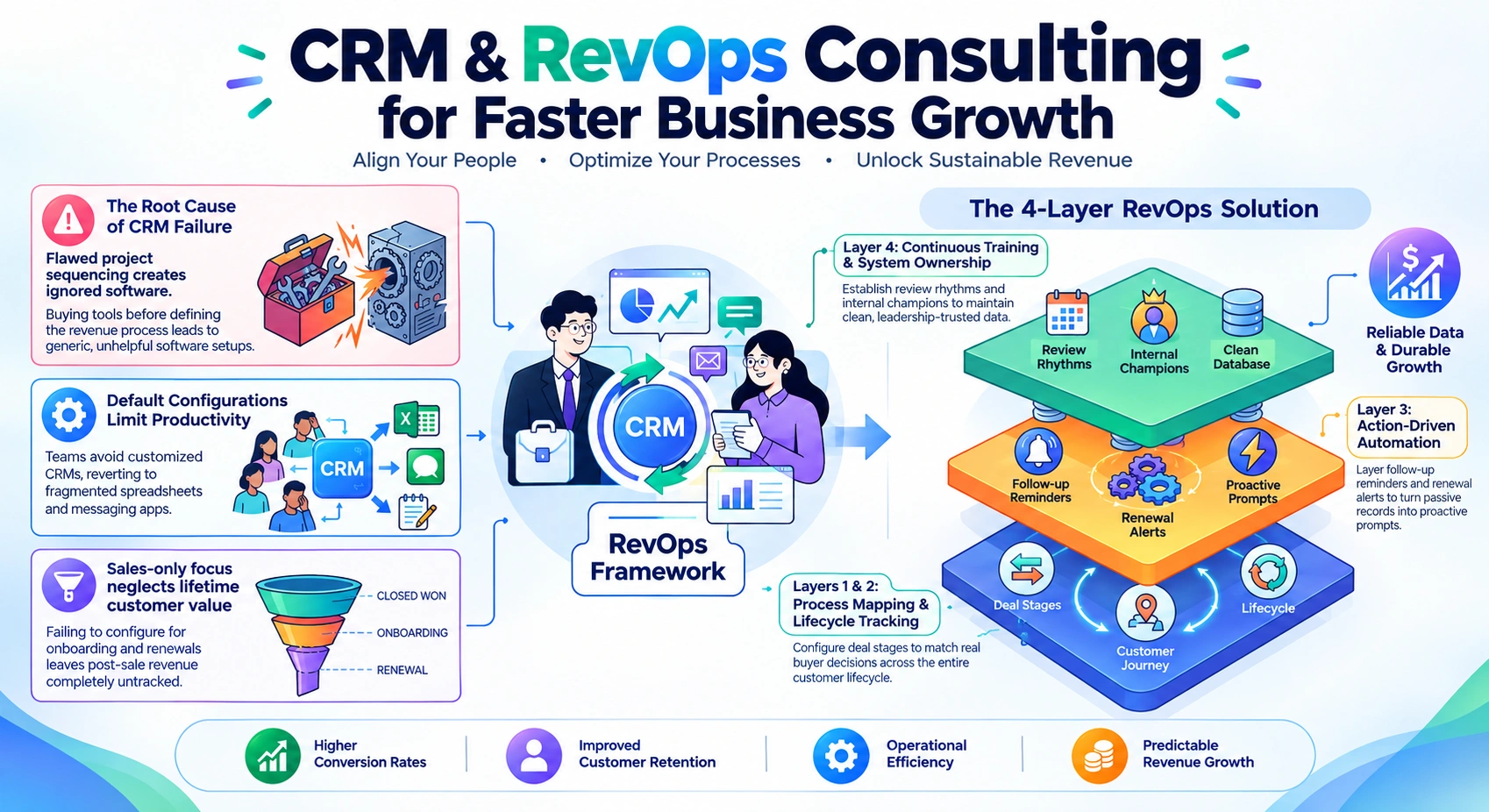
The root of the problem is sequencing, more than it is any specific tool choice. Businesses typically choose the CRM first, based on price, popularity, or a recommendation, and only think about process and strategy afterward, if at all. However, effective RevOps work has to run in the opposite direction, with process and strategy shaping exactly how the tool gets configured, rather than the tool's default settings quietly shaping how the business ends up working.
CRM and RevOps consulting fixes this by treating the tool and the underlying strategy as a single, unified project from day one, rather than as two separate initiatives that happen to touch the same software. This blog explains how that combined approach actually works in practice, and why it consistently produces faster, more durable growth than either piece pursued alone.
Why CRM and Strategy Need to Be Built Together
Buying CRM optimization services without a clear strategy behind them wastes money, since the optimization work has nothing genuine to optimize toward. Building a thorough revenue strategy without ever configuring the CRM around it wastes the strategy itself, since nothing in the team's daily tools actually reflects or reinforces it. Neither approach, on its own, produces a business that genuinely runs better day to day.
The first problem with a strategy-only approach, however well-designed the strategy itself might be, is that nothing actually runs the plan on a Tuesday afternoon when the team is busy and under pressure. A well-crafted sales CRM strategy has to live somewhere the team touches constantly and naturally, as part of their existing workflow, or it inevitably stays theoretical, discussed in quarterly meetings but ignored the rest of the time.
A second problem, with the opposite, tools-only approach, is that a CRM configured around nothing in particular, using whatever default stages and fields the software ships with, ends up reflecting nobody's actual process. As a result, the team either actively avoids using it, finding workarounds through spreadsheets and messaging apps instead, or they use it inconsistently, entering just enough data to satisfy a manager's occasional check-in rather than genuinely relying on it.
A third, related problem is that these two failure modes tend to reinforce each other over time. A business that has already been burned by a poorly implemented CRM becomes reluctant to invest properly in strategy work, assuming any system will suffer the same fate. Meanwhile, a business that has invested heavily in strategy without implementation becomes cynical about consulting more broadly, having seen expensive advice go nowhere.
CRM and RevOps consulting solves both problems simultaneously by designing the process and the tool side by side, in the same engagement, so that each one directly reinforces and validates the other rather than existing as separate, disconnected workstreams.
What CRM and RevOps Consulting Delivers
Layer 1 — Process-Led CRM Configuration
The engagement genuinely starts by mapping the real sales and customer journey as it actually happens today, including all its informal quirks and exceptions, and only then configuring the CRM to reflect exactly that mapped reality. Pipeline stages get built to match real decision points a deal actually passes through, rather than generic stages borrowed from a template. Fields get built to capture what genuinely matters for that specific business's decisions, rather than whatever fields happened to come pre-loaded.
As a result of this sequencing, every single part of the configured CRM has a clear, traceable purpose tied directly to the business's actual process, rather than existing as unused clutter that the team learns to simply ignore or scroll past.
This process-led approach also naturally surfaces gaps in the underlying process itself, since attempting to configure a stage or field around a step that turns out to be poorly defined forces that definition to get sharpened before the configuration can proceed.
Layer 2 — Customer Lifecycle Optimization
CRM and RevOps consulting deliberately extends well past the moment of the first sale, since revenue does not stop mattering once a deal closes. Customer lifecycle optimization means the CRM also carefully tracks onboarding progress, upcoming renewal dates, and emerging upsell signals, not merely the initial deal that first brought the customer in.
Because of this broader scope, the tool ends up genuinely supporting the full relationship a business has with a customer, across years in many cases, rather than only supporting the narrow moment when they first sign a contract or place an order. This matters enormously for businesses where repeat revenue, renewals, or account growth make up a meaningful share of overall revenue, which describes the vast majority of Indian SMEs once they mature past their earliest stage.
Lifecycle tracking also gives customer success and account management teams a genuine home inside the CRM, rather than leaving them to manage relationships through separate spreadsheets that never connect back to the original sales data.
Layer 3 — Automation Built Around the CRM
Once the CRM genuinely reflects the underlying process, automation gets carefully layered on top of that solid foundation. Lead acknowledgement messages that fire the moment a new enquiry lands. Follow-up reminders that trigger reliably based on time elapsed or stage stagnation. Renewal alerts that surface well ahead of a contract's actual expiry date, giving the account team real time to act.
Therefore, the CRM stops functioning as a passive record that someone has to remember to check, and instead starts actively driving the next best action for the team, prompting rather than waiting to be consulted.
Automation at this stage also typically includes basic reporting that pulls automatically from CRM data, removing the need for someone to manually compile numbers into a spreadsheet each week for a leadership review.
Layer 4 — Team Training and Adoption
Sales CRM strategy only genuinely works in practice if the sales team actually uses the CRM consistently, entering real information rather than the bare minimum needed to avoid a manager's complaint. Proper training, clearly communicated expectations, and a regular, recurring review rhythm together ensure that adoption sticks well beyond the initial rollout period.
As a result of this sustained attention to adoption, the business ends up with clean, genuinely reliable data that leadership can actually trust when making decisions about hiring, budgeting, or strategic direction, rather than data that everyone privately knows is only partially accurate.
Training at this stage also usually identifies one or two internal champions on the team who take particular ownership of CRM hygiene going forward, giving the system a caretaker rather than leaving it to gradually decay once the formal consulting engagement wraps up.
Common Mistakes in CRM and RevOps Projects
Mistake 1 — Buying the CRM Before Defining the Process
This remains the single most common mistake businesses make, and it is an understandable one, since buying software feels like tangible progress in a way that process mapping does not. Without a clearly defined process guiding the setup, the CRM configuration ends up generic and disconnected from how the business actually operates, regardless of how capable the underlying software itself might be.
Mistake 2 — Configuring for Sales Only
A CRM built exclusively around the sales function misses the broader customer lifecycle that exists well beyond the first deal, including onboarding, renewals, and account growth. As a result, retention and upsell opportunities go completely untracked, even though they often represent some of the most profitable revenue available to the business.
Mistake 3 — Skipping the Training Layer to Save Time
Even a genuinely well-built CRM fails to deliver real value without proper team buy-in and consistent use. Training and clearly communicated expectations are not optional extras that can be trimmed to save budget or time. Instead, they sit at the very core of whether the entire project succeeds or quietly fails within a few months.
Mistake 4 — Treating the Project as Finished at Launch
Some businesses consider the CRM project complete the moment it goes live. However, without an ongoing review rhythm and a clearly named internal owner responsible for the system, even a carefully built CRM gradually drifts back toward the disorganised state it started in.
How Xcellerators Hub Delivers CRM and RevOps Consulting
At Xcellerators Hub, CRM and RevOps consulting always starts with process mapping, then moves carefully through configuration, targeted automation, and thorough training. For Indian businesses carrying a CRM that nobody genuinely trusts or relies on, this approach turns the tool into an actual, valuable business asset rather than a recurring software expense that delivers little in return.
To go deeper into how this connects to the broader revenue system, explore RevOps Implementation Services to Build Scalable Revenue Systems and Top RevOps Consultant in India for Scaling Businesses.
The Tool Should Match the Strategy
CRM and RevOps consulting works precisely because it treats the tool and the underlying strategy as one connected project, rather than as two separate purchases made at different times for different reasons. When the CRM genuinely reflects the real process a business follows, the team actually uses it consistently, and the data it produces becomes something leadership can actually trust and act on. That trust, built up over time through consistent, accurate data, is what ultimately turns a CRM from a recurring cost centre that the business tolerates into a genuine growth engine that the business actively relies on for decisions.
Key Takeaways
- CRM and strategy must be built together, not as separate projects
- Configure the CRM around the real process, not generic defaults
- Extend the CRM across the full customer lifecycle, not just the first sale
- Layer automation only after the process and configuration are solid
- Train the team and set an ongoing review rhythm so adoption sticks
Ready to Make Your CRM Match Your Strategy?
Our RXF System helps Indian businesses design process and CRM together, then layer automation and training so the tool becomes a real growth engine.
Book a Coffee Call