
Scaling Operations for Growing Businesses — The Backbone Revenue Growth Actually Needs
Scaling operations for growing businesses is the part of growth that nobody talks about much in the early excitement of winning new clients. Almost everyone focuses their attention on sales and marketing, on the next campaign or the next big deal. However, revenue growth eventually and predictably runs directly into the limits of the operations sitting underneath it, no matter how strong the sales engine itself becomes.
A business can genuinely win more clients month after month, but if delivery cannot keep pace with that growing demand, the growth itself starts turning into strain rather than success. Orders get delayed past the timelines that were promised. Quality quietly slips as the same small team tries to stretch across more work than it was ever built to handle. As a result, the very growth the business worked so hard to win in the first place starts actively damaging the reputation it took years to build.
This pattern shows up with striking consistency across Indian companies scaling quickly, regardless of industry. The sales and marketing functions get invested in deliberately, with real budget and real attention. Operations, by comparison, often gets built almost entirely reactively, patched together piece by piece as specific problems appear, rather than being designed thoughtfully ahead of the growth that is clearly coming.
Scaling operations for growing businesses means deliberately building the infrastructure, the workflows, the supporting tools, and the team structure that lets revenue growth actually get delivered well once it arrives, rather than merely being sold and then struggled with afterward. This blog explains in detail what that infrastructure genuinely looks like, and how to build it before growth forces the issue.
Why Operations Break Before Revenue Does
Most Indian businesses invest heavily and visibly in sales and marketing, since the results of that investment are immediate and easy to point to. Operations, by comparison, often gets built reactively, patched together as specific problems appear rather than designed thoughtfully ahead of genuine need, since the payoff from operational investment is less visible until something actually breaks.
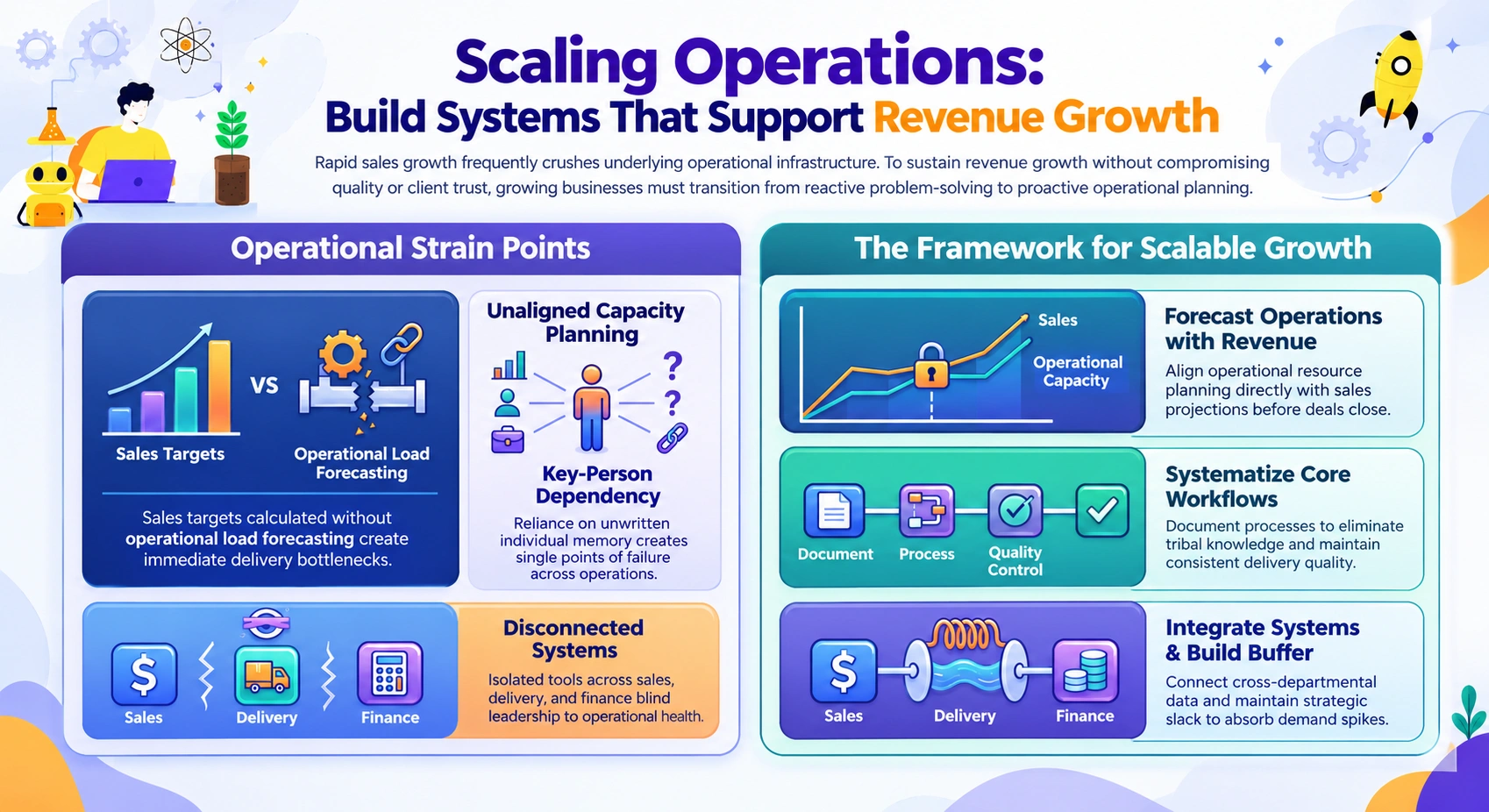
The first strain point that reliably appears is capacity planning, or more precisely the absence of it. Very few businesses formally forecast their operational load alongside their sales targets, treating the two as connected planning exercises rather than separate conversations happening in different meetings. As a result, a genuinely strong sales quarter arrives, everyone celebrates, and delivery discovers it has no real plan for handling the corresponding increase in workload that quarter has just created.
A second strain point is manual, heavily person-dependent workflows that were never designed with scale in mind. When operations run substantially on one particular person's accumulated knowledge, judgment, or sheer individual effort, growth immediately overloads that specific person well before it overloads the business as a whole. Because of this concentration of dependency, operations quietly become the actual ceiling on how fast revenue can grow, regardless of how much demand the sales team manages to generate.
A third strain point is disconnected systems across different parts of the business. Sales, delivery, and finance often run on entirely separate tools that do not share data with each other in any meaningful way. Therefore, nobody in the business has a genuinely complete, accurate picture of what is actually happening across the whole operation at any given moment, which makes coordinated decision-making during a growth period considerably harder than it needs to be.
A fourth strain point, closely related to the third, is the absence of any early warning system. Without connected data and clear capacity forecasts, operational strain tends to stay invisible right up until it becomes an obvious, visible failure, a missed deadline or a frustrated client, rather than showing up early as a manageable warning sign that leadership can act on calmly.
Scaling operations for growing businesses fixes all four of these strain points before they turn into visible, damaging failures that are far harder and more expensive to repair after the fact than they would have been to prevent in advance.
How to Build Scaling Operations for Growing Businesses
Step 1 — Forecast Operational Load Alongside Revenue
Business infrastructure growth genuinely starts with deliberately connecting the sales forecast to a corresponding operational capacity plan, treating them as two halves of the same planning process rather than separate workstreams. If sales genuinely expects thirty percent more deals next quarter, operations needs access to that exact number well ahead of time, not after the deals have already started closing.
As a result of this connected forecasting, the operations team can plan hiring, tooling changes, and workflow adjustments genuinely ahead of the growth arriving, rather than scrambling to react to it once it has already landed and started causing visible strain.
Step 2 — Document and Systematise Core Workflows
Operations management consulting typically starts by thoroughly documenting every core delivery workflow the business relies on, deliberately removing dependency on any single person's memory or individual working style in the process.
Because of this documentation work, the business can bring on genuinely new team members and maintain consistent, reliable quality from day one, rather than depending on tribal knowledge that only a small handful of long-tenured people happen to hold in their heads.
Step 3 — Connect Systems Across the Business
Scalable systems consulting means deliberately connecting sales, delivery, and finance data so that everyone across the business genuinely works from the same, current picture rather than from separate, disconnected fragments. A closed deal should automatically trigger the right sequence of operational steps, without requiring a manual handoff that depends on someone remembering to make a phone call or send an email.
Therefore, information moves through the business as fast as growth actually needs it to move, rather than waiting on someone to notice a change and manually pass it along to the next person or team in the chain.
Step 4 — Build in Slack, Not Just Raw Capacity
Operational scaling that runs constantly at close to one hundred percent capacity has genuinely no room left to absorb surprises, which inevitably arrive regardless of how carefully a business plans. Building some deliberate, planned slack into the system means the business can absorb an unexpected spike in demand without the whole operation visibly breaking under the pressure.
As a result of this built-in buffer, the operation stays meaningfully resilient even when demand does not arrive exactly as originally forecasted, which it rarely does with perfect precision in practice.
Common Mistakes When Scaling Operations
Mistake 1 — Scaling Sales Faster Than Delivery Can Handle
Winning more business than operations can actually deliver well damages precisely the client relationships the sales team worked so hard to build in the first place. Match the pace of investment on both sides deliberately, rather than letting sales run well ahead of what delivery can realistically support.
Mistake 2 — Relying Heavily on Key-Person Dependency
When one particular person holds critical operational knowledge that nobody else has access to, that person quietly becomes a single point of failure for the entire business, whether or not anyone has explicitly acknowledged it. Document and deliberately share that knowledge instead, well before it becomes an emergency.
Mistake 3 — Ignoring System Integration Between Teams
Disconnected sales, delivery, and finance tools create genuine blind spots exactly when visibility across the business matters most, which is precisely during periods of fast, demanding growth when coordination becomes hardest to manage informally.
Mistake 4 — Waiting for a Crisis Before Building Slack Into the System
Some businesses only recognise the value of buffer capacity after a particularly bad quarter forces the issue painfully into view. Building in slack proactively, before it is urgently needed, costs considerably less than the damage caused by not having it when a genuine spike arrives.
How Xcellerators Hub Supports Scaling Operations for Growing Businesses
At Xcellerators Hub, scaling operations for growing businesses means carefully forecasting capacity, documenting core workflows, connecting systems across the business, and deliberately building resilience directly into the operation itself. For Indian businesses growing quickly, this approach keeps delivery quality genuinely intact even as demand rises significantly.
To go deeper into how this connects to the wider business system, explore Business Process Optimization Services for SMEs and Business Systems Consulting for Sustainable Company Growth.
Operations Should Grow Ahead of Revenue, Not Behind It
Scaling operations for growing businesses fundamentally means deliberately building the necessary infrastructure before growth demands it, rather than scrambling reactively to catch up once the strain has already become visible and costly. Forecasted capacity, thoroughly documented workflows, genuinely connected systems, and deliberately built-in resilience together let revenue growth land well once it arrives, rather than straining the very business that worked so hard to win it in the first place.
Key Takeaways
- Operations often lag behind revenue because they are built reactively
- Forecast operational load alongside the sales forecast
- Document workflows to remove key-person dependency
- Connect sales, delivery, and finance systems for shared visibility
- Build deliberate slack so the operation can absorb demand spikes
Ready to Scale Operations Ahead of Revenue?
Our RXF System helps Indian businesses forecast capacity, document workflows, connect systems, and build resilience so delivery supports growth instead of straining under it.
Book a Coffee Call