
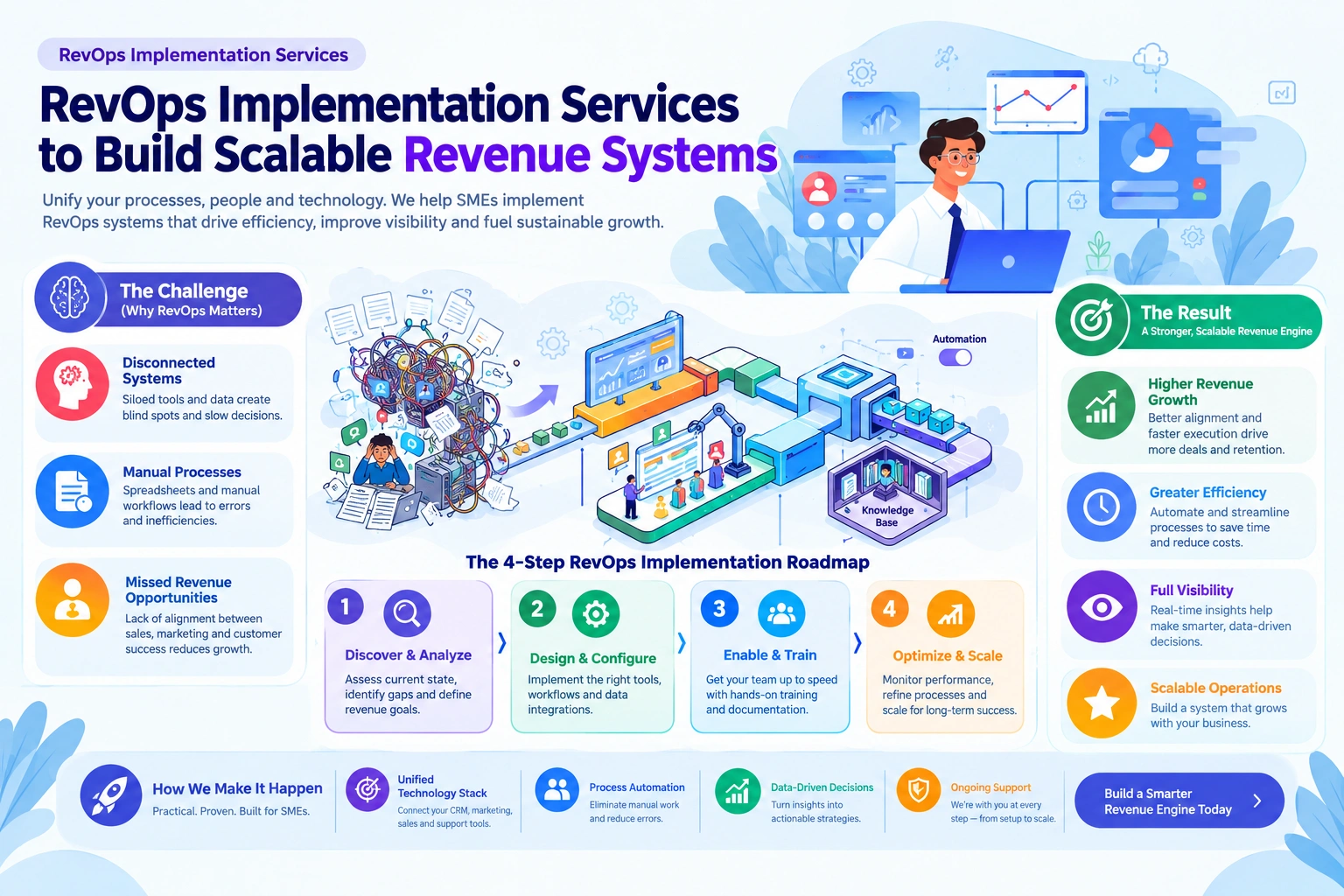
RevOps Implementation Services — Where Strategy Becomes a Working System
RevOps implementation services exist because strategy alone changes nothing in a business. Many Indian companies already know, at least in theory, what a good revenue system should look like. They can describe the pipeline stages they want. They can name the metrics they should be tracking. However, knowing what good looks like is not the same as actually having it built, configured, and running day to day.
This gap between plan and practice is exactly where most RevOps efforts quietly stall. A strategy workshop produces a clean framework on a slide. Everyone nods along and agrees it makes sense. However, nobody then goes and configures the CRM around those stages. Nobody builds the automation that would make the follow-up actually happen on time. As a result, the strategy sits in a shared document while the business keeps running exactly the way it always has, informally and inconsistently.
This gap is not usually a failure of ambition. It is a failure of execution capacity. Most internal teams are already stretched thin running the business day to day. Building a new system on top of that, correctly, takes dedicated time and specific technical skill that many businesses simply do not have sitting idle.
RevOps implementation services close this exact gap. They take the strategy, however well or loosely defined it already is, and actually build it out, stage by stage, tool by tool, until the business has a working revenue system rather than merely a plan for one that never quite gets built.
This blog explains what implementation actually involves in practice, why it consistently matters more than strategy alone, and where most implementation efforts tend to break down.
Why Implementation Is Where Most RevOps Efforts Fail
Strategy work, relatively speaking, is the easier half of any RevOps project. Implementation is where the real, grinding difficulty sits, and where most well-intentioned efforts quietly lose momentum.
The first challenge is genuine technical setup. Configuring a CRM properly around the right pipeline stages, the right qualification fields, and the right ownership rules takes careful, detailed work that cannot be rushed. However, most businesses either skip this step almost entirely, defaulting to whatever the CRM ships with out of the box, or they do it superficially, leaving the tool fundamentally disconnected from how the business actually sells.
A second challenge is genuine team adoption, which is a human problem as much as a technical one. A beautifully configured new system fails completely if the team does not actually use it consistently in their daily work. As a result, implementation has to include real training and deliberate habit-building, not just the technical configuration itself, or the new system simply gets ignored within a few weeks.
A third challenge is integration across separate tools. Revenue operations automation only genuinely works if the various tools involved, the CRM, the email platform, WhatsApp business tools, the support inbox, actually share data and talk to each other. Without this integration, data stays scattered across five different places, and the system never becomes the single source of truth it was meant to be.
A fourth challenge, often underestimated, is maintaining momentum after the initial rollout. The first few weeks of any new system tend to get real attention and enthusiasm. However, without a deliberate plan for the months that follow, old habits creep back in, and the new system slowly degrades into just another underused tool sitting alongside the CRM that failed before it.
RevOps implementation services are specifically designed to address all four of these challenges directly, rather than stopping short at the strategy stage and leaving the hardest, most important work to an already-stretched internal team.
What RevOps Implementation Services Cover
Step 1 — Revops Systems Setup
The first layer of any real implementation is careful technical setup. This means configuring the CRM around clearly defined pipeline stages that actually match how deals move through the business, building the qualification fields that capture what genuinely matters for each lead, and setting explicit ownership rules for every single lead and deal that enters the system.
As a result of this careful setup, the CRM stops functioning as a passive, glorified contact list and starts functioning as the actual operating system the revenue team works within every day. Every field exists for a specific reason tied to how the business genuinely operates, rather than being left as generic, unused defaults.
This setup phase also typically involves cleaning existing data, since most businesses migrating into a properly configured system are carrying years of inconsistent, duplicated, or incomplete records that need addressing before the new structure can work reliably.
Step 2 — CRM Optimization and Integration
Beyond the initial setup, CRM optimization means deliberately connecting the CRM to the other tools the business genuinely relies on day to day. Email platforms that the sales team lives in. WhatsApp business tools that dominate communication with Indian customers and prospects. Support inboxes that hold critical context about existing client relationships.
Because of this careful integration work, data flows automatically between systems instead of requiring someone to manually copy information from one tool into another, a task that reliably gets skipped or delayed under normal daily pressure. Therefore, every team, whether sales, marketing, or customer success, ends up working from the exact same, current picture of each customer, rather than from partial, outdated fragments scattered across separate tools.
Integration also dramatically reduces the administrative burden on the team, since information that used to require manual re-entry in three different places now only needs to be captured once, at the source.
Step 3 — Automation Build
RevOps implementation services build the specific automation that removes manual, repetitive work from the team's daily routine. Lead acknowledgement messages that fire automatically the moment a new enquiry comes in. Follow-up reminders that trigger reliably rather than depending on someone remembering. Stage-change alerts that flag stalled deals to a manager before they go completely cold.
As a result of this automation, the team ends up spending noticeably less time on routine administrative tasks and considerably more time on the actual conversations and relationship work that genuinely move deals forward and build trust with prospects and clients.
Automation is deliberately built only after the underlying process and CRM structure are already solid, since automating a poorly defined process simply speeds up the same underlying confusion rather than fixing it.
Step 4 — Team Enablement and Adoption
The final, and arguably most frequently overlooked, layer of implementation is genuine enablement. The team gets properly trained on the new system, supported by clear, accessible documentation and a defined, recurring review rhythm that keeps the system alive well after the initial rollout excitement fades.
Because of this dedicated enablement work, adoption genuinely sticks over time. The system does not quietly decay back into old, informal habits within a few weeks, which remains the single most common failure point in RevOps work generally, far more common than any purely technical shortcoming.
Enablement also includes identifying an internal champion or owner within the business who takes responsibility for CRM hygiene and system upkeep once the formal implementation engagement concludes, ensuring the system has a caretaker rather than being left to drift.
Common Mistakes in RevOps Implementation
Mistake 1 — Configuring Tools Before Defining Process
A CRM that gets configured without a genuinely clear process defined behind it simply digitises existing confusion, rather than fixing anything meaningful. Therefore, always define the actual revenue process thoroughly before touching the tool itself, no matter how tempting it feels to start clicking through CRM settings immediately.
Mistake 2 — Skipping Team Training to Save Time
A perfectly, carefully configured system still fails completely if the team does not genuinely know how to use it correctly in their daily work. Enablement is not an optional extra tacked onto the end of a project. Instead, it is where implementation actually succeeds or quietly fails in practice, regardless of how well the technical build itself was executed.
Mistake 3 — Leaving Tools Disconnected from Each Other
Without proper integration between tools, teams keep working from different, disconnected pictures of the same customer, exactly the problem RevOps was meant to solve in the first place. As a result, the promised "single source of truth" that RevOps is supposed to deliver never actually materialises in practice, no matter how good any individual tool is on its own.
Mistake 4 — Treating Implementation as a One-Time Project
Some businesses treat implementation as finished the moment the initial rollout is complete. However, without an ongoing review rhythm and a named internal owner, even a well-built system gradually drifts and decays. Therefore, implementation should always include a plan for the months following launch, not just the launch itself.
How Xcellerators Hub Delivers RevOps Implementation Services
At Xcellerators Hub, RevOps implementation services cover the entire build from start to finish, from CRM setup and cross-tool integration through to automation and genuine team enablement. For Indian businesses that already have a strategy but no working system to run it on, this is precisely where the real transformation actually happens, not in another strategy workshop.
To go deeper into how implementation connects to the wider revenue system, explore How to Use CRM and Automation Tools to Build a RevOps Engine and CRM & RevOps Consulting for Faster Business Growth.
A System You Can Run Beats a Plan You Cannot
RevOps implementation services turn strategy into something genuinely real and usable. A CRM that actually reflects how the business sells. Automation that removes the manual grind from the team's daily routine. A team that knows exactly how to run the system confidently, without depending on any one person's memory or presence to keep it functioning. That distinction, between having a RevOps plan sitting in a document and having a RevOps engine that actually runs every single day, is the entire difference implementation makes.
Key Takeaways
- Strategy alone changes nothing — implementation turns it into a working system
- Configure the CRM around real pipeline stages, fields, and ownership rules
- Integrate tools so data flows automatically and becomes a single source of truth
- Build automation only after the process and CRM structure are solid
- Train the team and set an ongoing review rhythm so adoption sticks
Ready to Build a Revenue System You Can Actually Run?
Our RXF System helps Indian businesses turn RevOps strategy into a working engine through CRM setup, integration, automation, and team enablement.
Book a Coffee Call