
Business Process Optimization for SMEs — Fixing the Work Behind the Work
Business process optimization for SMEs is about the work nobody sees on the surface. Not the product itself. Not the sales pitch. Instead, the actual, specific steps a business follows to get things done, day after day, deal after deal, client after client.
In most Indian SMEs, these steps grew informally, without any real design behind them. Someone figured out a workable way to handle onboarding once, under pressure, and it simply stuck as "the process" from then on. A workaround for a broken handoff between two people became the permanent, accepted way of doing things. As a result, the business ends up running on a patchwork of habits rather than any deliberate design.
This works reasonably well at a small scale, where a handful of people can compensate for gaps through sheer familiarity and communication. However, as the business grows, these informal, undocumented processes start to buckle under increased volume. Mistakes multiply as more transactions pass through the same fragile steps. New hires cannot follow a process that nobody ever wrote down clearly. Because of this, growth ends up adding chaos to the business instead of adding real capacity.
Business process optimization for SMEs fixes this systematically. It finds the workflows that are actually broken or inefficient, redesigns them with intention, and documents them clearly enough that the business can run without depending entirely on any one person's memory or presence. This blog explains exactly how that work happens, from mapping through to training.
Why SME Processes Break Down as the Business Grows
A process that works smoothly with three people rarely works the same way with fifteen, and the underlying reasons are strikingly consistent across most Indian SMEs going through this transition.
The first reason is undocumented knowledge sitting in just one or two heads. Early on, the founder or a key long-serving employee holds the process almost entirely in their memory, adjusting on the fly as situations arise. However, as the team grows beyond that small circle, this tacit knowledge does not transfer cleanly to new people joining the business. New hires end up guessing at how things should work, and avoidable mistakes follow as a direct result.
A second reason is manual work that genuinely should be automated by this stage. Many SME processes still run heavily on spreadsheets, scattered WhatsApp messages, and manual data entry repeated across multiple systems. As a result, the same routine task takes far longer than it needs to, and small errors creep in every time a human retypes information that already existed somewhere else.
A third reason is unclear ownership at the exact points where it matters most. When a process crosses multiple people or multiple teams, it becomes remarkably easy for no single person to feel fully responsible for the outcome. Because of this diffusion of responsibility, things fall through the cracks precisely at the handoff points between teams, which is often where the most visible failures to clients actually occur.
A fourth reason, closely related, is the absence of any review rhythm. Even where a process was reasonably well designed originally, nobody revisits it as the business changes around it. Therefore, small inefficiencies accumulate quietly over months and years, until the gap between how work should flow and how it actually flows becomes significant.
Business process optimization for SMEs solves all four of these root causes directly. It writes down what only ever lived in someone's head, automates the manual grind wherever it makes sense, assigns clear ownership at every single step, and builds in a rhythm for revisiting the process as the business continues to evolve.
How Business Process Optimization for SMEs Works
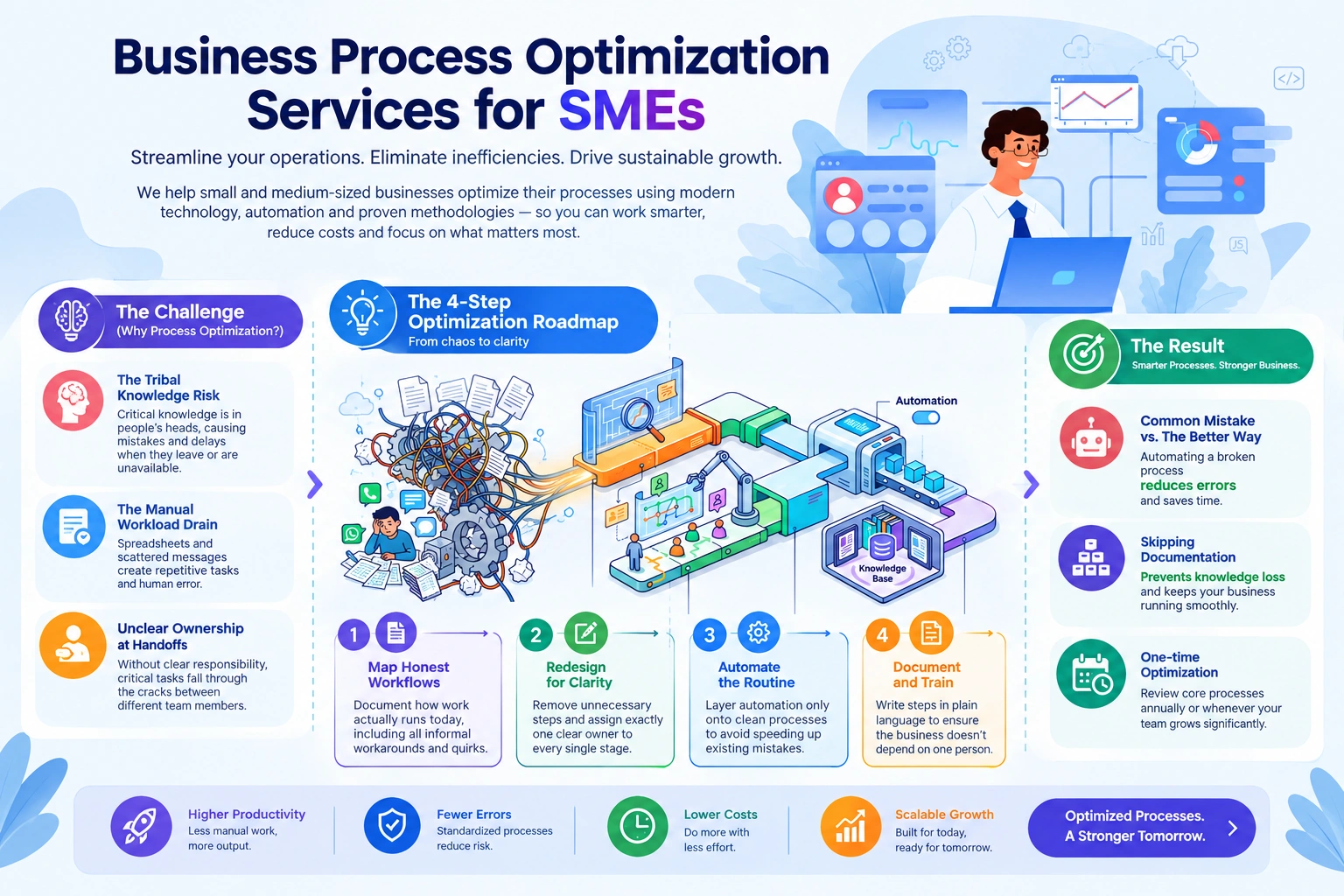
Step 1 — Map Every Core Process As It Actually Runs
Optimization work always starts with honest mapping, not immediate fixing. The team documents every core process exactly as it runs today, including all the informal workarounds and quirks, rather than how anyone assumes or hopes it runs.
This mapping exercise usually reveals genuine surprises, even to people who have worked inside the business for years. Steps that exist for no clear reason anyone can articulate anymore. Approval stages that add real delay without adding any corresponding value or risk protection. On top of that, specific gaps where nobody actually owns the final outcome, even though several people touch the process along the way.
As a result of this honest mapping, the business gets an accurate picture of where the real waste actually sits, rather than relying on where people simply assume or guess it sits based on frustration or anecdote.
Step 2 — Redesign for Clarity, Speed, and Ownership
Once every core process is mapped, each one gets carefully redesigned with intention. Unnecessary steps get removed entirely. Genuinely unclear steps get precisely defined, with explicit criteria for what triggers movement to the next stage. Every single step in the redesigned process gets exactly one clear owner responsible for it.
Therefore, the new version of each process is meaningfully shorter, clearer, and faster to execute than the old, informal one it replaces. Because of this redesign, the same team can comfortably handle a higher volume of work without needing to add headcount purely to compensate for process friction.
Redesign also typically surfaces natural opportunities to combine or eliminate steps that only existed historically because of how the business happened to grow, rather than because they add genuine value today.
Step 3 — Automate What Should Not Require Manual Effort
Certain routine tasks genuinely do not need a human handling them by hand, once a clear process exists to build automation around. Data entry that could pull directly from another system instead of being retyped. Repetitive follow-up messages that could trigger automatically based on a clear condition. Status updates that could flow to the right person automatically, rather than depending on someone remembering to send an update manually.
Business workflow optimization identifies exactly these tasks within each redesigned process and builds simple, reliable automation around them. As a result, the team ends up spending its time on genuine judgment calls and relationship-building work, rather than on repetitive administrative tasks that add no real value to the customer relationship.
Importantly, automation only gets layered on after the underlying process has been redesigned and clarified. Automating a process that is still fundamentally broken simply produces the same mistakes at a faster pace.
Step 4 — Document Clearly and Train the Team Properly
A redesigned, improved process only actually works in practice if the team genuinely knows it and follows it consistently. Therefore, every core process gets written down in plain, accessible language, with clear, sequential steps that anyone on the team can follow without needing to ask for clarification.
This documentation then becomes the primary training material for every new hire joining the business going forward. Because of this, onboarding gets meaningfully faster, and the quality of work stays consistent even as the team continues to grow and change over time.
Good documentation also protects the business against the risk of losing critical knowledge when a key employee eventually leaves, since the process itself, rather than any one person, now carries that institutional knowledge forward.
Common Mistakes SMEs Make with Process Optimization
Mistake 1 — Automating a Process That Is Still Broken
Automation speeds up whatever process it touches, including a genuinely bad one that has never been properly examined. Therefore, always redesign and clarify the process first, and only then layer automation on top of the improved version. Automating first simply locks in the existing dysfunction at a faster speed.
Mistake 2 — Skipping Documentation Entirely
A genuinely better process that continues to live only in one person's head has not actually been fixed in any durable sense. Write it down clearly, in language anyone can follow, or the improvement effectively disappears the moment that particular person leaves the business or takes extended leave.
Mistake 3 — Optimizing Once and Assuming It Is Permanently Done
Processes naturally drift over time as the business itself changes, adds new products, or grows its team significantly. As a result, even a genuinely well-executed, one-time fix eventually decays back toward inefficiency. Review core processes on a regular, deliberate cycle instead of treating optimization as a single event that never needs revisiting.
Mistake 4 — Designing Processes Without Input from the People Who Run Them
Processes designed purely from the top down, without input from the team members who execute them daily, often miss real, practical friction points that only become obvious from the ground level. Include frontline input directly in the redesign process for genuinely better, more workable outcomes.
How Xcellerators Hub Delivers Business Process Optimization for SMEs
At Xcellerators Hub, business process optimization for SMEs starts with honestly mapping every core workflow exactly as it runs today, then moves through redesign, targeted automation, and thorough documentation for each one. For Indian SMEs that have grown on improvised habits rather than deliberate design, this creates real, lasting operational stability.
To see how this connects to the wider revenue and growth system, explore SME Business Scaling Services and Scaling Operations: Build Systems That Support Revenue Growth.
Clean Processes Carry Growth Without Breaking
Business process optimization for SMEs is rarely glamorous, headline-grabbing work. However, it is precisely what allows a business to grow its volume and its team without falling apart quietly at the seams along the way. Clear processes, automated wherever it genuinely makes sense and thoroughly documented everywhere else, let a business scale its actual output without proportionally scaling its internal chaos and confusion. That is operational efficiency for SMEs done properly, and it compounds in value the longer it stays in place.
Key Takeaways
- SME processes often grow as informal habits and break under volume
- Map every core process as it actually runs before redesigning
- Redesign for clarity, speed, and single ownership at every step
- Automate only after the process is fixed — never automate a broken process
- Document clearly and train the team so improvements last
Ready to Fix the Work Behind the Work?
Our RXF System helps Indian SMEs map, redesign, automate, and document core processes so growth adds capacity instead of chaos.
Book a Coffee Call