
How to Increase Business Revenue — Growth That Does Not Break the Team
How to increase business revenue is probably the single most common question Indian founders ask, in one form or another, at almost every stage of running their company. However, the more genuinely useful question is subtly different. How do you increase revenue without also increasing chaos across the whole organisation at the same time?
Many businesses grow revenue the hard way, without really intending to. More leads come in, more deals get closed, more delivery work piles up, all of it layered onto the exact same overwhelmed team and the exact same undocumented, informal processes that existed when the business was much smaller. As a result, the business genuinely gets bigger in revenue terms, but noticeably messier in almost every other respect, at more or less the same time.
This pairing is not actually necessary, even though it feels inevitable while you are living through it. Increasing business revenue and keeping the business calm, organised, and well-run are not fundamentally opposing goals, whatever it might feel like during a particularly hectic quarter. In fact, the businesses that grow most sustainably over several years are usually the ones that deliberately build systems ahead of pushing for more volume, rather than pushing first and hoping the systems catch up later.
The chaos that so often accompanies growth is not some unavoidable law of business. Instead, it is a direct, predictable result of specific, identifiable decisions, or more often the absence of decisions, about sequencing. Businesses that increase business profits sustainably tend to make those sequencing decisions deliberately, rather than by default.
This blog breaks down a concrete revenue growth strategy that genuinely adds revenue without adding proportional chaos, and explains exactly why the sequencing of these steps matters as much as the steps themselves.
Why Revenue Growth Usually Creates Chaos
Chaos does not appear randomly or by bad luck. It follows a remarkably predictable pattern in most growing Indian businesses, one that repeats itself across very different industries and company sizes.
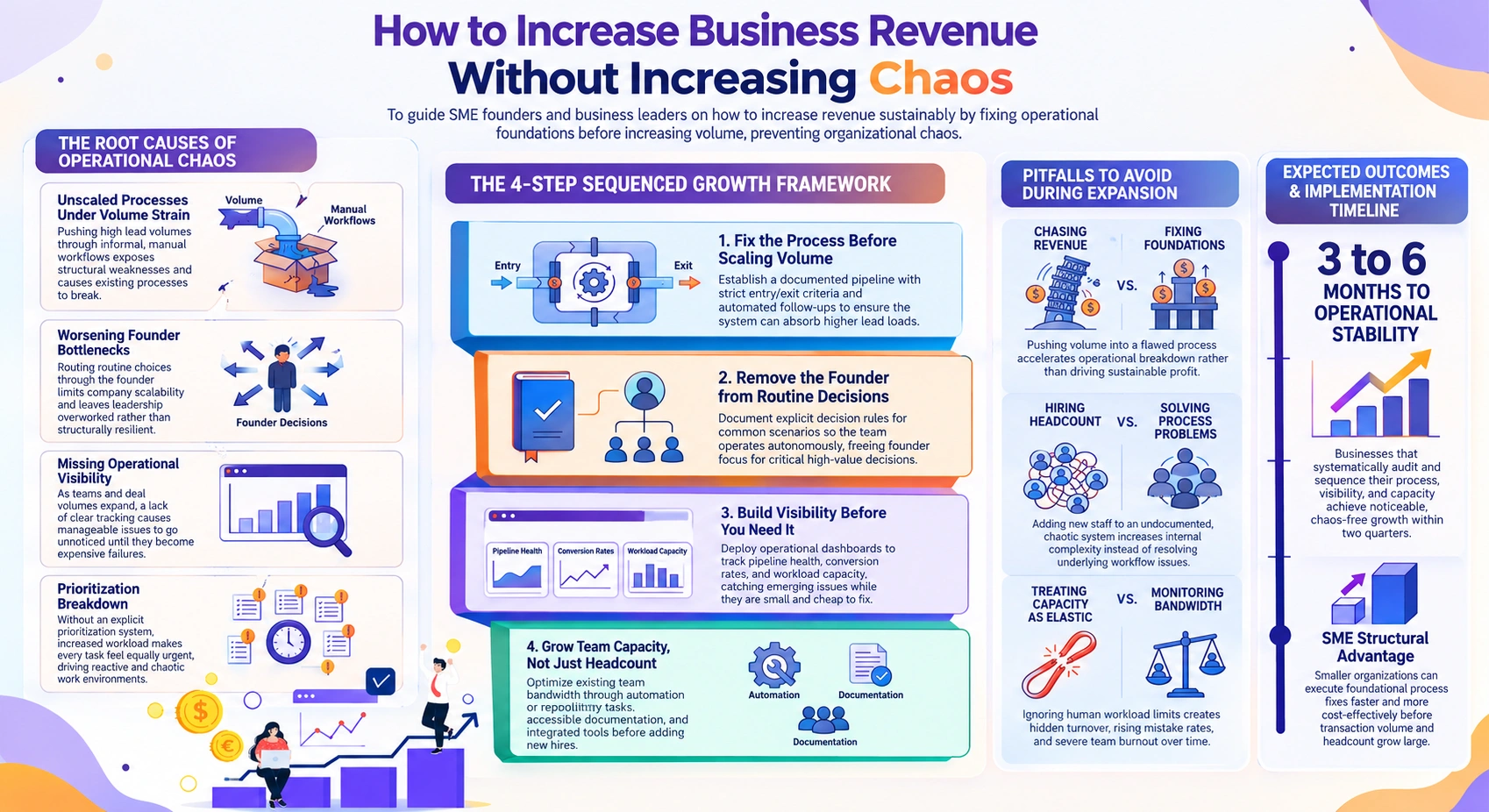
The first cause is scaling activity without scaling the underlying process to match it. More leads flow in every week, but the exact same manual, informal way of handling them stays firmly in place, simply because nobody stopped to redesign it. As a result, things that worked perfectly well at a small scale start visibly breaking under the weight of significantly more volume, and the cracks show up first in the areas that were always the weakest.
A second cause is persistent founder bottlenecks that growth actually worsens rather than resolves. Many businesses grow their revenue in a way that still routes every genuinely important decision through the founder personally, exactly as it did when the company was much smaller. Because of this, growth simply means the founder gets measurably busier and more stretched, not that the business itself becomes structurally stronger or more resilient.
The third cause is missing visibility across the growing organisation. As deal volume and team size both rise, nobody can meaningfully see the full picture anymore, the way a small founding team once could through simple daily proximity and conversation. Therefore, real problems go completely unnoticed until they become expensive, visible failures rather than small, manageable issues caught early.
A fourth cause, closely connected to the third, is unclear prioritisation once volume increases. When everything used to fit comfortably inside one person's attention, prioritisation happened naturally and informally. However, once volume exceeds what any one person can track, the business needs an explicit system for deciding what matters most, or everything ends up feeling equally urgent, which is itself a recipe for chaos.
Avoiding chaos during growth genuinely means fixing these four underlying causes before pushing harder for even more revenue, rather than hoping the causes somehow resolve themselves once the business is bigger and has more resources to throw at the problem.
A Revenue Growth Strategy That Avoids Chaos
Step 1 — Fix the Process Before Scaling Volume
Improve sales growth by first making genuinely sure the existing process can actually handle meaningfully more volume before you go out and generate that volume. This means a clear, documented pipeline. Defined stages with real entry and exit criteria. Consistent, reliable follow-up that does not depend on any one person remembering.
As a result of getting this sequencing right, adding considerably more leads and deals into the pipeline does not overwhelm the system, precisely because the system was deliberately built and tested to handle that increased load beforehand, rather than being stretched to its limit reactively after the fact.
Step 2 — Remove the Founder from Routine Decisions
Business expansion methods that continue to route every single decision through the founder simply do not scale past a certain point, no matter how capable or hardworking that founder is. Instead, document the specific decision rules the team genuinely needs in order to handle common, recurring situations confidently on their own, without needing to escalate every time.
Because of this deliberate documentation, the founder's time and attention genuinely free up for the small number of decisions that truly do need their direct, personal involvement, rather than being consumed entirely by routine matters the team could easily handle with clear guidelines in place.
Step 3 — Build Visibility Before You Actually Need It
A dashboard that clearly shows pipeline health, conversion rates at each stage, and current team workload matters considerably more as volume rises, not less, even though it is tempting to deprioritise this kind of infrastructure work while things still feel manageable. Build this visibility early, well before growth makes its absence genuinely painful and expensive.
As a result of having this visibility in place ahead of time, problems get caught while they are still small, cheap, and relatively easy to fix, rather than being discovered only once they have already caused real, visible damage to a client relationship or a quarter's numbers.
Step 4 — Grow the Team's Capacity, Not Just Its Headcount
Increase business profits meaningfully by first making the existing team genuinely more effective, before automatically assuming the answer to more volume is simply adding more people. Automation for repetitive, low-judgment tasks. Clear, accessible documentation that reduces time spent asking questions. Better, properly integrated tools that remove friction from daily work.
Therefore, revenue can grow substantially before headcount actually needs to grow at all in proportion, which keeps both costs and internal complexity meaningfully lower for longer, and gives the business more room to be deliberate about who it eventually does hire, rather than hiring reactively under pressure.
Common Mistakes That Create Chaos During Growth
Mistake 1 — Chasing Revenue Before Fixing the Foundation
Adding significantly more volume to a process that is already somewhat broken simply breaks it faster and more visibly than it would have broken anyway. Fix the underlying process first, deliberately, and only then scale the volume flowing through it, rather than hoping the process somehow holds up under pressure it was never designed for.
Mistake 2 — Hiring to Solve What Is Actually a Process Problem
New hires brought into an already chaotic, undocumented system usually end up adding to that chaos rather than fixing it, since they have nothing clear to follow and end up improvising just as much as everyone else already is. Build the system properly first, then hire deliberately to run and staff that system, rather than hiring first and hoping structure emerges naturally afterward.
Mistake 3 — Ignoring Team Capacity Limits Entirely
Pushing considerably more revenue through a team that is already stretched thin reliably produces burnout, rising mistakes, and eventually costly turnover, none of which shows up immediately in the numbers but all of which shows up eventually. Watch team capacity every bit as closely as you watch the pipeline itself, rather than treating people as an infinitely elastic resource.
Mistake 4 — Failing to Set Clear Priorities as Volume Grows
When everything feels equally urgent because there is no explicit system for prioritisation, teams end up making inconsistent, reactive decisions about where to focus their time. Establishing simple, clear priority rules as volume increases prevents this particular flavour of chaos before it takes hold.
How Xcellerators Hub Helps Businesses Increase Revenue Without Chaos
At Xcellerators Hub, the approach to increasing business revenue always starts deliberately with the foundation, not with spend or headcount. The team fixes the underlying process, builds genuine visibility into the business, and improves team capacity meaningfully before pushing for significantly more volume.
To go deeper into how this connects to broader growth work, explore How RevOps Helps Small Businesses in India Scale Without Burning Cash and Business Process Optimization Services for SMEs.
Sustainable Revenue Growth Feels Calm, Not Frantic
How to increase business revenue without chaos comes down almost entirely to sequencing, more than to any single tactic or tool. Fix the process first. Remove founder bottlenecks deliberately. Build visibility ahead of need. Improve team capacity before adding headcount. Then, and only then, scale the volume with real confidence. Done in this order, growth genuinely strengthens the business over time rather than straining it, and it feels noticeably calmer to live through, both for the founder and for the team around them.
Key Takeaways
- Growth chaos is caused by sequencing, not by growth itself
- Fix the process before scaling volume into it
- Remove founder bottlenecks with clear decision rules
- Build visibility early so problems stay small and cheap
- Grow team capacity before growing headcount
Ready to Grow Revenue Without the Chaos?
Our RXF System helps Indian businesses fix process, build visibility, and strengthen capacity first, so revenue growth adds strength rather than strain.
Book a Coffee Call