
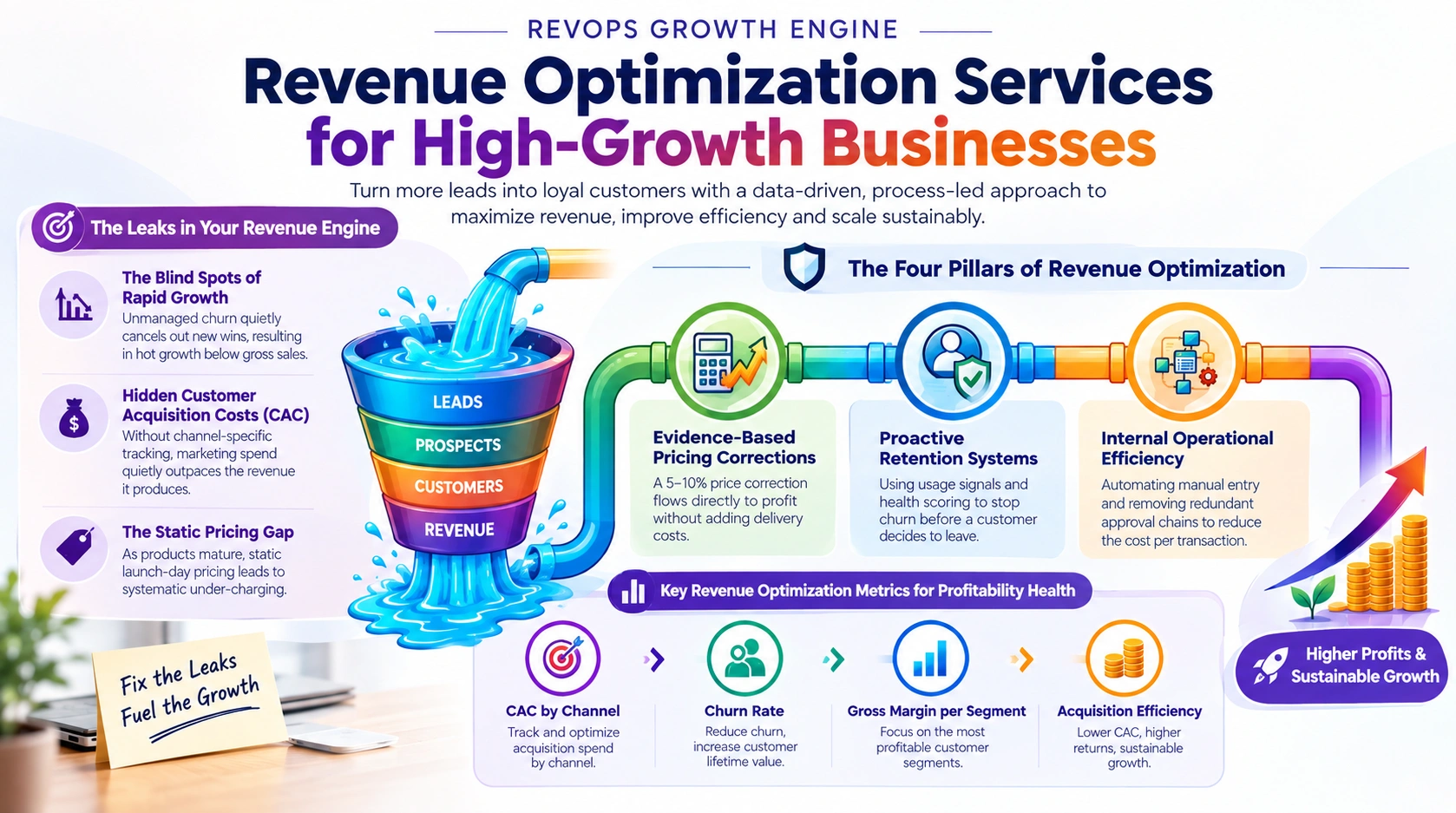
Revenue Optimization Services - Growth That Actually Protects Profit
Revenue optimization services exist for a simple reason. Growing revenue is not the same as growing profit. Many high-growth Indian businesses learn this the hard way. Sales climb month over month. However, margins shrink at the same time. The business gets bigger on paper, but not stronger underneath.
This happens because rapid growth often hides inefficiency rather than revealing it. A leaking sales process. A bloated customer acquisition cost that nobody is watching closely. Unmanaged churn quietly cancelling out new wins. As a result, the business works harder every quarter for the same, or even less, real profit than before.
The pattern is especially common in Indian SMEs and mid-market companies scaling fast. The founder is focused on the next deal, the next hire, the next campaign. Meanwhile, the systems that should be protecting profitability get almost no attention. Because of this, growth quietly becomes more expensive with every passing month, and few people notice until the numbers force the conversation.
Revenue optimization services fix this gap directly. Instead of just chasing more top-line revenue, they focus on making every rupee of existing revenue work harder. They find the specific leaks, close them systematically, and build the ongoing systems that keep profit growing alongside sales, not lagging behind it.
This blog breaks down what revenue optimization services actually involve, the specific leaks they target, and how they help high-growth businesses stay genuinely profitable while they scale.
Why High-Growth Businesses Need Revenue Optimization Services
Fast growth creates its own blind spots, and these blind spots are remarkably consistent across Indian companies scaling quickly.
The first blind spot is rising customer acquisition cost. As a business scales, competition for the same customers increases. Ad costs climb. Outreach gets harder as easy prospects get exhausted. However, most fast-growing businesses do not track acquisition cost closely enough, channel by channel, to notice this trend early. Because of this, marketing and sales spend quietly outpaces the revenue it produces, and nobody catches it until a quarter looks unexpectedly weak on margin.
A second blind spot is unmanaged churn. New clients come in faster than the team can properly onboard and support them. As a result, some clients leave just as quickly as they arrived, often without anyone flagging the pattern. The business keeps adding new logos while quietly losing old ones, and net growth ends up far lower than gross growth would suggest.
A third blind spot is pricing left on the table. Fast-growing businesses rarely revisit their pricing once it is set at launch. However, the value delivered typically increases faster than the price does, as the product matures or the service deepens. Because of this, businesses systematically under-charge for what they now actually offer, and that gap compounds across every single deal.
A fourth blind spot is operational drag inside the revenue process itself. Manual work that should be automated. Approval chains that add delay without adding value. Duplicate effort between teams that nobody has ever mapped out. Each of these adds hidden cost to every transaction the business completes.
Revenue optimization services are built specifically to catch all four blind spots. Rather than simply pushing for more top-line growth, they protect and expand the actual profit sitting inside the revenue the business already generates.
What Revenue Optimization Services Actually Include
A genuine revenue optimization engagement is not a single fix. Instead, it works across four connected areas, each one addressing a specific source of margin leakage.
Fix 1 - Customer Acquisition Cost Control
The first job of revenue optimization services is understanding true acquisition cost, channel by channel, rather than relying on a single blended average.
This means carefully tracking marketing spend, sales time, tools cost, and any commissions against every new customer won through each specific channel. Some channels look cheap on the surface, simply based on ad spend. However, once sales time and follow-up effort are properly accounted for, they often cost far more than the business assumes.
As a result of this granular view, businesses can redirect spend away from channels that look productive but are quietly unprofitable, toward the channels that actually produce customers worth acquiring. Because of this reallocation, growth becomes cheaper without becoming smaller, since the same total spend produces more profitable customers than before.
Over time, this channel-level visibility also reveals which types of customers are cheapest to acquire and retain, which then feeds directly back into the business's targeting and messaging.
Fix 2 - Pricing and Packaging Review
Many high-growth businesses set pricing once, early on, and then leave it largely untouched for years. However, that original pricing rarely keeps pace with the value the product or service has since gained through iteration and improvement.
Revenue optimization services run a structured pricing review as a core part of the engagement. This means comparing current pricing against competitors in the market, against the value actually delivered to customers, and against what customers have shown they are willing to pay through past deals and negotiations. Therefore, pricing decisions get made based on evidence gathered systematically, not on whatever number felt right at launch.
Even a modest pricing correction, sometimes as small as five to ten percent, produces outsized gains in profit. This happens because a pricing increase flows almost entirely to the bottom line, without any added delivery cost attached to it. In contrast, the same percentage gain through new customer acquisition requires significant additional spend and effort to achieve.
Packaging often gets reviewed alongside pricing. Bundling, tiering, and add-ons frequently reveal opportunities where customers would happily pay more for a slightly different structure, one the business simply has not offered yet.
Fix 3 - Churn and Retention Systems
Retaining an existing customer typically costs a fraction of what it costs to acquire a new one. However, high-growth businesses often under-invest in retention specifically because new acquisition feels more urgent and more visible day to day.
Revenue optimization services build the systems that catch at-risk customers early, before they actually decide to leave. This includes health scoring based on usage or engagement signals, regular structured check-ins rather than informal, occasional ones, and proactive outreach triggered automatically when a customer's engagement starts to drop.
As a result of these systems, churn falls, and the revenue the business has already won becomes measurably more stable and predictable quarter over quarter.
Over time, this stability compounds in a powerful way. A business that keeps a higher percentage of what it wins needs to win proportionally less new business to keep growing overall revenue. Because of this, the pressure on acquisition eases, freeing up budget and attention that can then go toward further optimization elsewhere in the business.
Fix 4 - Operational Efficiency in the Revenue Process
Revenue optimization services also examine where operational waste sits inside the sales and delivery process itself, not just in the customer-facing numbers.
Long approval chains that add days to a deal without adding real value. Manual work, like data entry or status updates, that could easily run on simple automation instead. Duplicate effort between marketing, sales, and delivery teams that nobody has ever mapped out or questioned.
Because of this accumulated waste, the same revenue often costs considerably more to generate than it actually needs to. Fixing this does not require cutting corners on quality or service. Instead, it means systematically removing friction that adds internal cost without adding any value the customer actually notices or benefits from.
As a result, the business ends up generating the same revenue with meaningfully less internal effort and cost, and margins expand accordingly, often without the customer experience changing at all.
Common Mistakes Businesses Make with Revenue Optimization
Mistake 1 - Chasing Growth Without Checking Profitability
Growth feels good, and it is easy to celebrate a strong quarter of new sales. However, growth without a parallel profitability check can quietly mask a business that is actually losing more money as it scales faster. Therefore, track profit per customer alongside revenue growth from the start, not as an afterthought once numbers already look concerning.
Mistake 2 - Never Revisiting Pricing
Static pricing in a business that keeps genuinely improving its product or service is a quiet, ongoing form of underselling. On top of the direct revenue lost, it also trains customers to expect no future change, which makes any later increase feel more jarring than it should. Review pricing on a regular, deliberate cycle instead of leaving it untouched indefinitely.
Mistake 3 - Treating Retention as a Support Function
Retention often gets categorised internally as a support or service cost centre, rather than a revenue function in its own right. However, it is genuinely one of the highest-leverage revenue levers available to any growing business. As a result, businesses that under-invest here end up paying for that gap repeatedly, in the form of churn that could have been prevented.
Mistake 4 - Optimizing Once and Assuming It Sticks
Some businesses run a single optimization project and then consider the work finished. However, acquisition costs shift, competitors adjust pricing, and customer expectations evolve continuously. Because of this, revenue optimization needs a recurring review rhythm, not a one-time engagement, in order to keep protecting margin as conditions change.
How Xcellerators Hub Delivers Revenue Optimization Services
At Xcellerators Hub, revenue optimization services start with a full profitability audit, not just a surface-level revenue audit. The team maps acquisition cost by individual channel, reviews pricing against the value actually being delivered today, and builds the retention systems that protect the revenue the business has already won.
For high-growth Indian businesses trying to scale without quietly eroding their margins along the way, this approach creates a real, measurable difference within a few months. It goes beyond generic advice to address the specific leaks present in that particular business.
To go deeper into how this connects to the broader revenue system, explore RevOps Consulting Services and Business Process Optimization Services for SMEs.
Growth Without Profit Is Not Actually Growth
Revenue optimization services exist because bigger is not automatically better, no matter how impressive the top-line number looks in a board deck. A business that grows revenue while steadily losing margin is not truly winning, even if the headline figures suggest otherwise. Real optimization controls acquisition cost with precision, corrects pricing based on evidence, protects retention systematically, and removes operational waste wherever it hides. Because of this combined effort, every rupee of revenue ends up working harder than the one that came before it. For Indian businesses scaling fast in 2026, this is the difference between growth that genuinely builds a stronger, more valuable company, and growth that simply adds noise and complexity to the top line without improving the business underneath it.
Key Takeaways
- Growing revenue is not the same as growing profit - optimization protects the margin
- Control customer acquisition cost channel by channel, not with a blended average
- Review pricing and packaging regularly against the value actually delivered
- Build retention systems so churn does not cancel out new wins
- Remove operational waste inside the revenue process to expand margins
Ready to Protect Profit While You Scale?
Our RXF System helps high-growth Indian businesses control acquisition cost, fix pricing, reduce churn, and remove operational waste so revenue stays genuinely profitable.
Book a Coffee Call