
Revenue Leakage in Business — The Quiet Drain on Your Profit
Revenue leakage in business is money you earned, or should have earned, that never reaches your bank account. It does not show up as a loss on any report. Instead, it hides in small gaps. A lead nobody called back. A discount nobody approved. A renewal nobody chased. Each gap looks minor, yet together they can cost a business a large share of its potential revenue.
Most Indian SME founders watch sales and costs closely. However, they rarely watch the space between the two. As a result, they work hard, win deals, and still wonder why cash feels tight.
The good news is simple. Leakage is fixable. Unlike a weak market, it sits inside your control. Once you know where to look, you can find it and close it.
This blog covers seven hidden reasons your business is losing money. It also gives a clear plan on how to reduce business revenue leakage without adding cost or complexity.
What Is Revenue Leakage in Business?
Revenue leakage is the gap between the revenue your business could capture and the revenue it actually collects. It is different from a lost deal. A lost deal means a buyer said no. Leakage means the buyer was ready, or already paying, and the business failed to capture the full value.
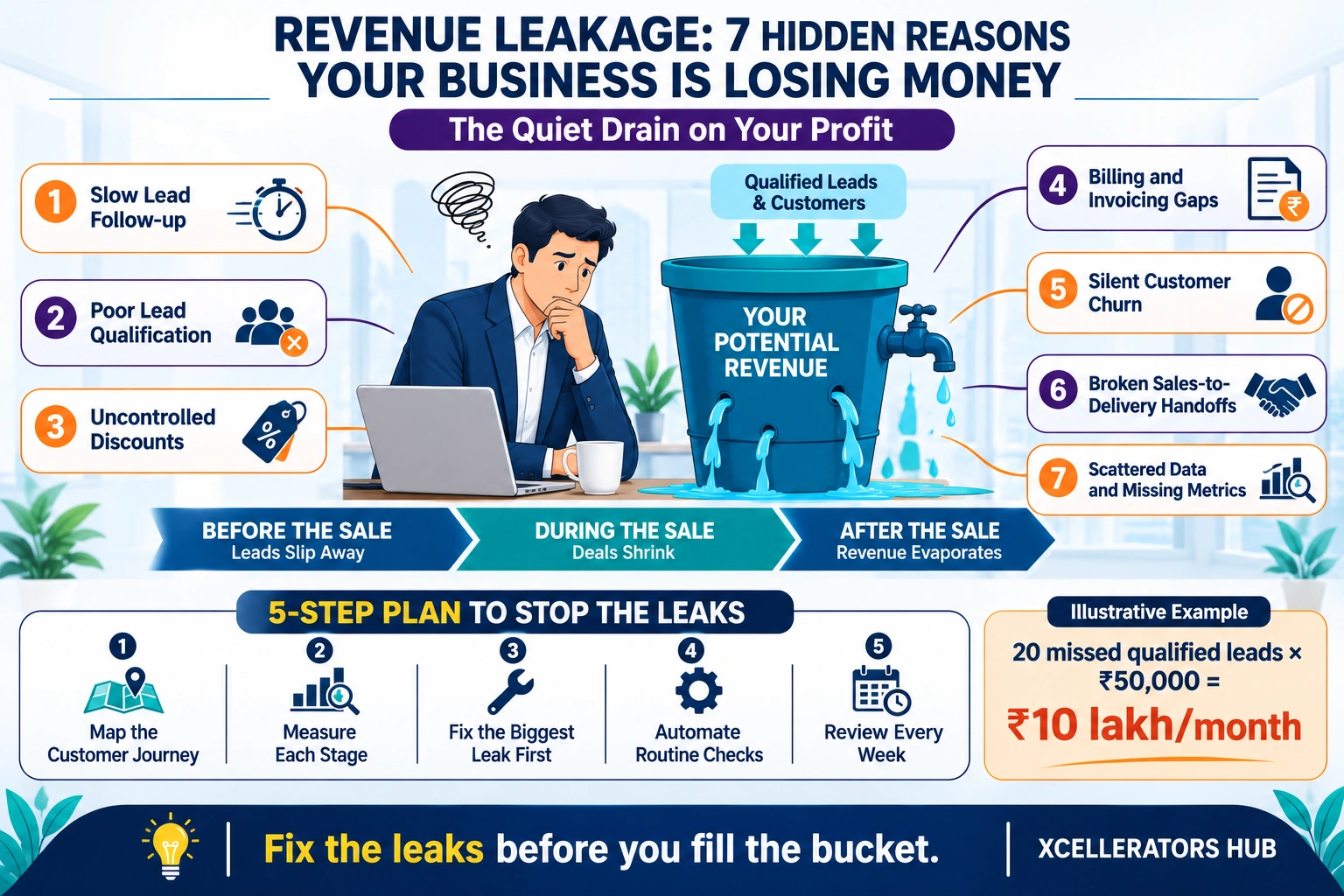
Leakage can happen at three stages of the customer journey.
Leakage Before the Sale
Leads arrive and slip away. Slow follow-up, poor targeting, and missing nurture all drain the pipeline before a real conversation begins.
Leakage During the Sale
Deals close at lower prices than they should. Unplanned discounts, unclear scope, and weak qualification quietly shrink every contract.
Leakage After the Sale
Money disappears through late invoices, missed renewals, silent churn, and unbilled work. Many founders overlook this stage completely.
Here is a simple example. Suppose 20 qualified leads slip away each month, and each was worth ₹50,000 in revenue. That is ₹10 lakh a month, or ₹1.2 crore a year. Nobody sees one big loss. Yet the total is huge. (This is an illustrative example, not a benchmark.)
7 Hidden Reasons for Revenue Leakage in Business
These seven causes appear again and again in growing Indian businesses. Check your own business against each one.
Reason 1 — Leads Go Cold Because Nobody Follows Up Fast
A lead fills a form or sends a message. Then the notification sits unread for a day. By the time someone replies, the buyer has already spoken to a competitor.
Interest fades quickly. Therefore, slow response is one of the biggest sources of revenue leakage in business. It is also one of the most invisible, since nobody sees a lead that never became a conversation.
The fix starts with speed. Set a clear rule for first response, ideally within minutes. Then assign every lead to a named owner. Over time, this one habit often recovers more revenue than any new ad campaign.
Reason 2 — Sales Chases the Wrong Prospects
Not every lead deserves equal effort. However, many teams treat every enquiry the same. They spend weeks on prospects who never had the budget, the need, or the authority to buy.
This waste hides inside busy calendars. The team feels productive. Yet the time spent on poor-fit prospects could have gone toward buyers ready to close.
A clear Ideal Customer Profile fixes this. When marketing and sales agree on who a good buyer is, the team focuses on deals that can actually close. As a result, win rates rise without any extra leads.
Reason 3 — Discounts Without Rules
Discounts feel like a harmless way to close a deal. In practice, they act as a slow leak on every contract. When each salesperson sets their own discount, margins erode and nobody tracks the total.
Consider an example. If unplanned discounts average 5% on ₹10 crore of annual sales, the business gives away ₹50 lakh a year. That money comes straight off the bottom line. (Again, this is an illustration.)
Set discount limits by deal size. Require approval above a set threshold. Also record the reason for every discount. Over time, the pattern shows whether discounts are winning deals or just lowering prices.
Reason 4 — Billing and Invoicing Gaps
Some of the most painful leakage happens after the work is done. A project finishes, but nobody sends the final invoice. A client asks for extra work, and the team delivers it without billing. A contract renews, yet the price stays at last year's level.
These gaps rarely look like problems. They look like small oversights. However, across dozens of clients and many months, they add up to serious money.
Create a simple monthly check. Compare work delivered against work billed. Then compare contract renewal dates against your pricing review calendar. This basic reconciliation catches most billing leakage within one cycle.
Reason 5 — Churn Nobody Tracks
Winning a client costs money and effort. Losing one quietly wipes out that investment. Yet many SMEs track new sales closely and ignore who left.
Silent churn is dangerous because it hides behind growth. New clients arrive, so total revenue looks healthy. Meanwhile, old clients leave, and the business runs just to stand still.
Track churn every month. Also check in with clients before problems grow. A short, regular call often saves an account that would have left silently. Because retention costs far less than acquisition, this fix pays back quickly.
Reason 6 — Broken Handoffs Between Sales and Delivery
Sales closes a deal and promises certain things. Delivery hears a different version, or no version at all. The result is scope creep, unhappy clients, and unpaid extra work.
This leak sits at the joint between two teams. Each team assumes the other is handling it. As a result, nobody owns the gap.
Fix it with a short written handoff. Before delivery starts, document what was promised, the client's goals, and any risks. Share it with the delivery lead. This simple step protects both margin and client trust.
Reason 7 — Scattered Data and No Metrics
The final cause sits underneath all the others. Without clear data, leaks stay invisible. Leads live in WhatsApp. Deals live in someone's head. Invoices live in a separate tool. Nobody sees the full picture.
Because of this, the business cannot answer basic questions. Where do leads drop off? Which clients are at risk? How much revenue sits in unbilled work? Without answers, leakage continues year after year.
Put your core data in one place, usually a properly configured CRM. Then track a small set of metrics every week. Visibility alone often exposes leaks that had run for years.
How to Reduce Business Revenue Leakage: A 5-Step Plan
Knowing the causes helps. Fixing them requires a plan. Use these five steps to reduce business revenue leakage in a structured way.
Step 1 — Map the Customer Journey
Write down every stage a customer passes through, from first enquiry to renewal. Include who owns each stage. Most founders find gaps within the first hour. In many cases, entire stages have no owner at all.
Step 2 — Measure Each Stage
Count what happens at every stage. How many leads arrive? How many get a response within an hour? How many reach a proposal? How many close, renew, or leave? These numbers show exactly where the drain is biggest.
Step 3 — Fix the Biggest Leak First
Do not try to fix everything at once. Pick the single largest leak and solve it fully. For example, if leads go cold, fix response speed before you touch pricing. Focus gives faster results than a scattered effort.
Step 4 — Automate the Routine Checks
Simple automation closes many leaks without extra effort. Auto-acknowledge new leads. Trigger reminders for follow-up. Flag deals that stall. Alert the team before renewals expire. These small systems replace memory with process.
Step 5 — Review Every Week
Leakage returns when nobody watches. Hold a short weekly review of your key numbers. Thirty minutes is enough. Over time, this rhythm turns leak-fixing from a one-time project into a habit.
Metrics That Reveal Revenue Leakage in Business Early
You cannot fix what you cannot see. Track these metrics to spot leakage before it grows.
- Lead response time: How fast does the first reply go out?
- Lead-to-opportunity rate: How many leads become real conversations?
- Win rate: How many qualified deals close?
- Average discount: How far below list price do deals close?
- Unbilled work: How much delivered work has no invoice yet?
- Invoice delay: How many days pass between delivery and payment?
- Churn rate: How many clients leave each period?
- Renewal rate: How many contracts renew, and at what price?
Start with three or four. Add more once the habit sticks.
Common Mistakes When Trying to Reduce Business Revenue Leakage
Mistake 1 — Chasing New Leads Instead of Fixing Leaks
More leads feel like the answer. However, new leads pour into the same leaking system. Therefore, fix the leaks first. Then scale lead generation behind a sound process.
Mistake 2 — Treating Leakage as a Finance Problem Only
Finance sees the late invoice. Yet the cause often sits in sales, delivery, or customer success. As a result, leakage needs a cross-team fix, not just a tighter accounting process.
Mistake 3 — Fixing Once and Never Checking Again
Leaks return as the business changes. New hires, new offers, and new clients all create new gaps. Instead of a single clean-up, build a regular review rhythm.
Mistake 4 — Blaming People Instead of Process
When money slips away, the instinct is to blame an individual. In most cases, the real cause is a missing process. Fix the system, and the same people produce better results.
How Xcellerators Hub Helps Reduce Revenue Leakage
At Xcellerators Hub, reducing revenue leakage starts with a full diagnostic of the revenue process. The team maps the customer journey, measures each stage, and finds exactly where money slips away. From there, they build the fixes: faster lead response, clear qualification, clean handoffs, automated reminders, and simple dashboards.
For Indian SMEs with lean teams, this approach recovers revenue without adding headcount or ad spend. Instead of pushing for more sales, it helps the business keep more of what it already earns.
Fix the Leaks Before You Fill the Bucket
Revenue leakage in business rarely announces itself. It grows quietly through slow follow-up, loose discounts, billing gaps, silent churn, weak handoffs, and scattered data. Each one looks small. Together, they decide whether growth turns into profit. The path forward is clear. Map the journey. Measure each stage. Fix the biggest leak first. Automate the checks. Review every week. Founders who follow this path often find that their business already earns more than it keeps. The money was there all along. It just needed a system to catch it.
Key Takeaways
- Revenue leakage is money you earned that never reaches the bank
- It hides in slow follow-up, discounts, billing gaps, churn, and broken handoffs
- Map the customer journey and measure each stage
- Fix the biggest leak first, then automate routine checks
- Review key metrics every week so new leaks get caught early
Ready to Stop Losing Revenue Quietly?
Our RXF System maps your customer journey, finds the biggest leaks, and builds the systems that help you keep more of the revenue you already earn.
Book a Coffee Call