
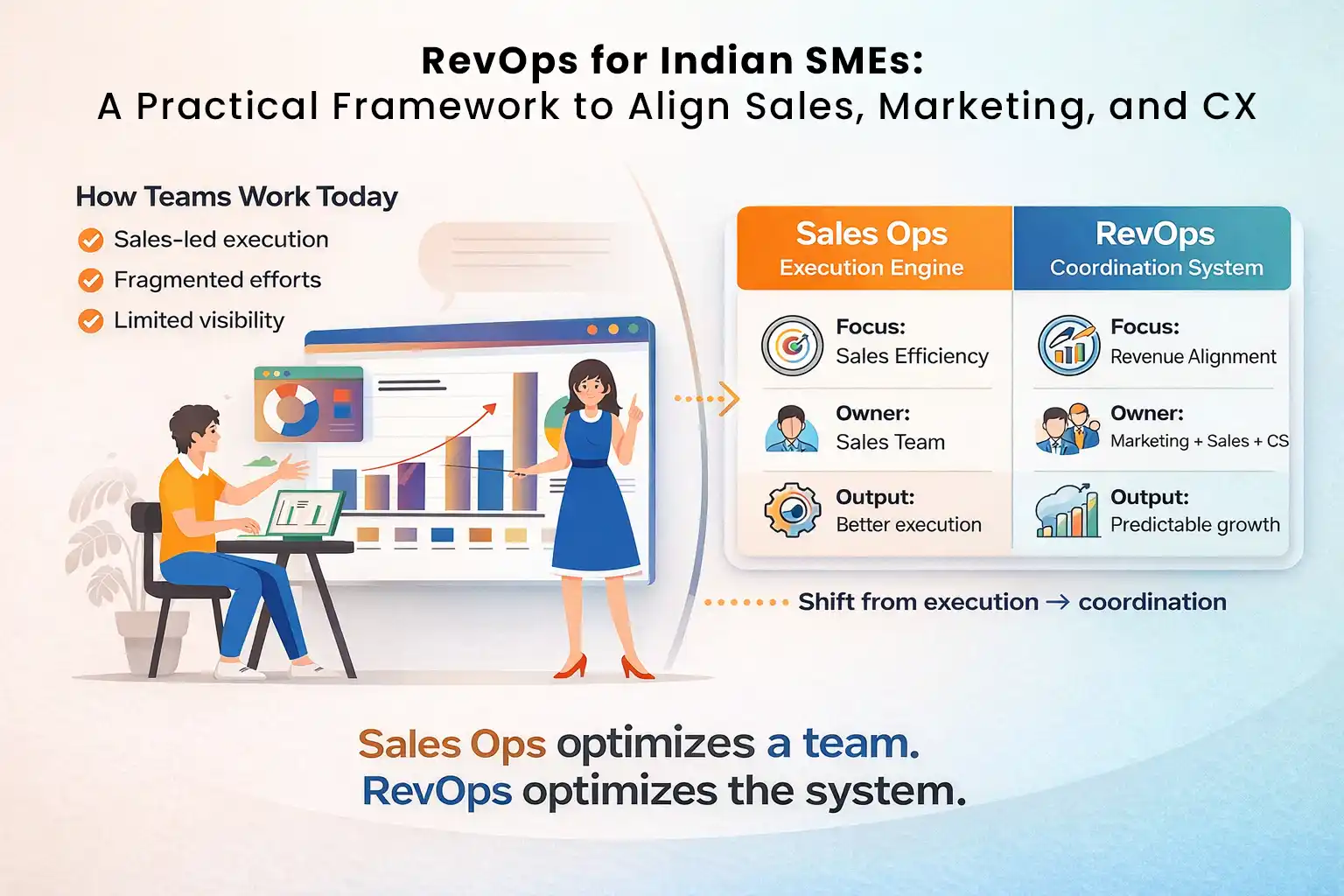
RevOps for Indian SMEs: Why Sales, Marketing, and CX Drift Apart as Businesses Grow
RevOps for Indian SMEs is no longer a niche concept or a “future-stage” idea. It has become a practical requirement for businesses that want to grow without losing control. Across India, small and mid-sized businesses are discovering that revenue problems rarely come from a lack of effort. Instead, they come from weak sales marketing CX alignment in India as teams expand and complexity increases.
In the earliest phase of an Indian SME, alignment happens almost by accident.
Founders stay close to customers.
Sales conversations are direct and personal.
Marketing decisions evolve through instinct and fast feedback.
Customer experience issues surface immediately.
In this stage, sales marketing CX alignment in India feels natural. It does not require frameworks, dashboards, or governance. The same people influence demand, close deals, and oversee delivery. Context moves freely because it lives in conversations, not systems.
For a while, this model works extremely well.
Revenue feels controllable.
Decisions feel obvious.
Feedback loops stay short.
However, this operating model has a ceiling. And most Indian SMEs hit that ceiling faster than they expect.
As the business grows, teams expand. Customer volumes increase. More leads enter the funnel. More deals move through the pipeline. Roles begin to specialise. Founders cannot stay involved in every decision. Context spreads across people, tools, and documents.
This is where alignment starts to break.
Not suddenly.
Not visibly.
But quietly.
This silent breakdown is exactly why RevOps for Indian SMEs has become so critical. Revenue Operations for SMEs: The Complete RevOps Guide.
Why Misalignment in Indian SMEs Is Hard to Detect Early
One of the most dangerous aspects of weak sales marketing CX alignment in India is that it rarely shows up as a single failure.
Sales teams remain busy.
Marketing campaigns continue to run.
Customer experience teams keep delivering.
From the outside, the business looks healthy.
Internally, however, leadership begins to feel friction. Forecasts become less reliable. Decisions take longer. Teams disagree on what the numbers actually mean. Conversations shift from “what should we do next?” to “what is really happening?”
This confusion exists because revenue complexity increases faster than organisational design.
Early-stage revenue depends on proximity.
Growth-stage revenue depends on systems.
When proximity fades and systems do not replace it, misalignment fills the gap.
This is the inflection point where RevOps for Indian SMEs becomes unavoidable.
The Indian SME Operating Reality Makes Alignment Fragile
Sales marketing CX alignment in India breaks faster because of how Indian SMEs operate.
Most Indian SMEs share common constraints:
- Capital efficiency matters deeply
- Teams stay lean for longer than ideal
- Founders carry operational responsibility across functions
- Speed is prioritised over documentation
In the early stages, these constraints create agility. Decisions happen fast. Problems surface quickly. Outcomes feel directly connected to effort.
As scale increases, the same constraints magnify misalignment.
Lean teams mean overloaded roles.
Founder dependence creates decision bottlenecks.
Speed without structure increases ambiguity.
Without a unifying operating framework, coordination becomes accidental instead of designed.
RevOps for Indian SMEs works precisely because it addresses this structural gap without introducing heavy bureaucracy.
Revenue Problems Are Usually Coordination Problems
A core idea behind RevOps for Indian SMEs is this:
Revenue problems rarely originate inside one team.
They emerge at the intersections.
Between marketing and sales.
Between sales and customer experience.
Between acquisition promises and delivery reality.
When sales marketing CX alignment in India weakens, problems appear downstream even if teams perform well individually.
Marketing may generate high lead volume, but sales struggles to qualify.
Sales may close deals, but customer experience teams struggle to deliver on expectations.
Customer experience may fight churn, but insights never influence acquisition strategy.
Each team optimises locally.
The system suffers globally.
This is why pushing teams harder rarely fixes the problem.
Why Traditional Fixes Fail for Indian SMEs
When misalignment becomes visible, Indian SMEs usually respond with familiar moves.
More meetings.
More tools.
More hires.
More reporting.
These actions increase activity. They rarely increase alignment.
Meetings create discussion, not shared ownership.
Tools create data, not shared meaning.
Hiring increases handoffs, not clarity.
In many cases, these fixes worsen the problem by adding complexity to an already fragmented system.
RevOps for Indian SMEs does not try to “fix” people.
It redesigns how decisions connect across sales, marketing, and CX.
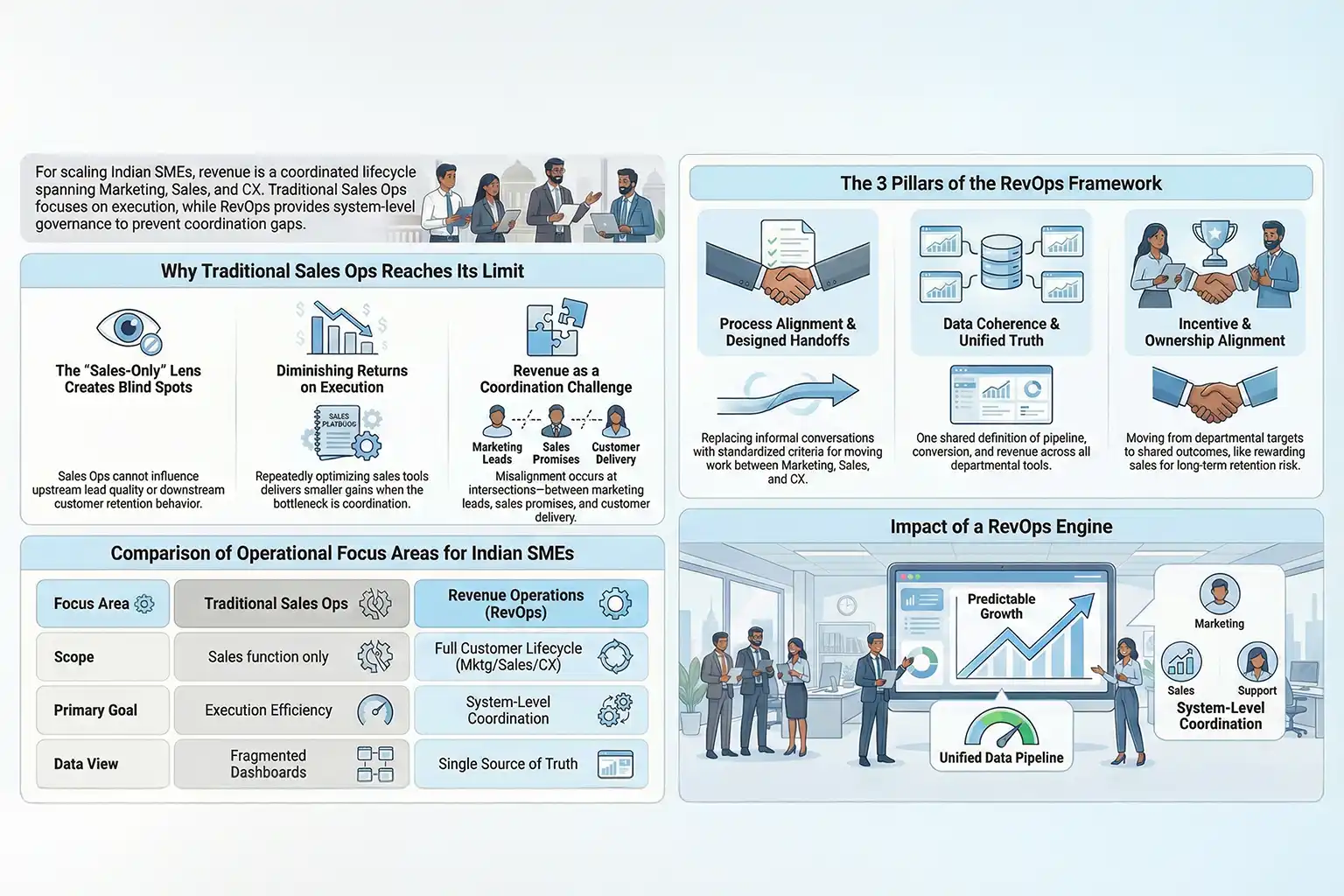
Revenue Is a Lifecycle, Not a Department
To understand why RevOps for Indian SMEs works, it helps to rethink revenue itself.
Revenue does not belong to sales.
It does not belong to marketing.
It does not belong to customer experience.
Revenue is created across a lifecycle.
Demand generation shapes opportunity quality.
Sales execution sets expectations and pricing.
Customer experience determines adoption, retention, and expansion.
Each stage inherits the assumptions created upstream.
A marketing message influences a sales pitch.
A sales promise defines onboarding effort.
An onboarding experience determines long-term value.
When these stages evolve independently, misalignment becomes inevitable.
Sales marketing CX alignment in India fails not because teams stop collaborating, but because coordination is no longer engineered.
RevOps exists to engineer that coordination.
RevOps for Indian SMEs: A Structural, Not Cultural, Solution
A common mistake Indian SMEs make is treating alignment as a cultural issue.
They ask teams to “communicate better.”
They encourage collaboration.
They push alignment through meetings.
Culture helps, but culture does not scale on its own.
RevOps for Indian SMEs treats alignment as a structural problem.
It focuses on:
- How definitions are shared
- How handoffs are designed
- How metrics reinforce behaviour
- How data flows across tools
- How accountability is distributed
When these elements align, behaviour follows naturally.
This is why RevOps improves sales marketing CX alignment in India without slowing execution.
The Shift RevOps Introduces
The biggest shift RevOps introduces is simple but powerful.
Revenue is not an outcome of effort.
Revenue is an outcome of alignment.
Once Indian SMEs adopt this lens, many problems begin to make sense.
Forecast misses stop feeling random.
Churn stops feeling mysterious.
Pipeline volatility becomes explainable.
RevOps for Indian SMEs creates a shared operating framework that replaces guesswork with clarity.
And this is only the foundation.
RevOps for Indian SMEs: The Practical Framework That Aligns Sales, Marketing, and CX
RevOps for Indian SMEs only works when it is practical. Theory does not fix misalignment. Tools alone do not fix misalignment. Motivation does not fix misalignment. Alignment improves only when the revenue system itself is designed to keep sales, marketing, and customer experience moving in the same direction by default.
This is where most discussions around sales marketing CX alignment in India go wrong.
They stay abstract.
Indian SMEs do not need more ideas about collaboration. They need a framework that fits their operating reality—lean teams, limited capital, founder involvement, and fast-moving markets. RevOps provides that framework when it is implemented as an operating model rather than a department.
Revenue Alignment Starts With Treating Revenue as a System
A core principle of RevOps for Indian SMEs is that revenue must be treated as a single system, not a collection of functions.
In many organisations, revenue is managed through fragments:
- Marketing owns leads
- Sales owns deals
- CX owns delivery and retention
Each team tracks its own metrics. Each team optimises for its own targets. Alignment is expected to happen through meetings and handoffs.
This approach breaks down quickly as scale increases.
Sales marketing CX alignment in India fails because no one owns the connections between stages. Everyone owns a part. No one owns the whole.
RevOps changes this by making the revenue lifecycle the unit of design.
Instead of asking how marketing performs, how sales performs, or how CX performs, RevOps asks:
- How does demand quality affect sales outcomes?
- How do sales commitments affect onboarding and delivery?
- How do customer outcomes influence future acquisition and positioning?
Once revenue is treated as a system, alignment becomes a design problem, not a behavioural one.
The RevOps Framework for Indian SMEs (High Level)
At a practical level, RevOps for Indian SMEs aligns sales, marketing, and CX through three tightly connected layers:
1. Process alignment
2. Data alignment
3. Incentive and ownership alignment
Each layer reinforces the others. Missing even one weakens the entire system.
Sales marketing CX alignment in India only holds when all three layers work together. RevOps Team Structures for Small, Medium and Large Businesses.
Let’s break them down in detail.
1. Process Alignment: Designing the Revenue Flow
Process alignment is the foundation of RevOps for Indian SMEs. Without it, everything else becomes cosmetic.
Process alignment answers a simple but critical question:
How does work move from marketing to sales to CX without losing context?
In many Indian SMEs, processes evolve organically. They work early. They break later.
Leads are passed to sales based on urgency.
Deals are handed to CX with partial notes.
Customer issues surface after damage is done.
RevOps replaces assumption-driven movement with designed handoffs.
Marketing to Sales Alignment
Sales marketing CX alignment in India often breaks at the very first handoff.
Marketing focuses on lead volume.
Sales focuses on lead quality.
Without shared definitions, friction is inevitable.
RevOps for Indian SMEs establishes:
- A shared definition of a qualified lead
- Clear criteria for when marketing hands off to sales
- Feedback loops from sales back to marketing
This does not slow teams down. It removes waste.
Sales spends less time chasing poor-fit leads.
Marketing improves quality instead of volume vanity.
Alignment improves without more meetings.
Sales to CX Alignment
The second major breakdown happens after deals close.
Sales closes based on targets.
CX inherits expectations it did not help set.
This is one of the most expensive misalignments for Indian SMEs.
RevOps for Indian SMEs designs this handoff deliberately:
- Sales commitments are documented clearly
- Implementation and onboarding expectations are standardised
- CX receives full deal context, not summaries
This single change improves retention more than most post-sale initiatives.
Sales marketing CX alignment in India strengthens because CX stops operating blind.
2. Data Alignment: Creating a Single Source of Truth
Process alignment fails without data alignment.
In many Indian SMEs, data fragmentation quietly destroys alignment.
Marketing lives in one tool.
Sales lives in another.
CX tracks issues somewhere else.
Each system tells a different story.
RevOps for Indian SMEs creates data coherence.
Not more dashboards.
Not more reports.
One shared view of the revenue lifecycle.
This means:
- One definition of pipeline
- One definition of conversion
- One definition of revenue
- One definition of churn and retention
Sales marketing CX alignment in India improves dramatically when teams stop arguing about numbers and start acting on shared facts.
Leadership gains visibility into cause-and-effect:
- Which leads convert best
- Which deals retain longest
- Which promises create delivery strain
Decisions shift from reactive to proactive.
3. Incentive and Ownership Alignment: Changing Behaviour by Design
The third layer of RevOps for Indian SMEs is often the most overlooked.
Incentives shape behaviour more than strategy.
If marketing is rewarded for volume, quality will suffer.
If sales is rewarded only for closing, CX will absorb the cost.
If CX is rewarded only for retention, acquisition feedback disappears.
RevOps aligns incentives around shared outcomes.
This does not mean everyone has the same target.
It means targets do not conflict.
Sales marketing CX alignment in India improves when:
- Marketing cares about conversion quality
- Sales cares about retention risk
- CX influences acquisition decisions
Ownership becomes shared without becoming blurred.
What Aligned Execution Looks Like in Practice
When RevOps for Indian SMEs is implemented correctly, alignment becomes visible in daily operations.
Marketing campaigns reflect real sales conversations.
Sales deals close with delivery realities in mind.
CX onboarding matches what was promised upstream.
Problems surface earlier.
Decisions improve faster.
Firefighting reduces.
Most importantly, growth becomes easier to explain.
Sales marketing CX alignment in India stops being fragile and starts becoming repeatable.
Why This Framework Fits Indian SMEs Specifically
Indian SMEs cannot afford heavy process or bloated teams.
RevOps works in this context because:
- It removes ambiguity instead of adding approvals
- It reduces rework instead of increasing documentation
- It improves speed by reducing friction
RevOps for Indian SMEs introduces structure at the system level, not the individual level.
People move faster when the system is clear.
Alignment Is Not a One-Time Fix
A critical truth about RevOps for Indian SMEs is that it is not a one-time project.
Markets change.
Products evolve.
Teams grow.
Alignment must evolve with them.
This is why RevOps is best understood as an operating discipline, not an initiative.
Sales marketing CX alignment in India improves when organisations continuously refine:
- Their definitions
- Their handoffs
- Their metrics
- Their ownership models
When, Why, and How Indian SMEs Should Adopt RevOps (And What Most Get Wrong)
By the time Indian SMEs begin actively searching for RevOps, the problem is rarely theoretical.
Revenue feels harder to manage.
Growth feels expensive.
Teams feel busy but misaligned.
Sales, marketing, and CX are all working. Yet outcomes feel unstable.
This is the inflection point where RevOps for Indian SMEs stops being optional and starts becoming necessary.
When Indian SMEs Actually Need RevOps
One of the biggest misconceptions around RevOps is timing.
Many founders believe RevOps is relevant only at large scale.
In reality, RevOps becomes valuable much earlier—the moment coordination costs exceed execution gains.
Clear signals that Indian SMEs are ready for RevOps include:
- Lead volume is growing, but conversion quality is inconsistent.
- Sales cycles are lengthening without a clear reason.
- CX is firefighting onboarding or delivery issues.
- Churn appears “sudden” or “unexpected”.
- Forecasts miss repeatedly despite strong pipelines.
- Teams disagree on what is actually happening.
These are not execution problems.
They are alignment failures.
Sales marketing CX alignment in India typically starts breaking before revenue visibly plateaus. By the time revenue slows, misalignment has already hardened into process debt.
RevOps for Indian SMEs works best when adopted at this early warning stage—not after damage compounds.
Why Most Indian SMEs Get RevOps Wrong at First
Even when Indian SMEs recognise the need for RevOps, many struggle with the first implementation.
The reason is not resistance.
It is misunderstanding.
Here are the most common mistakes.
Mistake 1: Treating RevOps as a Tooling Project
Many SMEs begin RevOps by buying new tools.
New CRM.
New automation platform.
New dashboards.
Tools amplify systems. They do not create them.
Without clear definitions, ownership, and handoffs, tools simply make misalignment faster.
RevOps for Indian SMEs must start with design, not software.
Mistake 2: Making RevOps a Department Instead of a Discipline
Another common mistake is creating a “RevOps team” without changing how decisions are made.
A team cannot fix a broken system if incentives and ownership remain fragmented.
RevOps is not a reporting layer.
It is not a coordination function that “supports” others.
It is the operating model that governs how sales marketing CX alignment works.
Mistake 3: Overengineering Too Early
Some SMEs swing too far in the opposite direction.
They introduce:
- Heavy documentation
- Rigid stage gates
- Excessive approvals
This creates resistance.
RevOps for Indian SMEs must remain lightweight. The goal is clarity, not control.
Alignment improves when ambiguity is removed—not when speed is sacrificed.
What Leadership Must Do Differently
RevOps success depends less on tools and more on leadership behaviour.
For Indian SMEs, founders and senior leaders play a critical role in enabling sales marketing CX alignment in India.
Leadership must shift in three key ways.
1. Stop Treating Revenue as a Sales Problem
As long as revenue is implicitly owned by sales, alignment will fail.
RevOps for Indian SMEs requires leadership to treat revenue as a shared system outcome.
This means:
- Marketing is accountable for downstream impact
- Sales is accountable for delivery implications
- CX is accountable for feedback into acquisition
Ownership becomes shared without becoming vague.
2. Demand System-Level Visibility
Leaders must stop asking only functional questions:
- Why did sales miss target?
- Why did marketing underperform?
- Why did CX lose this customer?
Instead, RevOps leaders ask:
- Where did the system break?
- Which upstream decision caused this downstream issue?
- What pattern are we missing?
This shift alone improves decision quality dramatically.
3. Reward Alignment, Not Heroics
Indian SMEs often survive early growth through heroics.
Late nights.
Manual fixes.
Exceptional individuals.
RevOps for Indian SMEs replaces heroics with repeatability.
Leadership must reward:
- Clean handoffs
- Predictable outcomes
- Early issue detection
- System improvement
Sales marketing CX alignment in India becomes durable only when heroics stop being necessary.
How RevOps Scales With the Business
A key advantage of RevOps for Indian SMEs is that it scales naturally.
Early stage:
- Simple definitions
- Clear handoffs
- Basic lifecycle metrics
Growth stage:
- Deeper segmentation
- Forecasting discipline
- Expansion and retention mechanics
Later stage:
- Advanced analytics
- Territory and account planning
- Portfolio-level revenue governance
RevOps does not need to be rebuilt.
It needs to be refined.
This is why RevOps works better than patchwork fixes as complexity increases.
The Long-Term Impact of Sales Marketing CX Alignment
When RevOps is implemented correctly, the impact compounds.
Marketing improves because feedback is real.
Sales improves because expectations are clear.
CX improves because delivery matches promise.
Revenue volatility decreases.
Forecast accuracy improves.
Customer trust strengthens.
Most importantly, leadership regains control.
RevOps for Indian SMEs turns growth from an act of effort into a function of design.
Final Perspective: Why RevOps for Indian SMEs Is No Longer Optional
RevOps for Indian SMEs is not about sophistication.
It is about survival at scale.
Early-stage growth can rely on proximity, intuition, and effort.
Scaling growth cannot.
As complexity increases, informal coordination collapses. Systems must replace intuition.
Sales marketing CX alignment in India does not happen because teams “try harder.”
It happens because alignment is designed into the revenue system itself.
This is the core value of RevOps.
It does not slow execution.
It removes friction.
It does not add bureaucracy.
It removes ambiguity.
It does not replace sales operations.
It completes the picture. RevOps for SMEs: A Guide to Structuring Your Commercial Operations.
For Indian SMEs navigating competitive markets, thin margins, and rapid scale, RevOps becomes the difference. It seperates growth that compounds and growth that strains the organisation.
This is why RevOps is not a trend for Indian SMEs.
It is the operating discipline that allows sales, marketing, and CX to move forward together; by default, not by force.
And that is the practical framework behind RevOps for Indian SMEs.
"RevOps isn't about adding more people or tools—it's about making sure the people and tools you already have are pulling in the same direction, especially when capital is tight and every rupee counts."
Key Takeaways
- Misalignment in Indian SMEs is structural, not cultural—RevOps fixes the system.
- Treat revenue as a lifecycle: Demand shapes sales, sales shapes CX, CX shapes future growth.
- Process alignment designs handoffs to preserve context and reduce waste.
- Data alignment creates one truth; incentive alignment reinforces shared outcomes.
- Adopt RevOps early when forecasts wobble or friction rises—before debt compounds.
Is Misalignment Slowing Your Growth?
Our RXF System helps Indian SMEs implement a practical RevOps framework for aligned revenue operations. Let's align your sales, marketing, and CX today.
Book a Coffee Call