
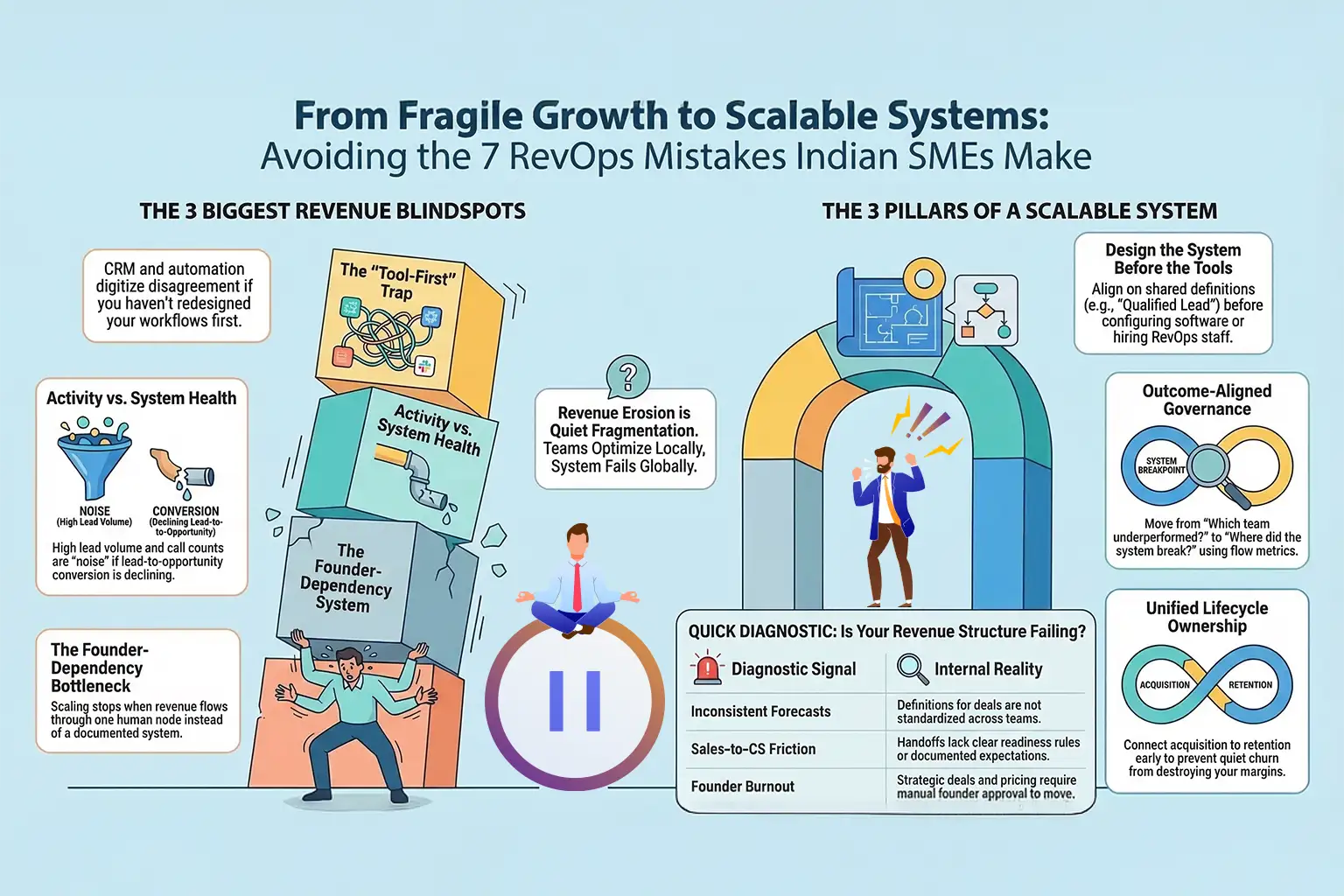
Revenue problems in Indian SMEs rarely explode overnight. There is no sudden collapse. There is no dramatic system crash. There is no single quarter that forces panic.
Instead, the warning signs show up quietly. Sales cycles stretch by a few weeks. Customer churn rises slightly. Forecasts feel less certain. Meetings grow longer. Decisions take more time. Nothing looks broken. Yet something feels off.
Most founders respond in predictable ways. They push sales teams harder. They increase marketing budgets. They hire more reps. They invest in new tools. Activity increases. However, predictability does not.
This is why many RevOps mistakes Indian SMEs make stay hidden for years. The real issue is not effort. It is structure. More specifically, it is the absence of a clear revenue structure.
In the early stage, proximity hides weak systems. Founders sit in sales calls. Marketing talks directly to prospects. Customer success escalates problems immediately. Information flows through conversations. For a while, that works.
However, as the business grows, informal coordination stops scaling. Revenue becomes a system. Yet the operating model does not change with it.
That gap is where most Revenue operations mistakes in India begin.
RevOps failures rarely start with incompetence. They start with fragmentation.
Marketing optimises campaigns. Sales optimises pipeline. Customer success optimises retention. Each team may perform well on its own. Together, revenue becomes unstable.
That instability is not random. It is structural. And the longer Indian SMEs ignore structural gaps, the more expensive growth becomes.
Below are the seven most damaging RevOps mistakes Indian SMEs make, why they happen so often in the Indian SME context, and how to fix them without slowing growth.
Mistake 1: Treating RevOps as a Tool Instead of an Operating Model
This is the most common and most costly of all RevOps mistakes Indian SMEs make.
When revenue feels unpredictable, leadership looks for visibility. Visibility feels like control. As a result, the instinctive solution becomes technology.
A CRM is purchased. Automation tools are added. Dashboards are created. Reports are standardised.
On paper, this looks like progress. In reality, it often deepens fragmentation.
Why This Revenue Operations Mistake in India Happens So Often
There are practical reasons why this pattern appears across many Revenue operations mistakes in India.
Software feels concrete. Vendors position RevOps as technology. Leadership wants quick clarity. Redesigning systems feels complex and slow. Buying tools is easier than redesigning workflows.
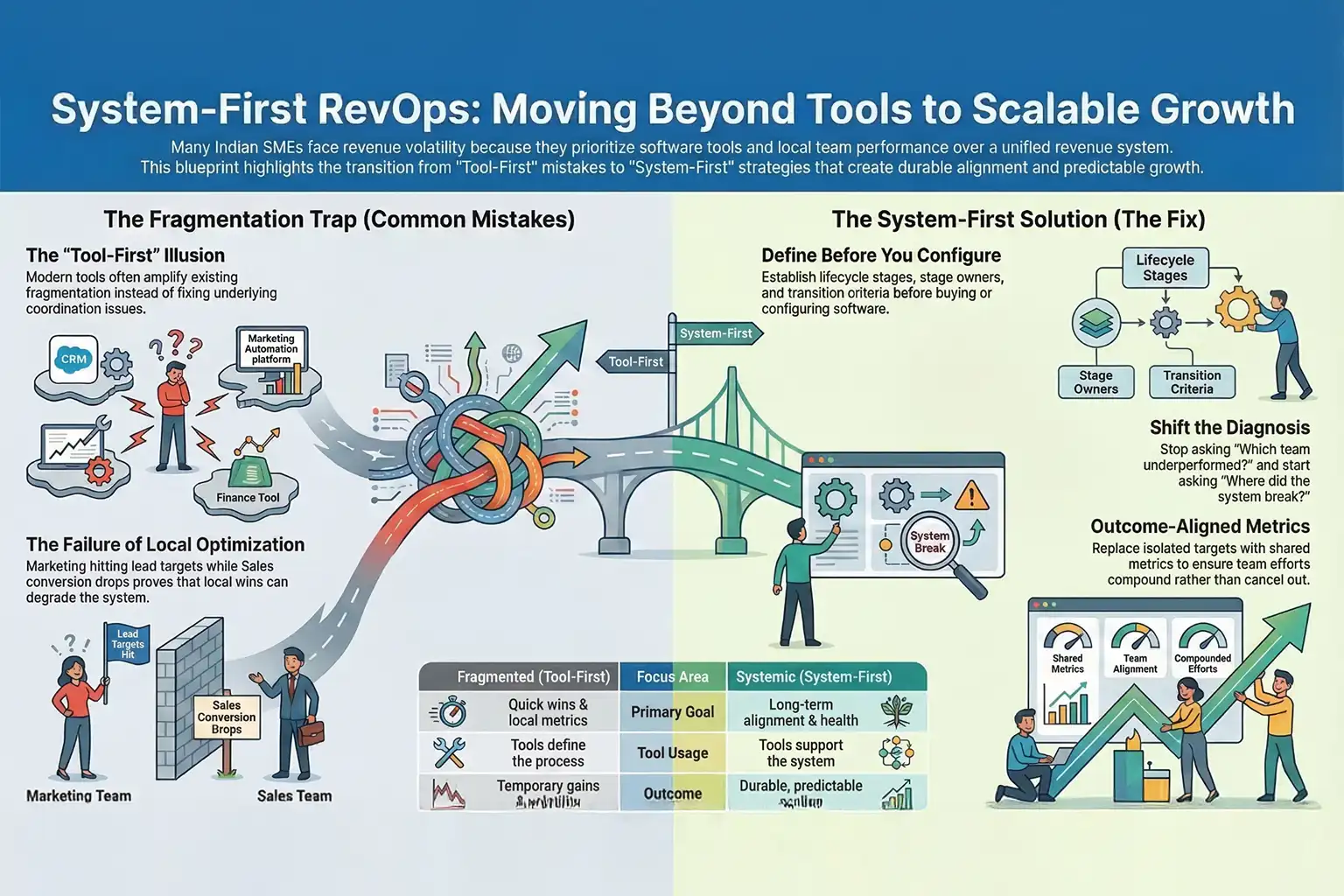
So instead of asking: “How should revenue flow across our organisation?” Teams ask: “What tool can fix this?” That shift in thinking changes everything.
What Actually Goes Wrong
When RevOps is treated as a tool instead of an operating model, three predictable problems appear.
- Definitions Stay Unclear
Marketing defines a qualified lead one way. Sales defines it differently. Customer success may not define it at all. The CRM does not fix this. It simply digitises disagreement. Over time, dashboards multiply. However, alignment does not improve. This is one of the most overlooked RevOps mistakes Indian SMEs make. - Handoffs Remain Weak
Leads move to sales without clear readiness rules. Deals move to onboarding without documented expectations. Customer feedback never loops back to marketing. Automation speeds up the movement of work. It does not improve the quality of transitions. As a result, friction increases across stages. - Metrics Track Activity, Not Outcomes
Marketing tracks lead volume. Sales tracks pipeline size. Customer success tracks churn. None of these metrics connect to system health. Teams celebrate activity. Revenue remains unstable. This is a classic pattern within Revenue operations mistakes in India — confusing visibility with alignment. Visibility shows what happened. Alignment explains why it happened. They are not the same.
The Hidden Cost of Tool-First RevOps
At first, everything looks better. Reports appear cleaner. Meetings look data-driven. Leadership feels informed.
However, over time, cracks appear. Teams argue over numbers. Forecasts drift from reality. Blame replaces diagnosis. Founders step back into operational decisions.
Why? Because the tool amplified fragmentation instead of fixing it.
This is how many RevOps mistakes Indian SMEs make compound quietly. Systems look modern. Internally, coordination weakens. Growth continues. Control declines.
What Proper RevOps Looks Like Instead
Real RevOps starts before tools. It begins with clarity.
Before configuring software, Indian SMEs must answer four basic questions:
- What defines each stage of the revenue lifecycle?
- Who owns each stage?
- What criteria move work forward?
- Which metrics reflect overall system health?
Only after these answers exist should tools be configured. Tools should support the revenue system. They should not define it.
When Indian SMEs reverse this order, they prevent multiple downstream RevOps mistakes Indian SMEs make before they appear. Instead of patching problems later, they build alignment early.
That shift — from tool-first thinking to system-first thinking — is the foundation of strong RevOps and the first step in correcting the most common Revenue operations mistakes in India.
Mistake 2: Optimising Functions Instead of the Revenue System
This is the second major RevOps mistake Indian SMEs make. It is more subtle than the first. It is also more dangerous.
When revenue slows, leaders optimise locally. They improve marketing performance. They refine sales scripts. They enhance customer success playbooks. Each improvement produces temporary gains. However, revenue volatility returns.
Why? Because revenue is systemic. Optimising parts does not fix a fragmented whole.
Why This Happens in the Indian SME Context
Indian SMEs operate under capital pressure. Budgets are tight. Teams are lean. Margin for error is thin.
As a result, leaders focus on quick wins. Marketing campaign tweaks. Sales incentive changes. Hiring more closers. Offering discounts to accelerate deals.
These tactics create short bursts of improvement. But they rarely create durable alignment.
This pattern explains many Revenue operations mistakes in India. Local optimisation feels productive. System optimisation feels abstract. However, as scale increases, system weakness dominates.
What Fragmented Optimisation Looks Like
Let’s examine a common scenario:
Marketing increases lead volume by 40%. On paper, success. Sales conversion drops by 20%. Customer success reports onboarding strain. Churn increases.
Marketing celebrates volume. Sales complains about quality. Customer success struggles quietly. Each team hits its metric. The system degrades.
This is one of the most damaging RevOps mistakes Indian SMEs repeatedly make. They reward local performance. They ignore systemic health.
Why This Gets Worse With Scale
As the organisation grows: Handoffs increase. Specialisation deepens. Information fragments. Each new hire adds another dependency. Each new tool adds another data source. Each new process adds another version of the truth.
Without systemic governance, optimisation collides. Revenue becomes harder to predict. Execution is not the bottleneck. Coordination is.
How to Correct This Mistake
Indian SMEs must shift from: “Which team underperformed?” To: “Where did the system break?”
This requires: Shared lifecycle definitions. Cross-functional revenue reviews. Outcome-aligned metrics. Clear stage ownership.
When teams optimise for shared outcomes instead of isolated targets, effort compounds instead of cancelling out.
This is the structural shift that separates scalable SMEs from permanently fragile ones.
Mistake 3: Hiring RevOps Before Fixing Structural Thinking
One of the most common RevOps mistakes Indian SMEs make is hiring a “RevOps person” before fixing how revenue actually works.
This usually happens during friction. Forecasts start missing. Teams argue over numbers. Data does not match across systems. Growth feels harder than before. Leadership feels pressure.
The instinctive reaction is simple: “Let’s hire a RevOps manager.”
At first, this sounds logical. However, this decision often hides a deeper issue. RevOps is not a role first. It is a system first.
When Indian SMEs hire RevOps without redesigning revenue ownership, they set that person up to struggle. This pattern repeats across many Revenue operations mistakes in India.
Why This Revenue Operations Mistake in India Happens So Often
Indian small businesses operate under constant bandwidth pressure. Founders often: Sit in sales calls, Review marketing metrics, Handle escalations, Approve discounts, Manage cash flow, Oversee hiring.
As coordination strain increases, founders feel stretched. Instead of redesigning how revenue decisions connect, they try to delegate alignment.
They assume: “RevOps will fix it.” However, that assumption creates risk.
If marketing, sales, and customer success still optimise independently… If definitions are inconsistent… If incentives still conflict… If leadership continues overriding process informally… Then the RevOps hire becomes a reporting layer. Not a system designer.
This is one of the most expensive RevOps mistakes Indian SMEs make because it creates the appearance of progress without structural change.
What Actually Happens After the Hire
There is a predictable pattern.
Phase 1: Optimism — Dashboards improve. Reports look cleaner. Meetings become more structured. Leadership feels relief.
Phase 2: Friction — The RevOps hire pushes for definition clarity. Sales says, “This slows us down.” Marketing says, “We need flexibility.” Customer success says, “We lack capacity.” Tension increases.
Why? Because the system was never redesigned. The RevOps hire is trying to impose structure on top of fragmentation.
Phase 3: Stagnation — Gradually, the RevOps role shifts toward analytics support instead of governance. Alignment remains weak. Handoffs remain unclear. Forecasts remain unstable. Leadership returns to firefighting.
Eventually, the company concludes: “RevOps doesn’t work for small businesses.” In reality, this is not a failure of RevOps. It is a failure of implementation. This misunderstanding drives many Revenue operations mistakes in India.
The Real Cost of This RevOps Mistake
This mistake compounds quietly. You add salary. You do not add clarity. You increase headcount. You do not reduce friction.
Over time, several problems appear: Political tension rises. RevOps is labelled “process police.” Execution slows. Founders step back into coordination.
Within 12 to 24 months, the impact becomes visible: Customer acquisition cost becomes unstable. Forecast accuracy declines. Retention varies unpredictably. Internal fatigue grows.
This is not a talent issue. It is a design issue. That is why this remains one of the most repeated RevOps mistakes Indian SMEs make.
How to Fix This Revenue Operations Mistake in India
The fix begins before hiring. Indian SMEs must first correct structural thinking.
- Align Leadership on Revenue Ownership
Revenue is cross-functional. Marketing influences quality. Sales influences commitments. Customer success influences retention. Without shared ownership, RevOps cannot function. - Define Shared, Non-Negotiable Terms
Agree on clear definitions: What is a qualified lead? When is a deal truly closed-won? What counts as an active customer? When does expansion begin? These definitions must exist before tools or roles. - Clarify Lifecycle Accountability
Who owns lead readiness? Who owns expectation setting? Who owns onboarding activation? Each stage needs one accountable owner. Not shared confusion. - Decide Governance Authority
Will RevOps enforce lifecycle standards? Or only advise teams? Without authority, RevOps becomes administrative. With clarity, RevOps becomes structural.
The Correct Order
Design first. Hire second.
When foundations exist, a RevOps hire strengthens alignment. Without foundations, a RevOps hire fights dysfunction.
Correcting this sequence prevents one of the most expensive RevOps mistakes Indian SMEs make. It also reduces long-term RevOps mistakes in India, before they harden into structural debt.
Mistake 4: Measuring Activity Instead of Revenue System Health
Another critical RevOps mistake Indian SMEs make is over-indexing on activity metrics instead of system metrics.
This mistake feels productive. Because activity is visible. Leads generated. Calls made. Emails sent. Meetings booked. Deals created.
However, revenue outcomes do not emerge from activity volume alone. They emerge from how activity flows across the lifecycle.
Why This Revenue Operations Mistake in India Persists
There are three reasons.
- Activity metrics are easy to track — CRMs produce them automatically.
- They feel controllable — Teams can “increase effort.”
- They protect accountability — It is easier to say “We did the work” than “The system failed.”
However, activity does not equal alignment. And alignment is what determines predictability.
What Activity-Driven Thinking Looks Like
Marketing celebrates lead volume growth. Sales celebrates pipeline size. Customer success celebrates ticket resolution speed.
Meanwhile: Lead-to-opportunity conversion declines. Sales cycles lengthen. Early churn increases. Forecast accuracy deteriorates.
The dashboard looks busy. Revenue feels unstable.
This disconnect is one of the most damaging Revenue operations mistakes in India because it delays structural correction.
The System-Level Metrics Indian SMEs Ignore
Instead of activity, RevOps focuses on:
- Lead-to-opportunity conversion quality
- Time spent stalled between stages
- Onboarding activation rates
- Early churn signals (first 90 days)
- Expansion readiness indicators
- Forecast accuracy delta
These metrics reveal coordination health. They expose where upstream decisions create downstream friction. Without them, leadership optimises noise.
The Compounding Cost
Over time, activity-focused teams: Inflate CAC without improving conversion quality. Increase hiring before fixing system leakage. Burn capital on acquisition without strengthening retention. Increase pressure instead of clarity.
This destroys capital efficiency — which is lethal in Indian SME environments. Because Indian businesses operate with tighter margins and longer cash cycles, Revenue operations mistakes in India amplify faster than in venture-backed Western startups.
How to Fix This Mistake
Shift from effort metrics to flow metrics.
Instead of asking: “How many leads did we generate?” Ask: “How many high-quality leads converted without friction?”
Instead of: “How many deals did we close?” Ask: “How many closed deals activated successfully?”
Instead of: “How many tickets did we resolve?” Ask: “How many customers reached value milestones?”
This shift transforms RevOps from reporting to governance.
Mistake 5: Ignoring Customer Success Until Churn Appears
This is perhaps the most financially dangerous of all RevOps mistakes Indian SMEs make.
In early stages, acquisition dominates attention. Sales drives growth. Marketing fuels pipeline. Customer success handles support reactively. Retention becomes a “later problem.” Until it isn’t.
Why This Revenue Operations Mistake in India Is So Common
Indian SMEs operate under acquisition pressure. Growth is measured visibly. Retention erosion is slower and less dramatic.
However, the economics are brutal. Acquisition without retention increases CAC recovery time. It compresses margins. It increases stress.
Yet many small businesses delay RevOps alignment across customer success because churn does not explode overnight. It leaks quietly.
The Hidden Leakage Pattern
Month 1: Strong acquisition. Onboarding friction. Low visibility into activation.
Month 3: Customers underutilise product/service. Support load increases.
Month 6: Renewals weaken. Expansion stalls.
Month 9: Marketing spends more to offset churn. Leadership concludes: “We need more leads.”
Instead, they need lifecycle alignment.
Why This Is a Structural RevOps Mistake
RevOps for Indian SMEs is fundamentally about connecting acquisition and retention.
If customer success insights do not feed back into: Targeting, Messaging, Qualification, Sales commitments — then churn is baked into the system.
Ignoring this connection is one of the costliest Revenue operations mistakes in India because it damages lifetime value while inflating acquisition cost.
The Fix
Integrate customer success into revenue governance early.
- Define activation milestones.
- Align sales expectations with onboarding capacity.
- Review churn drivers monthly at leadership level.
- Feed retention insights into acquisition strategy.
When RevOps governs this loop, acquisition and retention reinforce each other. Without it, they compete.
Mistake 6: Building Founder-Dependent Revenue Systems
One of the most dangerous yet invisible RevOps mistakes Indian SMEs make is building revenue systems that depend heavily on founder intervention.
At first, this seems normal. In early stages: Founders close key deals. Founders approve discounts. Founders handle escalations. Founders refine messaging. Founders override objections.
This works because volume is manageable. However, as the business grows, this dependency becomes a structural bottleneck.
Why This Revenue Operations Mistake in India Happens So Often
Indian small businesses are often founder-driven. Founders: Carry institutional knowledge. Hold pricing context. Understand customer nuance. Control negotiation boundaries. Manage key relationships.
Because of this, they become the informal glue across marketing, sales, and customer success.
But here is the risk. When the founder is the system, there is no system. Revenue predictability becomes tied to founder availability. That is not scalable. And this is one of the most underestimated Revenue operations mistakes in India.
What Founder-Dependent Revenue Looks Like in Practice
You see patterns like:
- Sales cannot close strategic deals without founder approval.
- Marketing cannot adjust positioning without founder input.
- Customer success escalates churn risks directly to founder.
- Pricing changes require manual review.
- Forecast confidence depends on founder judgement.
On paper, the company appears functional. In reality, revenue flows through one human node.
As scale increases, three things happen:
- Decision latency increases.
- Execution consistency declines.
- Founder burnout accelerates.
Growth slows not because the market shrinks, but because coordination cannot scale beyond individual capacity.
Why This Is a Core RevOps Mistake Indian SMEs Must Address
RevOps for Indian SMEs exists to replace person-dependent coordination with system-dependent alignment.
Without RevOps governance: Definitions live in founder memory. Qualification logic remains informal. Escalation paths remain reactive. Forecasting depends on intuition.
This creates fragile growth. It works until volume crosses a threshold. Then unpredictability increases sharply.
This is why founder-dependence is not just operational inefficiency. It is systemic revenue risk.
The Structural Fix
To correct this RevOps mistake Indian SMEs must:
- Document decision criteria — Pricing thresholds. Qualification rules. Escalation triggers.
- Standardise lifecycle definitions — Lead readiness. Deal commitment. Activation completion.
- Institutionalise cross-functional reviews — Revenue meetings should examine flow, not just numbers.
- Reduce founder override frequency — Overrides must become exceptions, not habit.
RevOps creates governance that scales judgement beyond individuals. This transition marks the shift from founder-led growth to system-led scale.
Mistake 7: Waiting for Revenue Crisis Before Adopting RevOps
Perhaps the most common Revenue operations mistake in India is timing.
Indian SMEs often delay RevOps adoption until revenue instability becomes obvious. By then, misalignment has hardened into structural debt.
Why This Happens
There are three psychological traps:
- “We’re too small for RevOps.”
- “We’ll fix alignment after we scale.”
- “This is a temporary dip.”
However, revenue rarely collapses dramatically. It erodes gradually. Forecast accuracy declines first. Sales cycles extend quietly. Churn creeps upward. Customer acquisition cost rises subtly.
Leadership reacts tactically. More campaigns. More sales hires. More reporting. More tools.
But without structural alignment, these efforts compound complexity instead of fixing it.
The Compounding Cost of Delayed RevOps
The longer RevOps is delayed, the more: Process debt accumulates. Incentive misalignment entrenches. Tool fragmentation increases. Blame culture strengthens. Forecast credibility erodes.
When RevOps is finally introduced, resistance is higher. Systems are harder to redesign. Teams are defensive. Leadership is fatigued.
This is why delayed adoption remains one of the most expensive RevOps mistakes Indian SMEs make.
Why Revenue Operations Mistakes in India Compound Faster
Indian small businesses operate under constraints that magnify misalignment:
- Tighter capital cycles
- Limited headcount
- High founder involvement
- Price-sensitive markets
- Strong competition
- Lower margin for forecasting error
Because of these realities, coordination inefficiencies burn cash faster. In larger enterprises, inefficiency hides behind budgets. In Indian SMEs, inefficiency directly impacts runway.
This makes Revenue operations mistakes in India structurally riskier than in mature markets. RevOps becomes less of a strategic enhancement and more of a capital protection mechanism.
A Practical Diagnostic: Are You Making These RevOps Mistakes?
Indian SMEs can run a simple structural test. If three or more of the following are true, RevOps misalignment exists:
- Teams use different definitions for leads or opportunities.
- Sales closes deals that struggle in onboarding.
- Marketing celebrates volume, but conversion quality declines.
- Forecast accuracy is inconsistent month-to-month.
- Customer churn reasons are unclear or untracked.
- Founder approval is required for most non-routine decisions.
- Revenue meetings focus on activity, not lifecycle flow.
- Data across tools does not reconcile easily.
- Blame shifts between teams when targets miss.
These are not performance problems. They are coordination failures. Which means they are RevOps problems.
What Indian SMEs Should Do Instead
Avoiding RevOps mistakes Indian SMEs make requires a structural shift.
Instead of asking: “How do we push harder?” Ask: “How does revenue flow across our lifecycle?”
Instead of hiring more salespeople: Fix handoffs.
Instead of buying more tools: Align definitions.
Instead of adding more reporting: Clarify ownership.
Instead of increasing pressure: Increase coherence.
RevOps works because it aligns incentives, definitions, metrics, and accountability. When alignment improves, execution compounds.
Final Perspective: RevOps as a Preventative Discipline, Not a Reactive Fix
RevOps is not a growth hack. It is not a reporting function. It is not an enterprise luxury.
For Indian SMEs, it is structural hygiene.
The seven RevOps mistakes Indian SMEs make are not tactical errors. They are design failures. And design failures compound.
Indian businesses that scale sustainably do not wait for revenue instability to become visible. They design revenue systems early. They treat marketing, sales, and customer success as a unified flow. They align metrics before volume increases. They clarify ownership before hiring accelerates. They institutionalise governance before chaos emerges.
That is how a business moves from effort-driven growth to system-driven scale.
Revenue operations mistakes in India are costly because they waste effort without improving predictability.
RevOps corrects that by ensuring: Decisions reinforce each other. Data reflects reality. Ownership is clear. Growth compounds instead of destabilising.
Ultimately, the difference between fragile growth and scalable growth is alignment. And alignment is not accidental. It is designed. That design is RevOps.
"The biggest RevOps mistake Indian SMEs make is assuming alignment will happen naturally. It does not. Revenue coordination weakens as complexity increases. Without design, misalignment compounds."
Key Takeaways
- Most revenue problems in Indian SMEs are structural — not effort-related
- Treat RevOps as an operating model, not just tools or a new hire
- Optimise the revenue system, not just individual functions
- Shift from activity metrics to lifecycle health metrics
- Fix alignment before revenue becomes visibly broken
Are RevOps Mistakes Slowing Your Growth?
Our RXF System helps Indian SMEs identify and fix structural revenue gaps quickly. Let's build predictable revenue together.
Book a Coffee Call