
Why Choosing the Right RevOps Tech Stack India Is Harder Than It Looks
For most Indian SMEs, building a RevOps tech stack India feels like the natural next step as they grow.
Revenue becomes more complex. Teams expand. Customer journeys become longer. Data starts spreading across tools.
At this stage, leaders look for control. And the fastest-looking solution is technology.
So the instinct becomes: “Let’s invest in tools.”
However, this is where things start to go wrong. Because tools feel like solutions. But in reality, tools only amplify the system that already exists.
The Core Problem: Tool-First Thinking
Most Indian SMEs approach RevOps like this: Buy a CRM. Add marketing automation. Build dashboards. Connect everything.
On paper, this looks like progress. In practice, it often creates more confusion than clarity.
Why? Because the underlying system has not been fixed. Definitions remain inconsistent. Handoffs remain unclear. Metrics remain disconnected.
As a result, the RevOps tech stack India becomes layered. But the revenue system remains fragmented.
Why This Is a Bigger Problem in India
This issue is amplified in the Indian SME context. Small businesses operate with: Limited budgets. Lean teams. High pressure on ROI. Faster decision cycles.
Because of this: Wrong tools waste money. Complex systems slow execution. Low adoption reduces value.
Unlike large enterprises, Indian SMEs cannot afford inefficiency. That is why building the right RevOps tech stack India is not just a technical decision. It is a strategic one.
What a RevOps Tech Stack India Should Actually Do
Before selecting tools, it is critical to define what the tech stack is meant to achieve.
A RevOps tech stack India should not exist just to “manage data.” It should enable alignment across the revenue lifecycle.
The True Purpose of a RevOps Tech Stack
A well-designed RevOps tech stack India should:
- Track how revenue moves across stages
- Connect marketing, sales, and customer success
- Provide visibility into conversion and retention
- Support consistent workflows
- Enable faster, better decisions
If tools do not support these outcomes, they add noise. Not value.
The System-First Principle
Before choosing the best RevOps tools for Indian SMEs, one rule must be clear: Structure comes first. Tools come second.
If your lifecycle is unclear: Tools will reflect confusion. If your handoffs are broken: Automation will scale inefficiency. If your metrics are misaligned: Dashboards will mislead decisions.
This is why many SMEs feel overwhelmed despite having multiple tools. They built the stack before fixing the system.
The Three Layers of a RevOps Tech Stack India
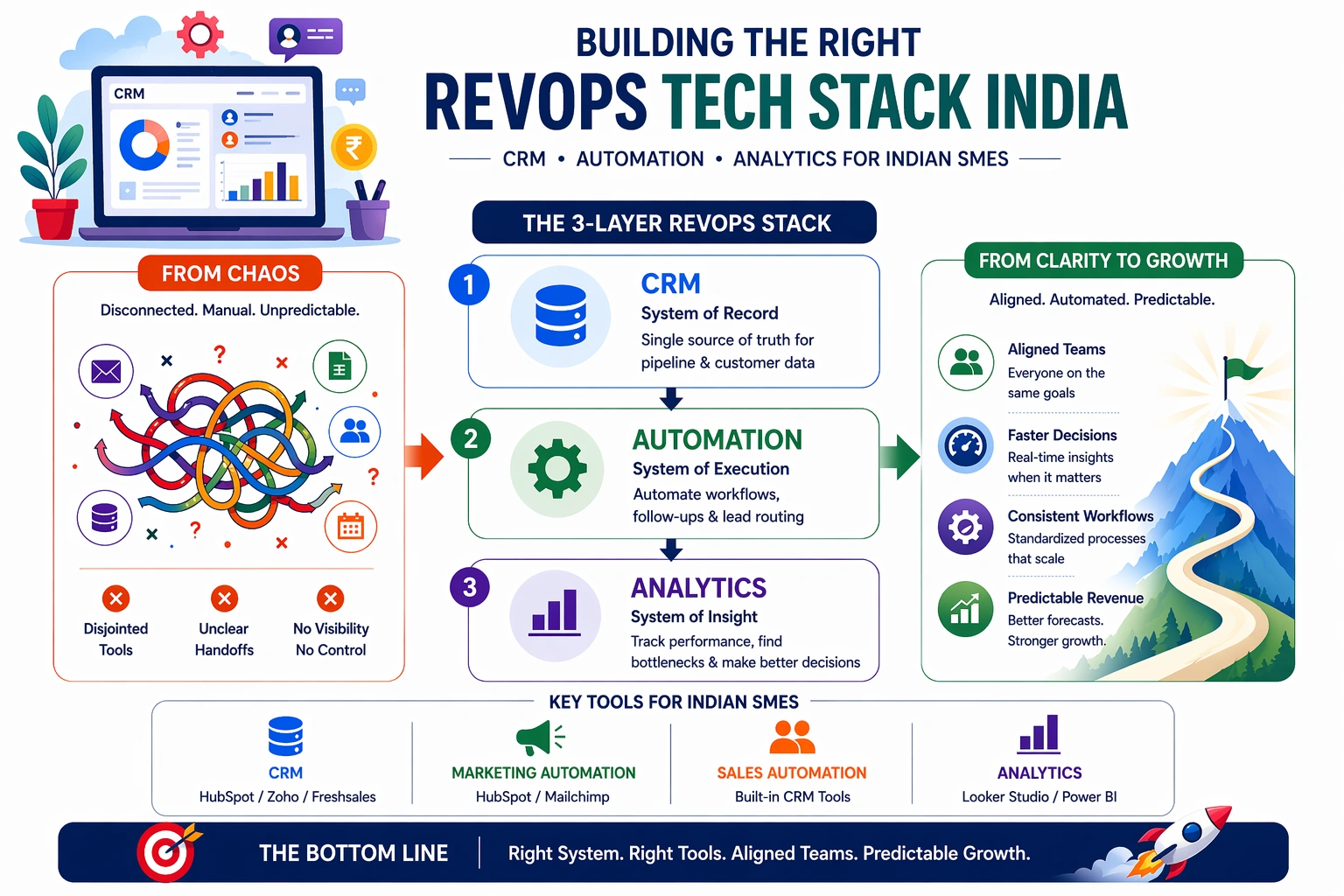
To simplify decision-making, every RevOps tech stack India can be broken into three layers:
- CRM (system of record)
- Automation (system of execution)
- Analytics (system of insight)
Each layer serves a distinct purpose. Together, they create a connected system.
Layer 1: CRM – The Foundation of Your RevOps Tech Stack India
The CRM is the most important component of your RevOps tech stack India. Everything flows through it.
What a CRM Should Actually Do
A CRM should not just store data. It should structure your revenue system. This includes: Tracking leads and opportunities, Defining pipeline stages, Capturing deal movement, Storing customer context, Enabling collaboration across teams.
It becomes the single source of truth.
Why CRM Choice Is Critical for Indian SMEs
Choosing the wrong CRM creates long-term friction. Poor usability reduces adoption. Complex interfaces slow teams. Inconsistent usage creates unreliable data.
For Indian SMEs, this has a direct cost. Bad data leads to bad decisions.
What to Look for in the Best RevOps Tools for Indian SMEs
When selecting a CRM, focus on: Ease of use, Clear pipeline visibility, Customisable stages, Strong integration capability, Simple reporting.
Avoid: Overly complex enterprise tools, Features you will not use, Heavy implementation requirements.
The Most Important CRM Principle
Your CRM should reflect your business. Not reshape it. Do not change your lifecycle to fit the tool. Instead, configure the tool to match your process.
This ensures: Higher adoption, Cleaner data, Better insights.
The Role of CRM in RevOps Implementation
In RevOps implementation in India, the CRM acts as: The central data hub, The workflow anchor, The visibility layer. If the CRM is not structured properly, the entire system weakens.
Layer 2: Automation – The Execution Engine of Your RevOps Tech Stack India
Once the CRM is structured, the next layer is automation. Automation increases efficiency. However, only when used correctly.
What Automation Should Actually Do
Automation should support execution. Not replace thinking. In a RevOps tech stack India, automation should: Route leads automatically, Trigger follow-ups, Assign tasks, Manage workflows, Reduce manual effort.
It should make processes faster and more consistent.
Why Automation Often Fails in SMEs
Many Indian SMEs introduce automation too early. They: Automate unclear processes, Automate without definitions, Automate without ownership.
This leads to: Confusion, Errors, Poor customer experience. Automation ends up amplifying inefficiency.
The Right Way to Use Automation
In how to choose the best RevOps tools for Indian SMEs, automation should: Follow clear rules, Support defined handoffs, Enhance existing workflows.
For example: Qualified leads automatically assigned to sales, Follow-ups triggered after customer actions, Onboarding tasks scheduled post-deal.
Automation should reduce friction. Not create it.
Why Automation Matters for Growth
When implemented correctly: Response time improves, Consistency increases, Team workload reduces. This improves: Conversion rates, Customer experience, Operational efficiency. All of which support revenue growth.
Layer 3: Analytics – Turning Data into Decisions
The final layer of a RevOps tech stack India is analytics. This is where data becomes actionable insight.
What Analytics Should Do
Analytics should answer key questions: Where is revenue slowing? Which stage is underperforming? What affects retention? How accurate are forecasts? It should guide decisions. Not just display numbers.
The Problem with Traditional Dashboards
Most dashboards show: Total leads, Pipeline value, Revenue numbers. However, they do not explain: Why deals are stuck, Where conversion drops, Why customers churn. As a result, decisions remain unclear.
The RevOps Approach to Analytics
RevOps analytics focuses on flow. Track: Stage conversion rates, Time between stages, Activation success, Retention trends. This provides clarity. And enables action.
Why This Matters for Indian SMEs
In Indian markets: Margins are tighter, Competition is stronger, Errors are costly. Better analytics leads to better decisions. And better decisions lead to stronger growth.
How to Choose the Best RevOps Tools for Indian SMEs
Now that the structure is clear, the next step in building a strong RevOps tech stack India is choosing the right tools.
However, this is where many businesses make costly mistakes. They choose based on: Popularity, Recommendations, Feature lists, Pricing discounts. Instead of choosing based on fit.
The Right Way to Evaluate Tools
When selecting the best RevOps tools for Indian SMEs, focus on alignment—not features. Ask: Does this tool match our lifecycle? Will our team actually use it? Does it simplify work or complicate it? Can it scale as we grow?
If the answer is unclear, the tool is not the right fit.
The “Less Is More” Principle
For Indian SMEs, simplicity wins. A smaller, well-integrated stack performs better than: Multiple disconnected tools, Complex workflows, Over-engineered systems.
This is especially important because: Adoption matters more than capability. A simple tool used consistently is more valuable than a powerful tool used poorly.
Recommended Categories in a RevOps Tech Stack India
Instead of focusing on specific brands, it is more useful to think in categories. Every RevOps tech stack India should include:
- CRM
- Marketing automation
- Sales enablement
- Customer success tools
- Analytics
1. CRM (Core System)
Your CRM remains the foundation. Examples (depending on scale): HubSpot CRM, Zoho CRM, Salesforce (for larger SMEs). For most Indian SMEs: HubSpot or Zoho offer the best balance of usability and functionality.
2. Marketing Automation Tools
These tools help manage: Lead capture, Email campaigns, Lead nurturing, Segmentation. Examples: HubSpot Marketing Hub, Mailchimp, Zoho Campaigns. Choose tools that integrate easily with your CRM.
3. Sales Enablement Tools
These tools support: Follow-ups, Pipeline tracking, Deal management, Communication. Examples: Built-in CRM tools (preferred for simplicity), Outreach tools (for advanced teams). For SMEs, keeping this inside the CRM is often better.
4. Customer Success Tools
These tools focus on: Onboarding, Customer tracking, Retention signals, Feedback collection. Examples: Simple CRM extensions, Dedicated CS tools (for scaling businesses). For early-stage SMEs, lightweight systems work best.
5. Analytics and Reporting Tools
These tools provide visibility into: Conversion rates, Pipeline movement, Retention trends, Forecast accuracy. Examples: Built-in CRM dashboards, Google Data Studio (Looker Studio), Power BI (for advanced needs). Again, simplicity is key.
How to Implement Your RevOps Tech Stack India Step-by-Step
Choosing tools is only half the process. Implementation determines success.
Step 1: Start with CRM Setup
Before adding anything else: Define pipeline stages, Align lifecycle definitions, Clean existing data. Do not import messy data into a new system. Fix structure first.
Step 2: Configure Workflows
Once the CRM is set: Define lead routing rules, Set up deal stages, Assign ownership clearly. This ensures consistency.
Step 3: Add Automation Gradually
Do not automate everything at once. Start with: Lead assignment, Basic follow-ups, Task reminders. Then expand as needed.
Step 4: Build Simple Dashboards
Focus on clarity. Track: Stage conversion rates, Deal velocity, Activation metrics, Retention signals. Avoid overloading dashboards.
Step 5: Train Teams Properly
Even the best RevOps tech stack India fails without adoption. Teams must understand: Why the system exists, How to use tools correctly, What data matters. Adoption drives value.
Common Mistakes When Building a RevOps Tech Stack India
Even with the right intent, SMEs often repeat the same mistakes.
1. Buying Too Many Tools
More tools ≠ better outcomes. It creates: Data fragmentation, Integration issues, Confusion.
2. Ignoring Team Adoption
If teams do not use tools: Data becomes unreliable, Reports lose value, Decisions weaken.
3. Overengineering the Setup
Complex systems slow teams down. Start simple.
4. Not Aligning Tools with Lifecycle
Tools must reflect your revenue process. Not the other way around.
5. Skipping Data Hygiene
Bad data leads to: Poor insights, Wrong decisions, Broken forecasts. Clean data is essential.
Where Xcellerators Hub Fits In
This system-first approach reflects how Xcellerators Hub designs a RevOps tech stack India for SMEs. Instead of focusing on tools first, the approach prioritises: Lifecycle clarity, Minimal, effective tool selection, High adoption systems, Scalable architecture.
Because technology should support growth. Not complicate it.
Final Perspective: A RevOps Tech Stack India Is Only as Strong as Its System
The biggest mistake Indian SMEs make is assuming tools will fix revenue problems. They do not. They only support existing systems.
The Key Shift
Instead of asking: “What tools should we buy?” Ask: “How should our revenue system work?” Then choose tools to support that system.
What Success Looks Like
When the right RevOps tech stack India is implemented: Teams share the same data, Workflows become consistent, Decisions become faster, Revenue becomes predictable.
Tools feel invisible. Because they support, not obstruct.
"A RevOps tech stack India is not about having more tools. It is about having the right system. When structure is clear and tools support it, growth becomes scalable."
Key Takeaways
- Structure first, tools second — always
- CRM is the foundation; automation and analytics support it
- Simplicity and adoption matter more than feature lists
- Choose tools that match your lifecycle, not the other way around
- Clean data and team training are non-negotiable
Need Help Building Your RevOps Tech Stack India?
Our RXF System helps Indian SMEs select, configure, and implement the right tools for aligned, predictable revenue growth.
Book a Coffee Call