
Why Customer Lifetime Value for Indian SMEs Remains Low Despite Growth
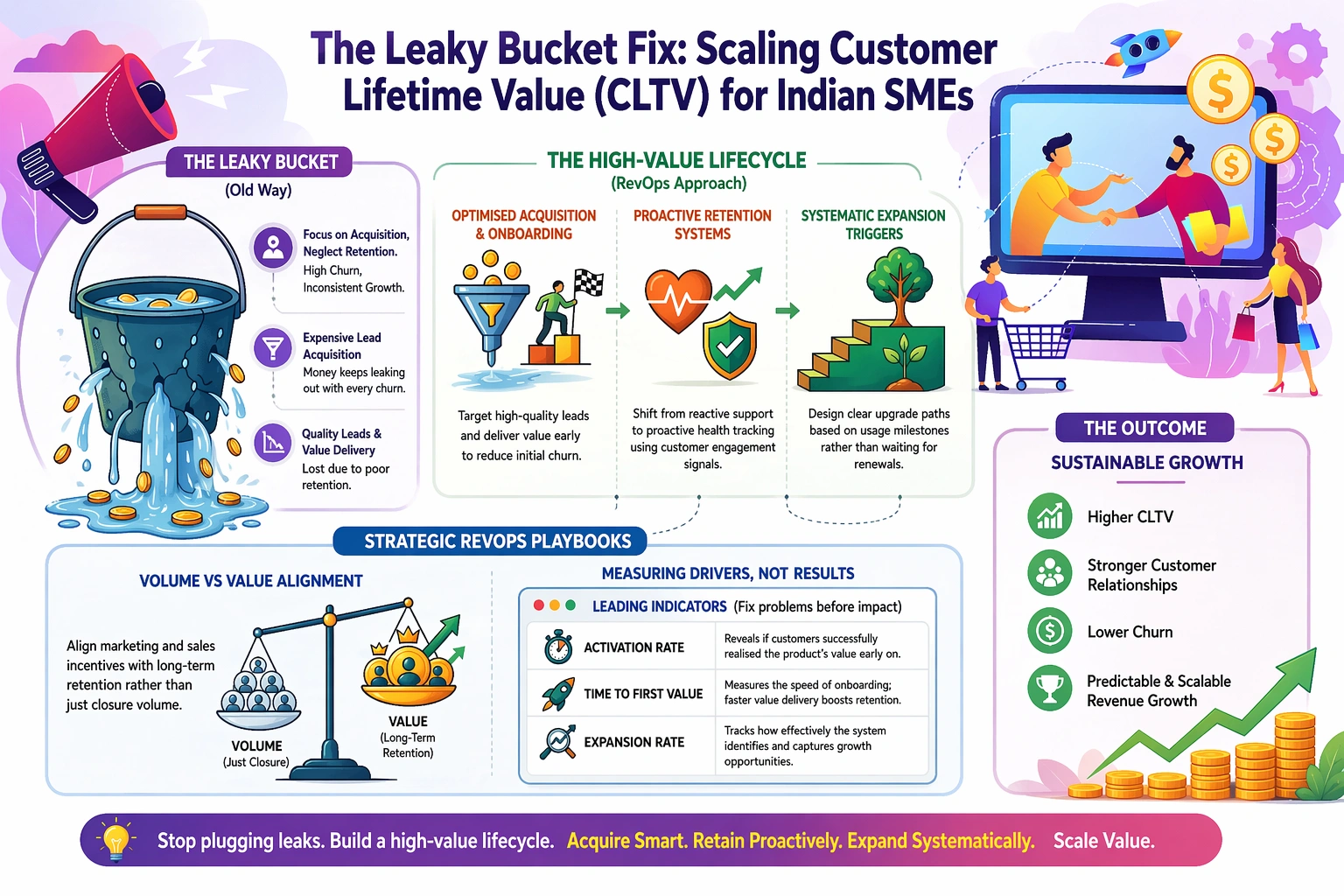
Most Indian SMEs focus heavily on acquisition. They generate leads. They close deals. They grow revenue. On the surface, everything looks strong.
However, over time, a deeper issue appears. Customers do not stay long enough. Expansion remains inconsistent. Repeat revenue feels unpredictable.
This is where customer lifetime value for Indian SMEs starts to break down. And more importantly, this is where growth becomes expensive.
The Hidden Problem: Growth Without Retention Alignment
Revenue growth often hides retention problems. New customers replace lost ones. Pipeline stays active. Sales keeps closing deals.
However, the system is leaking. Acquisition cost increases. Margins tighten. Forecasts become unstable.
This is why many businesses struggle even while growing. They are scaling input. Not value.
RevOps strategies to increase CLTV focus on fixing this exact problem. They align how customers are acquired, onboarded, and retained—so value compounds.
What CLTV Actually Means in the Indian SME Context
Customer lifetime value for Indian SMEs is not just a financial metric. It reflects how well your system retains and expands customers.
CLTV depends on: How long customers stay, How much they spend over time, How often they upgrade or renew.
However, most SMEs treat CLTV as a reporting metric. Not as a design outcome. That is the gap.
RevOps strategies to increase CLTV treat CLTV as something you build intentionally. Not something you measure later.
The Core Insight: CLTV Is Created Before the Sale
Most businesses assume CLTV is driven by customer success. However, that is only partially true. CLTV begins much earlier.
It starts with: Targeting, Positioning, Expectation setting.
If these are misaligned: Customers churn early, Expansion becomes difficult, Retention weakens.
For example: If marketing attracts the wrong audience → churn increases. If sales overpromises → onboarding struggles. If onboarding delays value → customers disengage.
This is why RevOps strategies to increase CLTV focus on the entire lifecycle. Not just post-sale activities.
The RevOps View of Customer Lifetime Value for Indian SMEs
RevOps changes how CLTV is understood. Instead of asking: “How do we retain customers?” It asks: “How do we design the system so customers naturally stay longer and expand?”
This shift is powerful. Because retention is not fixed at the end. It is shaped at every stage.
The CLTV Lifecycle
Customer lifetime value for Indian SMEs is built across five stages:
- Acquisition (who you bring in)
- Conversion (how you close them)
- Onboarding (how quickly they see value)
- Retention (how consistently they stay engaged)
- Expansion (how much they grow with you)
Each stage influences the next. Weakness in one stage affects the entire system. RevOps strategies to increase CLTV focus on aligning all five stages.
Playbook 1: Improve CLTV by Fixing Customer Acquisition Quality
Most SMEs try to increase CLTV by improving retention. However, the real leverage starts earlier. At acquisition.
Why Acquisition Quality Matters
Not all customers are equal. Some convert easily, adopt quickly, stay longer, and expand naturally. Others struggle to onboard, require heavy support, and churn early.
If acquisition quality is weak, retention becomes expensive.
How RevOps Improves Acquisition for Higher CLTV
RevOps strategies to increase CLTV focus on targeting alignment. This includes: Defining ideal customer profiles clearly, Aligning marketing campaigns with real buyer needs, Filtering low-quality leads early.
Instead of asking: “How do we get more leads?” Ask: “How do we get the right leads?”
Impact on Customer Lifetime Value for Indian SMEs
When acquisition improves: Conversion becomes smoother, Onboarding becomes easier, Retention improves naturally. This reduces CAC pressure and increases CLTV.
Playbook 2: Align Sales with Long-Term Value, Not Just Closures
Sales plays a critical role in CLTV. However, most sales teams optimise for closure. Not for retention.
The Problem with Short-Term Sales Thinking
When sales focuses only on closing: Expectations get inflated, Customers misunderstand value, Onboarding becomes difficult. This leads to early dissatisfaction and eventually churn.
The RevOps Fix
RevOps strategies to increase CLTV align sales incentives with long-term outcomes. This includes: Setting realistic expectations, Documenting customer goals clearly, Ensuring alignment with delivery capabilities.
Sales should not just close deals. They should set customers up for success.
Why This Matters for Indian SMEs
Customer lifetime value for Indian SMEs depends heavily on trust. If expectations break early: Customers disengage, Renewals weaken, Expansion becomes unlikely.
However, when sales aligns with delivery: Retention improves, Customer satisfaction increases, Expansion becomes easier.
Playbook 3: Design Onboarding for Fast Value Delivery
Onboarding is the most critical stage for CLTV. It determines whether customers stay or leave.
The First Value Moment
Customers decide quickly whether to continue. If they experience value early: They stay engaged. If they face friction: They disengage.
This is why RevOps strategies to increase CLTV prioritise activation.
What Effective Onboarding Looks Like
For Indian SMEs, onboarding should focus on: Clear milestones, Defined timelines, Guided implementation, Early success indicators.
Customers should know: What to expect, What to do, What success looks like.
The Impact on CLTV
When onboarding improves: Retention increases, Support load decreases, Expansion becomes possible. Customer lifetime value for Indian SMEs grows because customers see value early.
Playbook 4: Build a Retention System, Not Just Customer Support
Most Indian SMEs treat retention as a support function. Customers raise issues. Teams respond. Problems get resolved.
At first, this seems sufficient. However, over time, this approach reveals its limitations. It is reactive. It depends on customers speaking up. It addresses symptoms, not causes.
As a result, customer lifetime value for Indian SMEs remains inconsistent.
The Problem with Reactive Retention
When retention depends only on support: Issues are addressed too late, Customer frustration builds silently, Churn signals go unnoticed.
In many cases, customers disengage before they complain. They reduce usage. They delay responses. They stop seeing value.
The RevOps Approach to Retention
RevOps strategies to increase CLTV shift retention from reactive to proactive. Instead of waiting for problems, the system actively tracks customer health. This includes: Usage patterns, Engagement consistency, Milestone completion, Feedback signals.
As a result, retention becomes visible earlier. And more importantly, controllable.
Designing a Retention System That Scales
To improve customer lifetime value for Indian SMEs, retention must be structured into the lifecycle. This means: Defining clear success milestones, Tracking customer progress regularly, Scheduling proactive check-ins, Identifying risk signals early.
For example: If a customer does not activate within 14 days → trigger onboarding support. If engagement drops → initiate a review call. If key milestones are delayed → escalate internally.
These actions reduce churn before it becomes visible.
Why This Matters in the Indian SME Context
Indian SMEs often operate with tighter margins. This means losing customers is more expensive. Replacing churn requires: More marketing spend, More sales effort, More time.
RevOps strategies to increase CLTV reduce this dependency. They protect revenue instead of constantly replacing it.
Playbook 5: Design Expansion as a System, Not an Opportunity
Expansion is one of the most underutilised levers in Indian SMEs. Most businesses treat it as optional. They wait for renewal cycles. They reach out occasionally. They rely on timing or luck.
As a result, expansion becomes inconsistent. And customer lifetime value for Indian SMEs remains limited.
Why Expansion Fails Without Structure
Expansion fails when: There are no defined triggers, Customers do not see continuous value, Teams lack visibility into readiness.
Even satisfied customers may not expand. Not because they do not want to. But because the system does not guide them.
The RevOps Expansion Framework
RevOps strategies to increase CLTV introduce structured expansion triggers. Instead of relying on timing, expansion is based on signals. These include: Usage milestones achieved, Clear ROI demonstrated, Additional needs identified, Growth in customer requirements.
When these signals are tracked, expansion becomes predictable.
Building Expansion into the Lifecycle
To improve customer lifetime value for Indian SMEs, expansion must be planned early. This includes: Identifying expansion opportunities during onboarding, Aligning product or service tiers with customer growth, Creating clear upgrade paths, Training teams to recognise readiness signals.
Expansion should not feel like selling. It should feel like progression.
Impact on Revenue Stability
When expansion becomes systematic: Revenue per customer increases, Dependence on acquisition reduces, Profitability improves. This creates stronger, more stable growth.
Playbook 6: Measure What Actually Drives CLTV
Many SMEs track CLTV as a single number. However, that number alone does not explain anything. It shows the result. Not the cause.
RevOps strategies to increase CLTV focus on understanding what drives that result.
Key Metrics That Matter for CLTV
To improve customer lifetime value for Indian SMEs, focus on: Activation rate (did customers reach value?), Time to first value, 30-day retention rate, 90-day retention rate, Expansion rate, Revenue per customer over time.
Each metric highlights a specific part of the lifecycle.
Connecting Metrics to Decisions
Metrics are only useful when they guide action. For example: If activation is low → improve onboarding. If retention drops early → fix expectation gaps. If expansion is weak → improve value delivery.
This makes CLTV actionable. Not abstract.
Why This Approach Works
When businesses track drivers instead of outcomes: Problems become easier to identify, Decisions become faster, Improvements become measurable. This strengthens RevOps strategies to increase CLTV across the system.
Playbook 7: Align Teams Around CLTV, Not Just Revenue
One of the biggest barriers to improving CLTV is misalignment. Marketing focuses on volume. Sales focuses on closures. Customer success focuses on support.
Each team performs well individually. However, customer lifetime value for Indian SMEs remains unstable.
The Problem with Isolated Metrics
When teams optimise separately: Marketing generates leads that do not convert, Sales closes deals that struggle in onboarding, Customer success handles issues without context.
Effort increases. Alignment decreases.
The RevOps Alignment Model
RevOps strategies to increase CLTV align all teams around shared outcomes. Instead of isolated metrics, teams focus on: Conversion quality, Activation success, Retention stability, Expansion readiness.
This creates a unified revenue system.
Behaviour Changes When Metrics Align
When alignment improves: Marketing focuses on quality over quantity, Sales focuses on long-term value, Customer success influences acquisition decisions.
As a result: Customers stay longer, Revenue becomes more predictable, Growth becomes more efficient.
Common Mistakes That Reduce Customer Lifetime Value for Indian SMEs
Even with strong execution, many SMEs repeat common errors.
- Over-focusing on Acquisition — More customers do not guarantee better outcomes. Without retention, growth becomes expensive.
- Weak Onboarding Design — If customers do not see value early, they disengage quickly.
- Treating CLTV as a Reporting Metric — CLTV must be designed intentionally. Not just measured after the fact.
- Ignoring Cross-Functional Alignment — When teams operate in silos, customer experience suffers.
- No Structured Expansion Strategy — Without expansion, revenue per customer stagnates.
Where Xcellerators Hub Fits In
This system-driven approach reflects how Xcellerators Hub approaches RevOps for Indian SMEs. Instead of focusing on isolated improvements, the approach prioritises: End-to-end lifecycle alignment, Activation-led retention systems, Expansion readiness frameworks, Data-driven decision-making.
Because improving customer lifetime value for Indian SMEs is not about one change. It is about how all parts of the system connect.
Final Perspective: CLTV Is Built Through Alignment, Not Effort
Customer lifetime value for Indian SMEs does not improve through isolated fixes. It improves through coordinated design.
RevOps strategies to increase CLTV work because they: Align acquisition with retention, Connect sales with onboarding, Integrate retention with expansion.
When these connections strengthen: Customers stay longer, They generate more value, They grow with the business.
"Most Indian SMEs try to grow by adding more customers. However, the real leverage comes from increasing value per customer. RevOps strategies to increase CLTV shift this focus from volume to value."
Key Takeaways
- CLTV is built across the entire lifecycle — not just in customer success
- Acquisition quality directly impacts retention and expansion
- Onboarding is the most critical stage for long-term customer value
- Retention and expansion must be designed as systems, not afterthoughts
- Aligning teams around shared CLTV metrics creates compounding growth
Ready to Boost CLTV in Your Indian SME?
Our RXF System helps Indian SMEs implement proven RevOps strategies to increase customer lifetime value and build sustainable revenue growth.
Book a Coffee Call