
Why Early-Stage Indian Startups Struggle to Scale Revenue Predictably With RevOps
For most early-stage founders in India, revenue growth begins informally. Long before anyone actively asks about RevOps for early-stage startups India, growth is driven by hustle, intuition, and proximity to customers.
Founders sell directly.
Marketing decisions happen quickly.
Customer feedback reaches decision-makers without delay.
As a result, the business feels alive and responsive. Deals close because founders hear objections firsthand. Messaging improves because feedback is immediate. Revenue feels controllable because the same people influence every step of the journey.
For a while, this approach works extremely well.
Early wins arrive fast.
Customer acquisition feels scrappy but effective.
Revenue grows through momentum and effort, not systems.
Because of this success, many early-stage Indian startups assume they can “add structure later.”
However, that assumption quietly becomes dangerous.
As soon as volume increases, the same model starts to crack. More leads enter the funnel. More deals run in parallel. More customers require onboarding, support, and follow-up. Gradually, revenue outcomes become harder to explain.
Pipelines look busy, yet forecasts miss.
New customers sign up, yet retention feels uneven.
Revenue grows, yet confidence in future months declines.
At this stage, founders often search for a scalable revenue engine for startups. Yet they rarely realise the real issue. The problem is not sales effort. It is not marketing spend. It is not product quality.
Instead, the problem is the operating model.
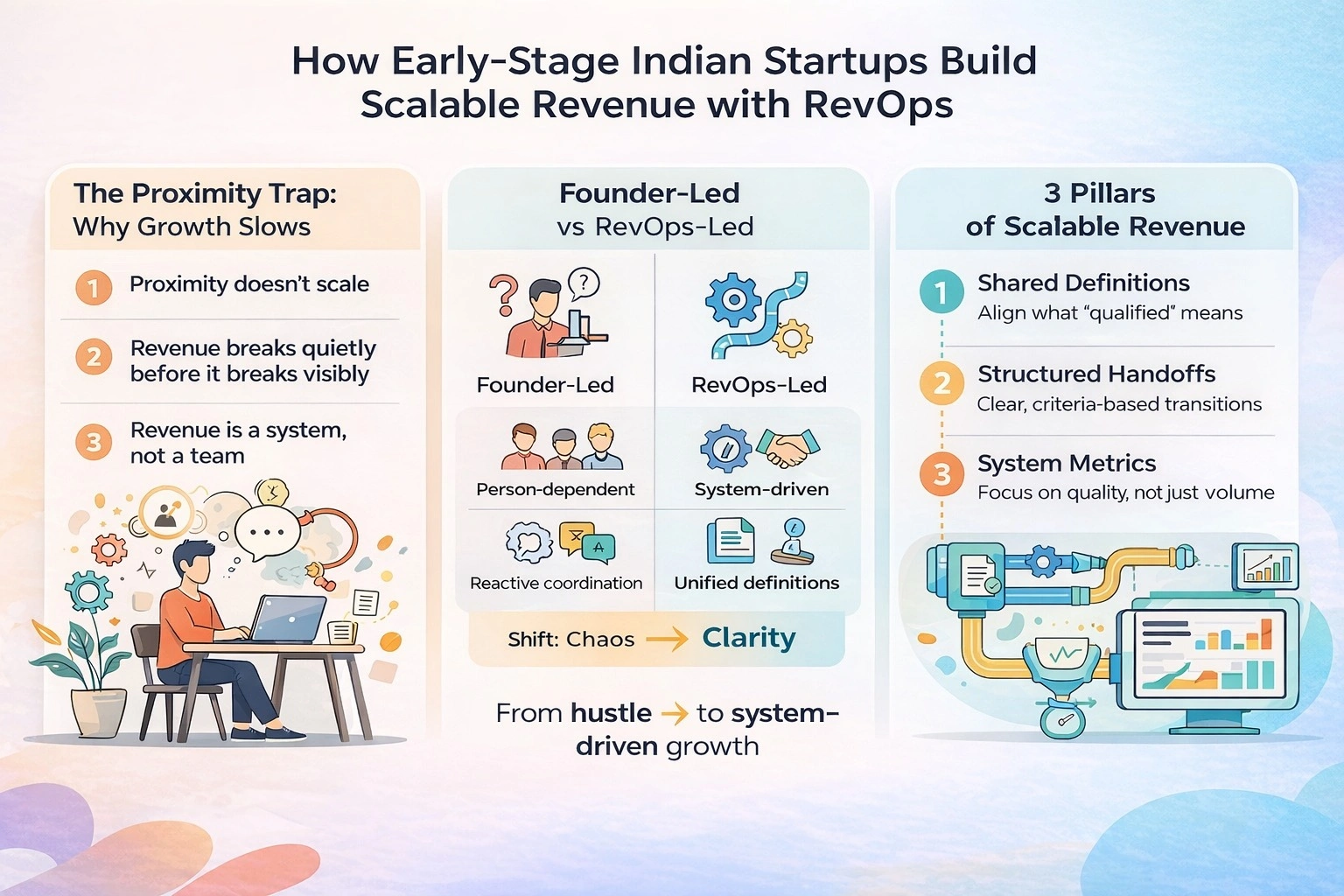
Early-stage revenue relies on proximity.
Scalable revenue relies on systems.
When proximity fades and systems do not replace it, misalignment fills the gap. That gap is exactly what RevOps for early-stage startups India is designed to address.
How Revenue Breaks Quietly Before It Breaks Obviously in Early-Stage Startups
One of the most confusing phases for early-stage Indian startups arrives when revenue feels unstable, even though nothing appears visibly wrong.
Sales stays busy.
Marketing campaigns remain active.
Customer success feels stretched but still delivers.
From the outside, the startup looks healthy. Internally, however, founders feel rising tension. Decisions take longer. Forecasts feel less reliable. Teams review the same numbers but reach different conclusions.
This phase is especially dangerous because it does not feel like failure.
Revenue does not collapse overnight.
Instead, it weakens gradually.
At first, small disconnects appear between teams. Marketing optimises for volume without visibility into conversion quality. Sales closes deals without understanding delivery constraints. Customer success manages onboarding without influence over expectations set earlier.
Each disconnect seems manageable on its own.
Over time, they compound.
Eventually, founders notice a pattern. Growth requires more effort for the same results. Hiring more salespeople helps briefly, then stalls. Launching more campaigns increases activity, not clarity. Adding tools produces more data, not better decisions.
At this point, many startups double down on tactics.
They push harder.
They hire faster.
They buy more tools.
What they rarely do is redesign how revenue is produced.
That redesign is the core purpose of RevOps for early-stage startups India.
RevOps exists because early-stage revenue problems are rarely execution problems. Instead, they are coordination problems that look like execution issues on the surface.
How Revenue Breaks Quietly Before It Breaks Obviously in Early-Stage Startups
One of the most confusing phases for early-stage Indian startups arrives when revenue feels unstable, even though nothing appears visibly wrong.
Sales stays busy.
Marketing campaigns remain active.
Customer success feels stretched but still delivers.
From the outside, the startup looks healthy. Internally, however, founders feel rising tension. Decisions take longer. Forecasts feel less reliable. Teams review the same numbers but reach different conclusions.
This phase is especially dangerous because it does not feel like failure.
Revenue does not collapse overnight.
Instead, it weakens gradually.
At first, small disconnects appear between teams. Marketing optimises for volume without visibility into conversion quality. Sales closes deals without understanding delivery constraints. Customer success manages onboarding without influence over expectations set earlier.
Each disconnect seems manageable on its own.
Over time, they compound.
Eventually, founders notice a pattern. Growth requires more effort for the same results. Hiring more salespeople helps briefly, then stalls. Launching more campaigns increases activity, not clarity. Adding tools produces more data, not better decisions.
At this point, many startups double down on tactics.
They push harder.
They hire faster.
They buy more tools.
What they rarely do is redesign how revenue is produced.
That redesign is the core purpose of RevOps for early-stage startups India.
RevOps exists because early-stage revenue problems are rarely execution problems. Instead, they are coordination problems that look like execution issues on the surface. HubSpot: Revenue Operations for Startups.
RevOps for Early-Stage Startups India Starts With Revenue as a System
To understand RevOps for early-stage startups India, founders must first change how they think about revenue.
Revenue does not come from sales alone.
It does not belong to marketing or customer success in isolation.
Revenue is the outcome of a system.
That system spans the full customer lifecycle:
- how demand is generated
- how leads are qualified
- how deals are priced and closed
- how customers are onboarded
- how value is delivered
- how retention and expansion occur
Each stage directly affects the next.
For example, a marketing promise shapes a sales conversation.
In turn, a sales commitment defines onboarding complexity.
Then, onboarding quality affects adoption, retention, and referrals.
Because of this chain reaction, revenue outcomes rarely reflect one team’s performance. Instead, they emerge from how decisions connect across teams.
In early-stage Indian startups, however, these stages usually evolve independently.
Marketing focuses on channels and lead volume.
Sales focuses on closures and targets.
Customer success focuses on delivery and support.
Each team may hit its own metrics. Yet revenue remains volatile. The reason is simple. The system connecting those metrics is weak.
This is why founders searching for a scalable revenue engine for startups often feel stuck. They optimise parts of the system while ignoring the system itself.
RevOps for early-stage startups India exists to close this gap.
It does not improve one function in isolation.
Instead, it governs how all revenue functions interact.
That distinction matters more than most founders realise.
The Shift From Founder-Led Revenue to Operational Complexity in Indian Startups
In the earliest phase, coordination is people-driven.
Founders hold context.
Decisions happen in real time.
Knowledge lives in conversations, not systems.
This model works because complexity is low.
The same few people influence demand, close deals, and oversee delivery. When something breaks, it becomes visible immediately. Corrections happen fast. Revenue feels manageable because the system is small and tightly connected.
As the startup grows, however, this operating model starts to fail.
Teams specialise.
Roles narrow.
Information spreads across CRMs, spreadsheets, tools, and dashboards.
Founders can no longer join every sales call or customer meeting. Decisions move further from customers and closer to reports. Context fragments.
Without deliberate design, coordination becomes accidental.
Marketing optimises for lead volume without knowing which leads convert well.
Sales focuses on closing without understanding long-term customer outcomes.
Customer success manages onboarding without influence over promises made earlier.
Everyone works hard.
No one owns the system.
This is how revenue complexity overtakes intuition.
The startup does not stop growing.
It stops feeling predictable.
This moment marks the inflection point where RevOps for early-stage startups India becomes essential, not optional.
Why RevOps for Early-Stage Startups India Is Needed Earlier Than Founders Expect
Many founders assume RevOps is something to add later. Often, they plan to revisit it after product–market fit or after hitting a certain scale.
However, this delay is costly.
In reality, early-stage startups benefit the most from RevOps because:
- teams are still small
- processes remain flexible
- habits are not yet fixed
At this stage, RevOps for early-stage startups India does not add bureaucracy. Instead, it removes ambiguity.
It replaces person-dependent coordination with lightweight systems that scale. It creates shared definitions before confusion hardens. It aligns teams before blame replaces trust.
This is why RevOps at the early stage looks very different from enterprise RevOps.
The goal is not control.
The goal is coherence.
And coherence is what turns early traction into a scalable revenue engine for startups.
What RevOps for Early-Stage Startups India Actually Means in Practice
Before founders can apply RevOps for early-stage startups India, they must strip away the buzzwords.
RevOps is often misunderstood because it is framed around tools or job titles rather than outcomes.
RevOps is not:
- a CRM implementation
- a reporting layer
- a single RevOps hire
- a system of approvals
RevOps is an operating model.
It defines how revenue is created, measured, and managed across the lifecycle. Instead of asking how sales can close faster or how marketing can generate more leads, RevOps asks a simpler question:
How do revenue decisions connect, and where do they break?
This framing matters deeply for early-stage Indian startups. At this stage, every mistake is expensive. Every misalignment burns cash, time, and founder attention. A scalable revenue engine for startups cannot rely on heroics.
It must rely on clarity.
RevOps provides that clarity by governing four elements:
- definitions
- handoffs
- metrics
- data flow
When these elements align, effort compounds.
When they do not, effort cancels out.
Why Sales Ops Alone Is Not Enough for Early-Stage Indian Startups
Most early-stage Indian startups begin with sales operations, even if they never use that term.
They set up a CRM.
They define pipeline stages.
They track forecasts and targets.
Initially, this approach makes sense.
Sales operations work well when:
- deal cycles are short
- founders stay involved in closing
- customer journeys remain simple
However, as volume increases, sales ops reaches its limits.
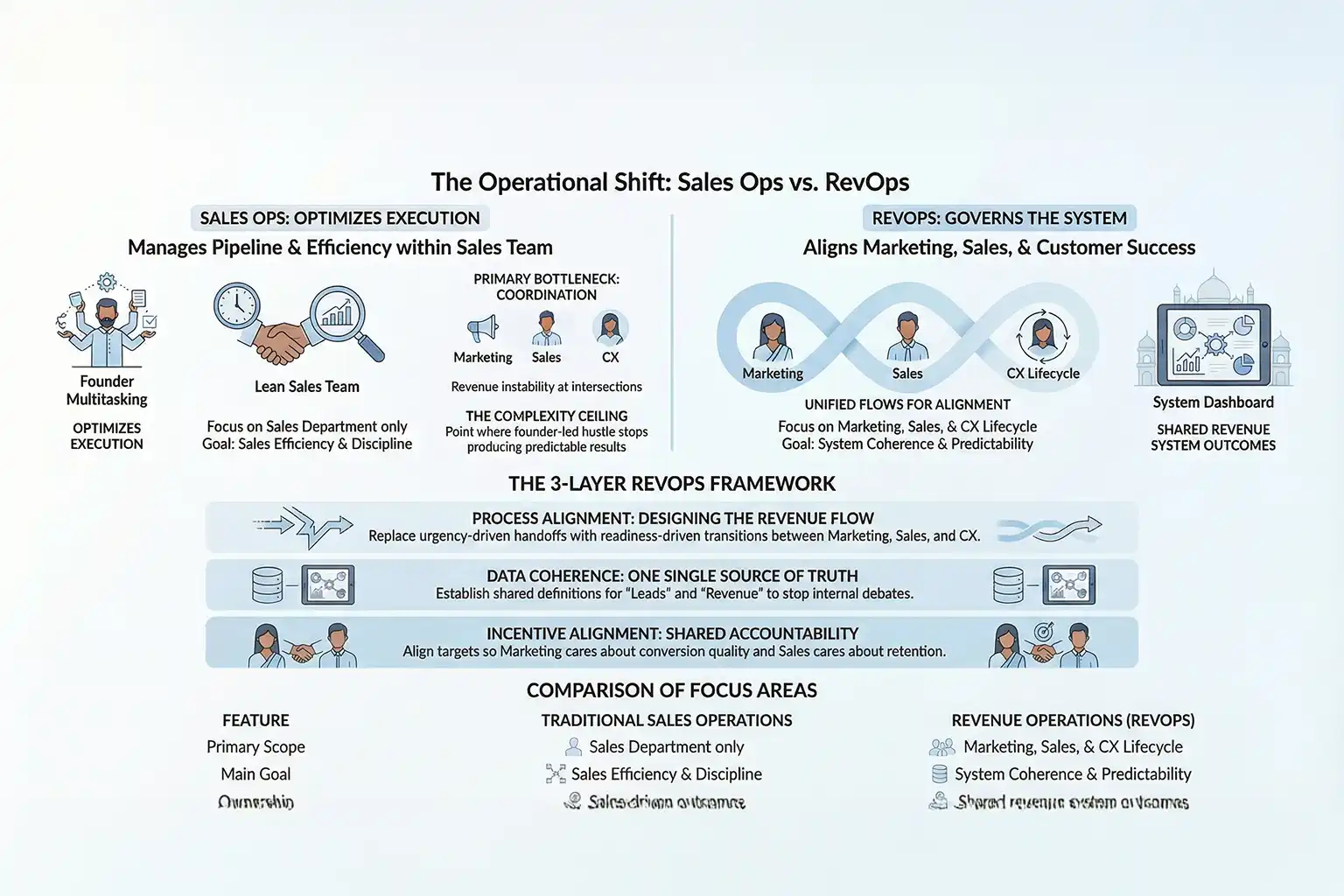
Sales ops optimises inside sales.
RevOps for early-stage startups India governs across revenue.
Sales ops can improve pipeline hygiene.
It cannot fix lead quality upstream.
Sales ops can improve forecasting accuracy.
It cannot control churn downstream.
This explains why many founders feel stuck despite “doing everything right” in sales.
They tighten processes.
They improve scripts.
They refine incentives.
Yet revenue volatility persists.
That volatility exists because revenue is no longer shaped by sales execution alone. Instead, it is shaped by how marketing, sales, and customer success interact.
This is why RevOps for early-stage startups India becomes relevant much earlier than most founders expect.
The Core RevOps Pillars That Create a Scalable Revenue Engine for Startups
A scalable revenue engine for startups does not come from growth hacks or aggressive targets. It comes from alignment that holds under pressure.
RevOps creates that alignment through four core pillars.
1. Shared Revenue Definitions
In many early-stage startups, teams use the same words but mean different things.
A “lead” in marketing is not a “lead” in sales.
An “opportunity” in sales is not a “customer” in success.
“Revenue” means different things in different dashboards.
This confusion is invisible at first. It becomes destructive at scale.
RevOps for early-stage startups India starts by enforcing shared definitions:
- What qualifies as a lead
- When a lead becomes sales-ready
- What constitutes a closed deal
- When revenue is recognised
- When a customer becomes “healthy”
Once definitions align, teams stop debating numbers and start debating decisions.
This alone dramatically improves clarity.
2. Designed Handoffs Across the Lifecycle
In early-stage startups, work often moves based on urgency.
Marketing hands off leads because sales is “hungry.”
Sales hands off deals because targets are due.
Customer success inherits accounts without context.
These urgency-driven handoffs create downstream chaos.
RevOps replaces urgency with readiness.
Leads move to sales only when qualification criteria are met.
Deals move to customer success only when expectations are documented.
Feedback flows back upstream instead of stopping at delivery.
This design prevents downstream teams from paying for upstream shortcuts.
For Indian startups with lean teams, this is critical. Poor handoffs create rework. Rework burns cash.
3. Metrics That Reflect System Health, Not Activity
Early-stage startups love activity metrics.
Leads generated.
Calls made.
Deals pushed forward.
Activity looks productive. It often hides risk.
RevOps for early-stage startups India shifts focus to outcome-linked metrics:
- conversion quality
- velocity across stages
- early churn signals
- expansion readiness
These metrics reveal where the system weakens, not just where people are busy.
This shift is essential for building a scalable revenue engine for startups. Without it, teams optimise locally and damage the system globally.
4. Coherent Data Flow Across Tools
Most startups add tools faster than they align them.
CRM says one thing.
Marketing automation says another.
Support tools tell a third story.
RevOps ensures data coherence.
Not more dashboards.
Not more reports.
One shared source of truth for revenue decisions.
This coherence allows founders to see cause-and-effect instead of correlation. Decisions become proactive instead of reactive.
How RevOps Prevents Cash Burn in Early-Stage Indian Startups
Cash efficiency is not optional in India. It is existential.
Every misaligned hire costs months.
Every bad deal drains runway.
Every churned customer distorts unit economics.
RevOps for early-stage startups India directly protects cash by:
- improving lead quality before sales effort increases
- preventing bad-fit deals from entering the pipeline
- reducing churn caused by mismatched expectations
- ensuring expansion efforts target the right customers
A scalable revenue engine for startups is not one that grows fast. It is one that grows cleanly.
RevOps ensures that growth does not introduce hidden liabilities.
When Startups Delay RevOps, Problems Harden Into Debt
Startups that delay RevOps often succeed anyway—temporarily.
Founders compensate.
Teams stretch.
Heroics fill gaps.
Over time, however, misalignment hardens into:
- process debt
- data debt
- incentive debt
Fixing these later becomes painful and expensive.
This is why RevOps for early-stage startups India works best before chaos sets in. Early alignment costs little. Late correction costs momentum.
RevOps for Early-Stage Startups India: How to Implement RevOps Without Overengineering
One of the biggest misconceptions around RevOps for early-stage startups India is that it requires heavy process, expensive tools, or a dedicated RevOps team. Because of this belief, many founders delay adoption. As a result, risk quietly increases while complexity compounds.
In reality, RevOps implementation at an early stage should be lightweight, deliberate, and iterative.
The goal is not perfection.
Instead, the goal is directional alignment that compounds over time.
A scalable revenue engine for startups does not appear after chaos sets in. Rather, it emerges when founders design the revenue system before complexity forces their hand.
Step 1: Map the Revenue Lifecycle End to End
Before changing tools, hiring specialists, or introducing dashboards, founders must first map how revenue actually flows today.
This includes:
- how leads are generated
- how leads are qualified
- how deals are closed
- how customers are onboarded
- how value is delivered
- how retention and expansion happen
Very often, this exercise reveals uncomfortable truths.
Hidden handoffs appear.
Unowned stages surface.
Critical decisions lack accountability.
Because of this, lifecycle mapping becomes the foundation of RevOps for early-stage startups India. Without it, improvements remain fragmented and reactive.
Step 2: Define Ownership at Every Stage
Next, a scalable revenue engine for startups requires clear ownership.
Not shared responsibility.
Not “everyone handles it.”
But explicit accountability.
Each lifecycle stage must have:
- one clear owner
- defined success criteria
- clear inputs and outputs
For example:
- Marketing owns lead readiness, not just lead volume
- Sales owns expectation setting, not just closures
- Customer success owns adoption, not just support tickets
When RevOps is applied correctly, these responsibilities connect instead of compete. As a result, teams stop optimising in isolation.
Step 3: Standardise Definitions Before Adding Metrics
At this stage, many early-stage startups rush into dashboards and reports. However, RevOps reverses this order.
First, define:
- what a qualified lead actually means
- when a deal is truly closed
- what an “active customer” really signifies
Only after this clarity exists do metrics become useful.
This step alone eliminates many internal debates and restores confidence in decision-making. Consequently, it is one of the fastest wins in RevOps for early-stage startups India.
Step 4: Align Metrics to Outcomes, Not Effort
A scalable revenue engine for startups cannot be built on effort metrics alone.
RevOps for early-stage startups India shifts focus to outcome-based signals, such as:
- lead-to-opportunity conversion quality
- time lost between lifecycle stages
- early churn indicators
- expansion readiness
These metrics expose system health, not just activity.
When metrics align, incentives align.
When incentives align, behaviour follows.
These are often where RevOps begins to quietly transform culture—without mandates or micromanagement.
Step 5: Introduce Governance Without Slowing Teams Down
Governance often scares early-stage founders because it sounds bureaucratic. However, good RevOps governance does the opposite.
It:
- removes ambiguity
- speeds up decisions
- prevents rework
Simple examples include:
- clear qualification checklists
- documented handoff criteria
- shared revenue reviews
Because of this, growth no longer depends on constant founder intervention. Instead, decisions scale with the system.
Common RevOps Mistakes Early-Stage Indian Startups Make
Even startups that adopt RevOps for early-stage startups India early tend to stumble in predictable ways.
Mistake 1: Treating RevOps as a Tool Implementation
Buying a CRM or automation platform is not RevOps.
Without aligned definitions and handoffs, tools simply amplify confusion. Therefore, RevOps must always begin with system design, not software.
Mistake 2: Hiring RevOps Too Late or Too Early
Hiring too late means:
- process debt hardens
- alignment becomes painful
Hiring too early means:
- systems overengineer
- teams slow down
The right time usually appears when:
- volume increases
- founders feel coordination strain
- revenue becomes harder to explain
Mistake 3: Optimising Teams Instead of the System
Startups often push marketing, sales, or customer success harder in isolation. However, RevOps focuses on how decisions connect across teams.
Local optimisation without system design destroys scalability.
Mistake 4: Ignoring Customer Success Until Churn Appears
Many early-stage startups delay customer success thinking it is a “later-stage problem.” Unfortunately, this is expensive.
RevOps ensures customer outcomes shape acquisition decisions early, which is essential for building a scalable revenue engine for startups.
Early Warning Signs Your Startup Needs RevOps Now
Founders rarely wake up thinking, “We need RevOps.”
Instead, they feel symptoms.
Common signals include:
- strong pipeline but weak conversion
- rising churn without clear causes
- sales closing deals that struggle post-sale
- teams arguing over numbers
- forecasts missing repeatedly
These are coordination failures, not effort failures.
When these signs appear, RevOps for early-stage startups India stops being optional.
Why RevOps Gives Indian Startups a Structural Advantage
Indian startups operate under unique constraints:
- tighter capital cycles
- intense competition
- price-sensitive markets
- limited margin for error
Because of this, misalignment becomes expensive very quickly.
RevOps creates advantage by:
- reducing wasted effort
- improving predictability
- protecting unit economics
- enabling sustainable scale
A scalable revenue engine for startups is not built by pushing harder.
Instead, it is built by aligning smarter.
RevOps provides that alignment.
Final Perspective: RevOps as the Foundation of Scalable Growth
RevOps is not a growth hack.
It is not a maturity badge.
It is not an enterprise-only concept.
RevOps for early-stage startups India exists to replace fragile coordination with designed systems before chaos sets in.
Early growth rewards intuition.
Scale punishes it.
RevOps bridges that gap.
By aligning sales, marketing, and customer success into a single revenue system, RevOps allows startups to grow without burning cash, trust, or momentum.
This is why resilient startups do not wait for revenue to break before acting.
They design for scale early.
That is what turns effort into leverage.
That is what builds a scalable revenue engine for startups.
"RevOps isn't about adding more people or tools—it's about making sure the people and tools you already have are pulling in the same direction, especially when capital is tight and every rupee counts."
Key Takeaways
- Early-stage revenue relies on proximity; scalable revenue relies on systems—RevOps bridges the gap.
- Revenue problems in startups are coordination issues disguised as execution failures.
- RevOps treats revenue as a system, aligning marketing, sales, and customer success for predictability.
- Implement RevOps lightweight: Map lifecycle, define ownership, standardise definitions, align metrics.
- Delaying RevOps hardens debt; early adoption prevents cash burn and builds leverage.
Is Misalignment Slowing Your Growth?
Our RXF System helps Indian startups implement a practical RevOps framework for aligned revenue operations. Let's align your teams today.
Book a Coffee Call