
Why Revenue Forecasting for Small Businesses India Breaks Under Scale
Revenue forecasting for small businesses India often starts with confidence. At first, everything feels manageable. Founders stay close to deals. Sales conversations are visible. Customer feedback is direct.
Because of this proximity, revenue feels predictable. However, as the business grows, that clarity fades. More leads enter the funnel. More deals move at the same time. More customers require onboarding and support.
As a result, forecasting becomes harder. Pipelines look strong. Yet revenue falls short. Deals appear close. Yet they do not convert. Customers sign up. Yet they do not stay.
This is where most Indian SMEs begin to struggle. And this is exactly why revenue forecasting for small businesses India fails—not because of effort, but because of missing system alignment.
The Hidden Gap: Forecasting Activity Instead of Revenue Flow
Most Indian SMEs build forecasts using activity-based inputs. They track: Pipeline size, Number of deals, Monthly targets, Sales estimates.
At first, this feels logical. However, activity does not equal outcome. A large pipeline does not guarantee revenue. More calls do not guarantee conversions. More deals do not guarantee retention.
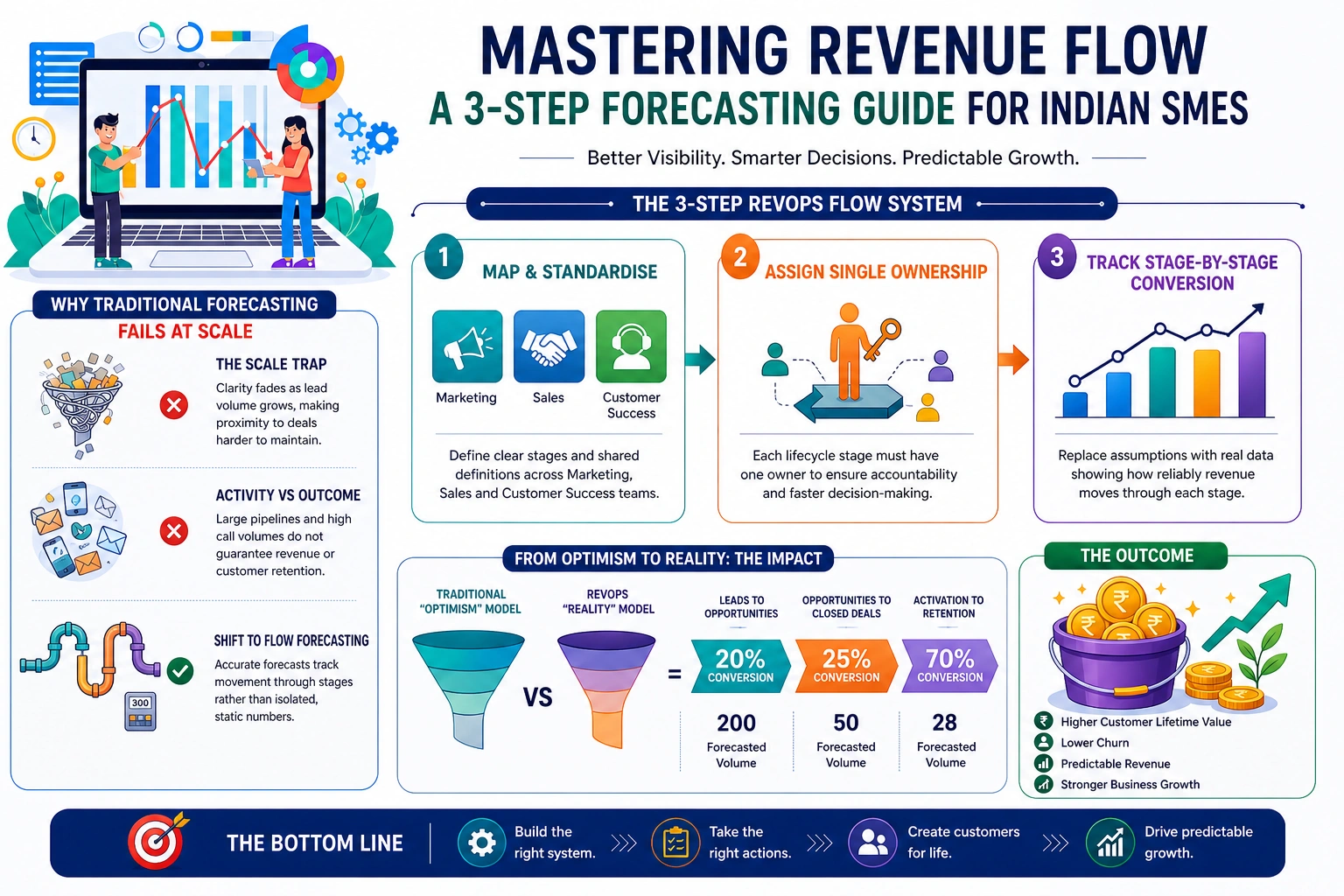
This is the core issue. Revenue is not created at one point. It moves through a system. This is where RevOps revenue forecasting changes the approach. Instead of tracking isolated numbers, it tracks how revenue flows across stages.
What Revenue Forecasting for Small Businesses India Should Actually Track
To design a reliable system, Indian SMEs must shift their focus. Instead of asking: “How much pipeline do we have?” They must ask: “How reliably does revenue move through each stage?”
Revenue moves through a lifecycle: Lead → Opportunity → Deal → Activation → Retention. Each stage has its own risk. Each stage affects the final outcome.
If even one stage weakens, forecasts break. For example: Strong lead volume + weak conversion = inflated forecast. Strong sales + weak onboarding = hidden churn. Strong acquisition + weak retention = unstable growth.
This is why RevOps revenue forecasting focuses on stage-by-stage movement.
The Core Shift: From Pipeline Forecasting to Flow Forecasting
Traditional forecasting uses assumptions. RevOps forecasting uses real conversion data.
Traditional Model: Total pipeline × expected conversion = forecasted revenue
RevOps Model: Stage-by-stage conversion × actual flow = forecasted revenue
For example: 1,000 leads → 20% become opportunities = 200 → 25% close = 50 → 80% activate = 40 → 70% retain = 28. Now the forecast reflects reality. Not optimism.
This is the foundation of strong revenue forecasting for small businesses India.
Step 1: Map Your Revenue Lifecycle Clearly
Before building any forecast, clarity must come first. You need to map how revenue actually moves. This includes: How leads are generated, How they are qualified, How deals are closed, How onboarding works, How customers reach value, How retention happens.
Most Indian SMEs skip this step. They move directly to dashboards. That creates confusion. RevOps revenue forecasting starts with understanding the system—not reporting on it.
What This Step Reveals
When lifecycle mapping is done properly, several issues appear: Undefined stages, Inconsistent transitions, Hidden delays, Untracked drop-offs.
For example: Leads passed too early to sales, Deals closed without clear expectations, Customers stuck before activation. Each of these affects forecasting accuracy. Without fixing them, forecasts remain unreliable.
Step 2: Standardise Definitions Across Teams
Revenue forecasting for small businesses India breaks when teams use different definitions. Marketing may define a “qualified lead” one way. Sales may define it differently. Customer success may not define it at all.
This creates conflicting data. And when data conflicts, forecasts fail.
To fix this, define: What is a qualified lead? What qualifies as an opportunity? When is a deal truly closed? What defines an active customer? These definitions must be shared across teams.
This step alone improves clarity immediately.
Why This Step Matters More Than Tools
Many SMEs try to fix forecasting using software. However, tools cannot fix unclear definitions. They only organise confusion. RevOps revenue forecasting works because it fixes structure first. Tools come later.
Step 3: Assign Clear Ownership Across the Lifecycle
Every stage must have one owner. Not shared responsibility. Not vague accountability. Clear ownership.
For example: Marketing owns lead quality, Sales owns deal clarity, Customer success owns activation.
When ownership is clear: Problems surface faster, Decisions become easier, Forecasts become more accurate.
When ownership is unclear: Issues get delayed, Blame increases, Forecasting weakens.
Revenue forecasting for small businesses India improves when accountability is structured.
Step 4: Track Conversion at Every Stage
This is the core of RevOps revenue forecasting. Instead of tracking totals, track movement.
Key metrics include: Lead → opportunity conversion, Opportunity → close rate, Close → activation rate, Activation → retention rate.
These metrics show: Where revenue slows, Where it breaks, Where it leaks.
When these are tracked consistently, forecasting becomes dynamic. Not static.
Why This Is Critical in the Indian SME Context
Indian SMEs operate with tighter capital cycles. So small inefficiencies matter more. If conversion drops slightly: CAC increases, Revenue timing shifts, Cash flow becomes unstable.
This makes forecasting accuracy essential. RevOps revenue forecasting protects stability by identifying issues early.
Where Most SMEs Stop (And Why That’s a Problem)
At this point, many businesses feel they have done enough. They have: Defined stages, Assigned ownership, Tracked conversions.
However, forecasting still fails. Why? Because two critical elements are still missing:
- Retention integration
- Continuous review and adjustment
Without these, forecasting remains incomplete.
"Revenue forecasting for small businesses in India fails not because of lack of effort, but because of missing system alignment. Shift from activity tracking to revenue flow tracking."
Key Takeaways
- Map your full revenue lifecycle before building any forecast
- Standardise definitions and assign clear ownership across stages
- Track stage-by-stage conversion rates instead of total pipeline
- Integrate retention and activation into your forecasting model
- Make forecasting a continuous review process, not a monthly guess
Struggling with Unreliable Revenue Forecasts?
Our RXF System helps Indian SMEs design accurate, flow-based revenue forecasting systems that support confident decision-making and stable growth.
Book a Coffee Call