
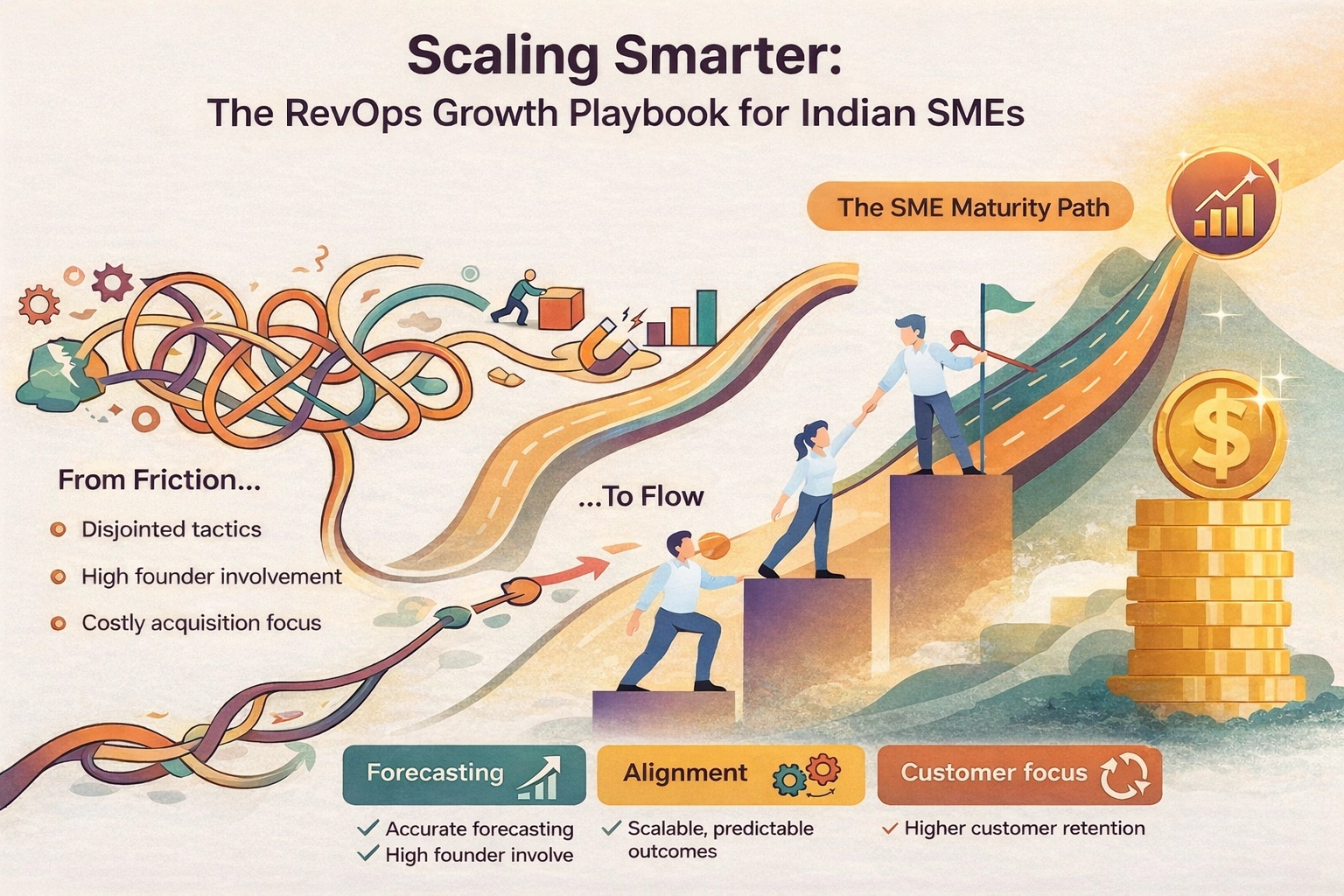
Revenue growth for Indian SMEs rarely fails because of lack of effort. It fails because of lack of alignment.
Most small and mid-sized businesses in India work hard. Sales teams push aggressively. Marketing runs campaigns consistently. Customer success handles issues daily. Activity remains high.
Yet revenue growth feels unstable. Forecasts miss targets. Customer acquisition cost fluctuates. Retention varies from quarter to quarter. Margins tighten unexpectedly.
This pattern explains why revenue growth for Indian SMEs often plateaus despite strong execution. The issue is not ambition. The issue is structure. And that is where RevOps growth playbooks become powerful.
Why Revenue Growth for Indian SMEs Becomes Harder Over Time
In the early stage, growth feels organic. Founders close key deals. Marketing adapts quickly. Customer conversations shape positioning. Revenue moves fast because information flows directly.
However, as Indian SMEs scale, complexity increases. More leads enter the funnel. More deals move simultaneously. More customers require onboarding and support. More data accumulates across tools.
At this stage, revenue becomes a system. But most Indian SMEs continue operating as if revenue is still people-driven. This mismatch creates friction.
Marketing optimises volume. Sales optimises closures. Customer success optimises support resolution. Each team may improve locally. Yet revenue growth for Indian SMEs becomes less predictable.
Without RevOps governance, effort fragments. That is why structured RevOps growth playbooks matter. They align execution across the full revenue lifecycle.
What Makes RevOps Growth Playbooks Different?
Traditional growth strategies focus on tactics. Run more ads. Hire more sales reps. Launch new offers. Increase outreach. These tactics increase activity.
RevOps growth playbooks increase alignment. The difference is critical. Tactics push harder. Playbooks connect smarter.
Revenue growth for Indian SMEs becomes sustainable only when acquisition, conversion, activation, retention, and expansion work as one flow.
RevOps growth playbooks focus on:
- Lifecycle clarity
- Shared definitions
- Stage ownership
- Flow-based metrics
- Feedback loops
Instead of asking, “How do we sell more?” RevOps asks, “How does revenue move, and where does it stall?” That shift changes everything.
The Core Constraint in Revenue Growth for Indian SMEs
Most Indian SMEs face three recurring constraints:
- Capital sensitivity
- Lean teams
- Founder bandwidth limits
Because of this, mistakes compound faster. In large enterprises, inefficiency hides behind budget. In Indian SMEs, inefficiency affects survival.
This makes revenue growth for Indian SMEs a coordination challenge, not just a demand challenge.
When lead quality drops, CAC rises. When onboarding weakens, churn increases. When forecasting drifts, cash planning suffers. Each of these is not just a sales issue. It is a system issue.
RevOps growth playbooks exist to fix system leakage before it becomes financial damage.
Playbook 1: Align the Revenue Lifecycle Before Scaling Acquisition
Many Indian SMEs attempt to accelerate revenue growth by increasing top-of-funnel activity. They increase ad spend. They expand outbound efforts. They hire additional sales reps. Initially, pipeline volume rises. However, conversion quality does not improve.
Why? Because the lifecycle was not aligned before scaling input. This is one of the most common mistakes affecting revenue growth for Indian SMEs.
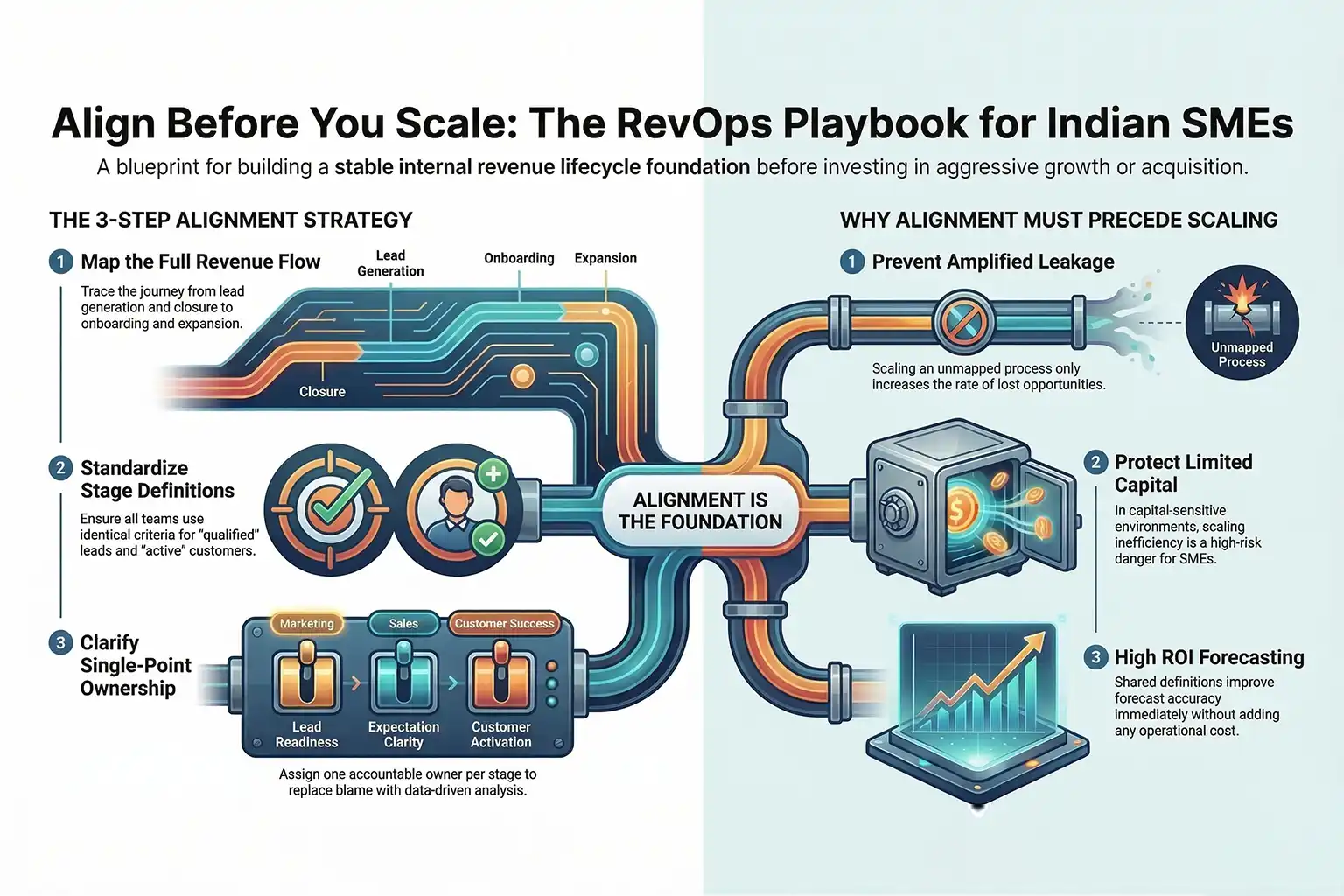
Step 1: Map the Full Revenue Flow
Before pushing acquisition, leadership must map how revenue moves today. From lead generation → To qualification → To deal closure → To onboarding → To activation → To retention → To expansion.
Most businesses are surprised by what this reveals. Handoffs lack clarity. Definitions differ across teams. Onboarding struggles begin at sales commitments. Retention issues trace back to targeting errors.
Without this visibility, growth efforts amplify leakage. RevOps growth playbooks always start with mapping. Not scaling.
Step 2: Standardise Stage Definitions
Revenue growth for Indian SMEs weakens when teams use different definitions. What qualifies as a marketing-qualified lead? When is an opportunity real? What counts as a closed deal? When is a customer considered active?
If definitions differ, dashboards mislead. Shared definitions reduce friction instantly. They also improve forecast accuracy without adding cost. This is one of the highest ROI steps in any RevOps growth playbook.
Step 3: Clarify Ownership Across Stages
Each lifecycle stage must have one accountable owner. Not shared responsibility. Not “everyone handles it.”
For example: Marketing owns lead readiness. Sales owns expectation clarity. Customer success owns activation.
When ownership is clear, revenue growth for Indian SMEs becomes easier to diagnose and improve. When ownership is unclear, blame replaces analysis.
Why This Playbook Matters for Indian SMEs Specifically
In capital-sensitive environments, scaling inefficiency is dangerous. If Indian SMEs increase marketing spend before fixing lifecycle flow, they amplify cost without increasing stability.
If they hire more sales reps without clarifying qualification standards, they increase internal friction. If they chase expansion without improving onboarding, churn erodes gains.
RevOps growth playbooks prevent this compounding effect. They ensure revenue growth for Indian SMEs scales on stable foundations.
The Real Goal: Compounding Revenue, Not Just Increasing Revenue
There is a difference between growing revenue and compounding revenue. Growing revenue increases numbers temporarily. Compounding revenue increases predictability over time.
RevOps growth playbooks focus on compounding. They align incentives. They reduce leakage. They improve flow between stages. They protect margins.
For Indian SMEs, compounding revenue means: More stable forecasting, Lower CAC volatility, Higher lifetime value, Less founder intervention, Stronger capital efficiency.
That is the foundation of sustainable revenue growth for Indian SMEs.
Playbook 2: Forecast-Driven Revenue Governance
Revenue growth for Indian SMEs often breaks down at forecasting. Not because leaders lack ambition. But because forecasts are built on activity instead of flow.
Many SMEs track: Pipeline size, Deals in progress, Monthly targets, Sales calls completed. However, they do not track: Stage conversion quality, Time stalled between stages, Activation rates after closure, Early churn signals.
As a result, forecasts look solid on paper. Yet actual revenue fluctuates. RevOps growth playbooks shift forecasting from opinion-based to system-based.
Why Forecasting Fails in Indian SMEs
There are three common reasons.
First, definitions differ. Sales may classify a deal as “advanced.” Finance may classify it as “uncertain.” Customer success may see onboarding risk already.
Second, stage exit criteria are weak. Deals move forward based on optimism, not readiness.
Third, retention is disconnected from acquisition forecasts. New revenue is projected. Churn impact is underestimated. This creates illusion growth.
Revenue growth for Indian SMEs becomes unpredictable because inflow and outflow are not governed together.
The RevOps Fix: Forecast Flow, Not Just Pipeline
RevOps growth playbooks improve forecasting by focusing on conversion probabilities at each stage.
Instead of asking: “How big is the pipeline?” Ask: “What percentage moves cleanly from stage to stage?”
For example: Lead → Opportunity conversion rate, Opportunity → Closed-won conversion rate, Closed-won → Activated customer rate, Activated → 90-day retention rate.
Each of these is a structural indicator. When conversion weakens in one stage, forecasts adjust immediately. This makes revenue growth for Indian SMEs more stable without increasing spend.
Weekly Revenue Flow Reviews
RevOps governance introduces short, structured revenue flow reviews. Not long performance meetings. Focused alignment reviews.
In these sessions: Marketing reviews lead quality, not just volume. Sales reviews stage progression, not just pipeline size. Customer success reviews activation and retention health. Leadership looks at the full revenue flow.
This simple habit strengthens forecast reliability faster than adding tools.
Playbook 3: Retention-Led Revenue Growth for Indian SMEs
Many Indian SMEs chase growth through acquisition. However, sustainable revenue growth for Indian SMEs requires retention leverage. Acquisition fuels revenue. Retention compounds it.
Without retention alignment: CAC increases, Lifetime value drops, Expansion becomes difficult.
RevOps growth playbooks integrate retention into core revenue planning.
Why Retention Is Often Ignored
Retention problems rarely appear immediately. Churn leaks slowly. Month 1 looks fine. Month 3 weakens slightly. Month 6 shows a pattern.
By then, acquisition has already scaled. This creates pressure. More leads are required to offset churn. Revenue growth for Indian SMEs becomes dependent on constant acquisition. That is expensive.
The RevOps Retention Loop
RevOps growth playbooks connect three stages tightly: Targeting, Expectation setting, Onboarding.
If marketing targets the wrong segment, churn rises. If sales overpromises, onboarding struggles. If onboarding fails to deliver early value, retention weakens.
Retention is not a customer success problem. It is a lifecycle alignment issue.
Activation as the Leading Indicator
RevOps focuses on activation, not churn. Activation answers: Did the customer reach first value quickly?
For example: Did a service client complete onboarding milestones? Did a SaaS user adopt core features? Did a consulting client implement early recommendations?
When activation improves, churn naturally decreases. Revenue growth for Indian SMEs strengthens without increasing acquisition cost.
Playbook 4: Conversion Optimization Across the Lifecycle
Most businesses optimise conversion only inside sales. RevOps growth playbooks optimise conversion across the entire lifecycle. Conversion begins before sales. And continues after closure.
Stage 1: Marketing-to-Sales Conversion
Instead of increasing lead volume, improve lead readiness. Ask: Are targeting criteria clear? Are qualification rules consistent? Are campaigns attracting the right segments?
Small improvements here reduce CAC dramatically. Revenue growth for Indian SMEs improves because fewer low-quality leads enter the system.
Stage 2: Sales-to-Onboarding Conversion
Many deals close but struggle post-sale. This indicates misalignment.
RevOps introduces: Clear expectation documentation, Defined implementation timelines, Standard onboarding checklists.
When onboarding friction drops, customer confidence increases. That improves retention and expansion.
Stage 3: Onboarding-to-Expansion Conversion
Expansion rarely happens automatically. It depends on: Early value delivery, Clear milestone tracking, Regular review touchpoints.
RevOps growth playbooks define expansion triggers in advance. For example: Usage threshold reached, Contract milestone achieved, Value ROI demonstrated.
When expansion readiness becomes measurable, revenue growth for Indian SMEs accelerates organically.
Why These Playbooks Work in the Indian SME Context
Indian SMEs operate in competitive, price-sensitive markets. Margins are tighter. Capital cycles are stricter. Founder bandwidth is limited.
Because of this, inefficiency compounds faster. RevOps growth playbooks protect: Cash flow stability, Forecast reliability, Retention health, Team alignment.
Instead of growing through pressure, businesses grow through clarity. That clarity drives durable revenue growth for Indian SMEs.
What Changes After Implementing RevOps Growth Playbooks?
When these playbooks take hold, several changes appear:
- Forecast accuracy improves.
- Customer acquisition cost stabilises.
- Retention becomes predictable.
- Founder involvement reduces.
- Revenue volatility decreases.
Growth feels controlled instead of chaotic. Execution remains fast. However, coordination becomes intentional. That combination is rare. And powerful.
Playbook 5: Expansion and CLTV Acceleration
Revenue growth for Indian SMEs becomes powerful when expansion is predictable. Many SMEs focus on new revenue. Fewer design for expanded revenue.
However, sustainable growth does not only come from new customers. It comes from deeper value per customer. RevOps growth playbooks treat expansion as a designed outcome, not a lucky upsell.
Why Expansion Fails in Indian SMEs
Expansion fails for three common reasons:
- No defined expansion triggers
- Weak activation tracking
- Poor feedback loops between sales and customer success
Most businesses wait for renewal time to discuss upgrades. By then, opportunity momentum is low. Instead, RevOps integrates expansion planning early.
Designing Expansion Readiness
Expansion should be based on signals, not instinct. Examples include: Usage milestone reached, Performance benchmark achieved, Contract phase completed, ROI demonstrated.
When expansion triggers are defined clearly, sales and customer success align on timing. Revenue growth for Indian SMEs accelerates without increasing acquisition cost.
Playbook 6: Founder-Independent Revenue Scaling
One of the hidden barriers to revenue growth for Indian SMEs is founder dependency. In early stages, founder involvement drives success.
Founders: Close strategic deals, Approve pricing, Handle escalations, Override objections. However, as volume increases, this model slows growth.
RevOps growth playbooks reduce founder bottlenecks by converting intuition into systems.
Step 1: Document Decision Rules
Pricing thresholds, Discount boundaries, Qualification standards, Escalation triggers.
When rules are documented, execution becomes consistent. Revenue no longer depends on founder availability.
Step 2: Standardise Cross-Functional Reviews
Instead of reactive escalations, introduce predictable revenue reviews. Weekly flow check-ins, Monthly retention reviews, Quarterly expansion audits.
These meetings focus on lifecycle health, not individual blame. As a result, revenue growth for Indian SMEs becomes more stable and less personality-driven.
Playbook 7: Capital-Efficient Revenue Growth Strategy
Capital efficiency matters deeply in Indian SME environments. Unlike venture-funded companies, most Indian SMEs cannot afford prolonged inefficiency.
RevOps growth playbooks improve capital efficiency in three ways:
- Lower acquisition waste
- Higher retention stability
- Predictable forecasting
Reducing Acquisition Waste
When lifecycle alignment improves: Lead quality increases, Sales conversion strengthens, Onboarding friction drops.
This reduces cost per acquisition without cutting demand. Revenue growth for Indian SMEs improves without increasing spend.
Protecting Retention Margins
Retention stability directly impacts profitability. When activation improves: Customer lifetime value increases, Expansion becomes easier, Referral potential rises.
Retention-led growth compounds revenue.
Strengthening Forecast Reliability
Forecast reliability protects cash planning. When conversion rates are tracked at each stage: Revenue variance decreases, Hiring decisions improve, Inventory planning stabilises.
RevOps growth playbooks turn forecasting from guesswork into flow analysis. That stability is critical for revenue growth for Indian SMEs.
A Simple RevOps Maturity Path for Indian SMEs
Indian SMEs do not need enterprise-level complexity. They need clarity.
A practical maturity path looks like this:
Stage 1: Alignment Foundation
Shared definitions, Clear stage ownership, Basic lifecycle mapping
Stage 2: Flow Visibility
Conversion tracking across stages, Activation measurement, Retention integration
Stage 3: Governance Discipline
Regular cross-functional revenue reviews, Forecast calibration, Defined expansion triggers
Stage 4: Optimisation and Scale
Automation supporting clear processes, Predictive forecasting, Segment-specific growth strategies
Revenue growth for Indian SMEs becomes stronger at each stage. The key is sequencing. Do not automate before aligning. Do not scale before stabilising.
Common Mistakes While Implementing RevOps Growth Playbooks
Even when SMEs adopt RevOps, they sometimes stumble. Common errors include:
- Overengineering processes too early
- Adding tools before fixing definitions
- Focusing on reporting instead of flow
- Ignoring customer success input
- Scaling acquisition before fixing retention
Avoiding these protects revenue growth for Indian SMEs from unnecessary friction.
Final Perspective: Revenue Growth for Indian SMEs Requires System Design
Revenue growth for Indian SMEs is not just about selling more. It is about selling in a coordinated way.
RevOps growth playbooks work because they align marketing, sales, and customer success into one revenue system. Instead of pushing harder, businesses connect smarter.
When alignment improves: Effort compounds, Forecasts stabilise, Retention strengthens, Founder stress reduces, Capital efficiency improves.
Revenue growth for Indian SMEs becomes predictable. And predictable growth scales.
"Revenue growth for Indian SMEs does not break because teams stop working. It breaks because teams stop connecting. RevOps growth playbooks restore that connection."
Key Takeaways
- Revenue growth for Indian SMEs plateaus due to misalignment, not lack of effort
- RevOps playbooks focus on lifecycle alignment, not just more activity
- Align before scaling: map flow, define ownership, standardise definitions
- Retention and expansion compound revenue faster than acquisition alone
- Capital-efficient growth comes from system clarity, not pressure
Ready to Make Revenue Growth Predictable?
Our RXF System delivers proven RevOps playbooks tailored for Indian SMEs. Let's align your revenue engine for compounding growth.
Book a Coffee Call