
Why RevOps Implementation in India Feels Difficult for Small Businesses
RevOps implementation in India often feels harder than it should—especially for small businesses. At first, the idea sounds simple. Align marketing. Align sales. Align customer success. Create a smooth revenue system.
However, when founders actually try to implement it, things feel unclear. Where do you start? What do you change first? Do you need new tools? Do you need a new team? Because of this confusion, many Indian SMEs delay action.
The Perception Problem Around RevOps
One of the biggest reasons RevOps implementation in India feels difficult is perception. RevOps is often seen as: A complex framework, An enterprise-only function, A tool-heavy system, A costly transformation. As a result, small businesses assume: “We’re not ready for this yet.” However, this assumption creates risk. Because RevOps is not about complexity. It is about clarity.
What Actually Happens Without RevOps
In the early stage, most Indian SMEs operate through proximity. Founders are involved in sales. Marketing decisions happen quickly. Customer issues are escalated directly. This works well at low scale.
However, as the business grows: More leads enter the funnel, More deals run in parallel, More customers require onboarding. At this point, coordination weakens. Marketing focuses on campaigns. Sales focuses on closures. Customer success focuses on delivery. Each team works hard. Yet outcomes become harder to explain.
This is where RevOps implementation in India becomes necessary—not optional.
The Real Problem: Misalignment, Not Lack of Effort
When revenue becomes inconsistent, most SMEs assume the problem is execution. They increase sales effort, run more campaigns, hire more people, add more tools. However, these actions increase activity. They do not fix alignment.
The RevOps Perspective
RevOps implementation in India changes how businesses think about revenue. Instead of asking: “How do we improve performance?” It asks: “How does revenue flow across the business, and where does it break?” This shift is critical. Because revenue is not created by one team. It is created across the lifecycle.
What RevOps Implementation in India Actually Means
RevOps is not: A CRM implementation, A reporting dashboard, A new job title. RevOps is an operating model. It governs how revenue is created across marketing, sales, and customer success.
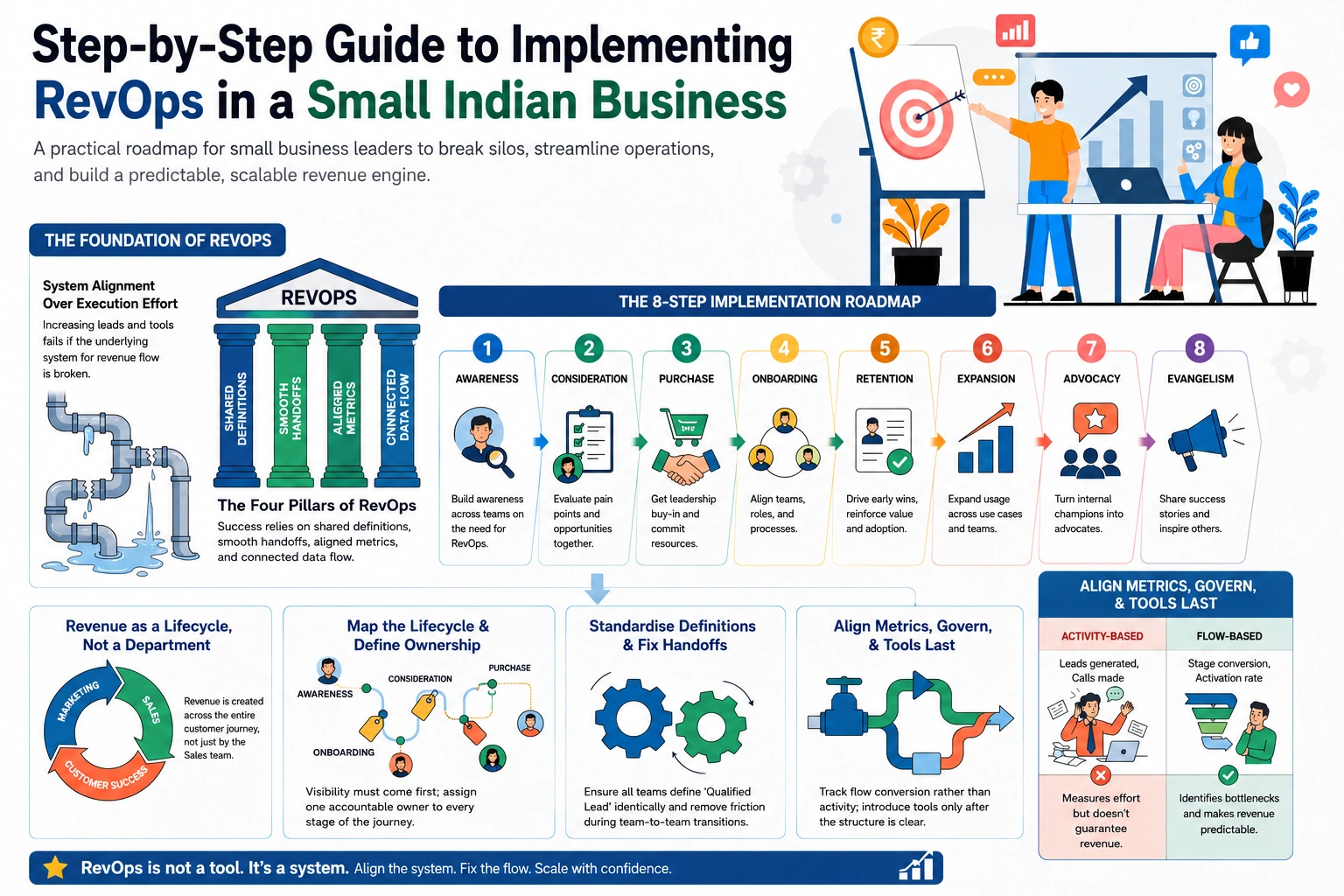
The Four Pillars of RevOps
Every RevOps system is built on four elements:
- Definitions – shared meaning across teams
- Handoffs – how work moves between stages
- Metrics – what success looks like
- Data flow – how information connects
Step 1: Map Your Revenue Lifecycle Clearly
The first and most important step in RevOps implementation in India is mapping how revenue actually flows. Most SMEs skip this. They jump directly into tools or dashboards. That is a mistake.
You must define every stage of your revenue lifecycle: How leads are generated, How they are qualified, How deals are closed, How customers are onboarded, How value is delivered, How retention happens, How expansion occurs.
Step 2: Define Clear Ownership Across the Lifecycle
Each stage must have one accountable owner. Not shared responsibility. Not vague accountability. Clear ownership.
For example: Marketing owns lead quality, Sales owns deal clarity, Customer success owns activation. When ownership is clear: Problems surface faster, Decisions become easier, Forecasts become more accurate.
Step 3: Standardise Definitions Across Teams
This is one of the simplest yet most powerful steps in how to implement RevOps for SMEs. Define: What is a qualified lead? What qualifies as an opportunity? When is a deal truly closed? What defines an active customer? These definitions must be shared across teams.
Step 4: Fix Handoffs Between Teams
Revenue problems often occur at transitions. Define clear handoff rules: When work moves forward, What criteria must be met, What information must be shared.
Step 5: Align Metrics with the Revenue Lifecycle
Shift from activity metrics (leads generated, calls made) to flow metrics (stage conversion rates, activation success, retention trends).
Step 6: Establish Simple Revenue Governance
Introduce short weekly revenue flow reviews and monthly reviews. This creates rhythm without bureaucracy.
Step 7: Introduce Tools Only After Structure Is Clear
Tools come last. Start simple with a clean CRM and basic reporting. Add automation gradually only after the system is aligned.
Step 8: Continuously Optimise the Revenue System
RevOps implementation in India is not a one-time project. It is an ongoing discipline. Regularly review conversion rates, onboarding, retention, and expansion.
Common Mistakes in RevOps Implementation in India
- Starting with tools instead of structure
- Overengineering processes too early
- Ignoring customer success in RevOps
- Tracking activity instead of outcomes
- Lack of leadership alignment
Final Perspective: RevOps Implementation in India Is About Clarity, Not Complexity
RevOps implementation in India does not require large teams or complex systems. It requires clarity. When businesses map their lifecycle, define ownership, align metrics, improve handoffs, and establish governance, revenue becomes predictable. Execution becomes smoother. Growth becomes scalable.
"RevOps implementation in India is not about transformation. It is about alignment."
Key Takeaways
- Start with lifecycle mapping and ownership — not tools
- Standardise definitions and fix handoffs first
- Track flow metrics instead of activity
- Establish simple governance for continuous improvement
- RevOps is about clarity and alignment, not complexity
Ready to Implement RevOps in Your Small Indian Business?
Our RXF System provides a proven, step-by-step framework tailored for Indian SMEs.
Book a Coffee Call